Volunteers Preserve Memory of West Virginians Lost to AIDS
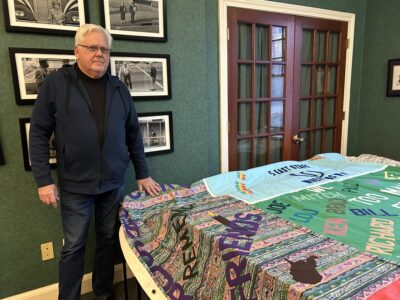
photo by: Joselyn King
Jim Beasley of Wheeling stands with a section of the AIDS Memorial Quilt. Volunteers gathered Monday at the First State Capitol Building in Wheeling to create four additional panels for the quilt in memory of those who lost their lives to AIDS.
WHEELING — For nearly 40 years, Dec. 1 has been designated as “World AIDS Day” — but the observance was not officially recognized across America on Monday.
That didn’t stop a group of volunteers from gathering at the First State Capitol Building in Wheeling to craft four new panels for the AIDS Memorial Quilt in memory of West Virginians who lost their lives to the disease.
“Unfortunately, the White House has decided it will not be celebrating World AIDS Day,” said Mikaya Green, chair of the Friendlier City Project. “That is the first time since 1988 that that has happened.”
The Friendlier City Project had already planned the panel-making event for Dec. 1 in collaboration with the AIDS Task Force of the Upper Ohio Valley.
“The AIDS quilt is a very cathartic way to memorialize the people who have passed away from the AIDS pandemic,” she explained.
Jay Adams, president of the AIDS Task Force For The Upper Ohio Valley said he has been working with the AIDS quilt since 1988 — a year after it was started in 1987. The AIDS Task Force For The Upper Ohio Valley always has access to at least one section of the quilt for display, he explained.
Each one of the sections, or panels, on the quilt has a name of a victim. When eight of these are joined together, they are called a block, Adams said.
He pointed out among the panels on the block displayed in Wheeling on Monday one that was crafted by nurses on 5 East at Wheeling Hospital in the late 1990s.
“We haven’t had a panel-making workshop for a long time, and it’s nice to see this group of volunteers come to us and want to be involved,” Adams added.
Volunteer Jim Beasley of Wheeling made his first panel for the quilt to honor his late partner George, who succumbed to AIDS in 1993. Beasley has since found love again, and married another man in 2010.
“It’s close to my heart,” Beasley explained. “When all of this was beginning to happen in the 1980s, none of us knew much about the AIDS situation. Everything was hush-hush, and nobody talked about it.”
Often, victims became isolated, he continued. If word of their illness got out, they were often ostracized by their friends.
“Sometimes, people would just disappear and you wouldn’t hear from them again,” he added.
Beasley noted it is important to keep awareness of AIDS alive so as to educate future generations about the disease.
“I don’t want these people to be forgotten,” he said. “This is the first time since 1988 that there hasn’t been publicity, and this administration is showing disrespect by ignoring that. World AIDS Day is very important, and for people to know it’s just not going to go away. There are still people being diagnosed all the time.”
Top Headlines
Volunteers Preserve Memory of West Virginians Lost to AIDS
Consent Forms Going Out for Madison Elementary School Health Clinic

U.S. Air Travelers Without REAL IDs Will Be Charged a $45 Fee
California Family Was About To Cut the Cake When Gunfire Erupted at a Toddler’s Birthday Party

November Tax Collections, Investment Returns Bring West Virginia’s Fiscal-Year-to-Date Surplus to $131.3 Million