
Archaeologist Explains Discovery of WWI Artifacts
By LINDA COMINS
Staff Writer
A century after the United States’ entry into World War I, archaeologists are just beginning to discover wartime artifacts and concealed burial grounds.
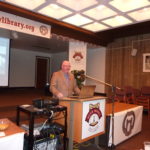
Hank D. Lutton, a registered professional archaeologist, appeared at Lunch With Books at the Ohio County Public Library in Wheeling Tuesday and addressed the topic, “Beneath the Poppies and Crosses: What Archaeology Reveals About the First World War.” He is a curator at Grave Creek Mound Archaeological Complex in Moundsville.
He described the Great War as “one of the most dehumanizing events in human history.” As archaeologists uncover mass graves, they seek to identify bodies and rebury the remains individually. That effort “restores the humanity to these people who have often been stripped of it,” he said.
Discussing relatively recent discoveries related to the 1914-18 conflict, Lutton said the first excavation of a World War I battlefield took place in 1991, with the first book on the war’s archaeology being published in 2007.
Archaeological interest was spurred by the case of beloved French author Alain Fournier who, with 20 other Frenchmen, went on patrol in the forest near Verdun in 1914 and were never seen again. Their sudden disappearance sparked conspiracy theories, but no concrete evidence until 1990, when 14 years of research culminated in the discovery of an eyewitness account in German military records. The witness said the French soldiers were cut down by gunfire and buried by Germans in a mass grave.
Lutton said professional archaeologists found a burial pit containing 21 bodies buried in French uniforms. The placement of the bodies showed that the Germans buried the enemy according to military rank.
Almost all of the French soldiers were identified by their ID disks, while others were named through military enlistment records. The bodies were reburied in individual graves.
This discovery marked the first time that personal effects were given to descendants of soldiers, rather than being placed in museums or sold. “This was a very sharp departure” from common practice, he said.
He said archaeology can address some of the war’s most dramatic aspects. For instance, it was rumored that the Lusitania, a passenger liner torpedoed by a German U-boat, was carrying small arms. A 2008 expedition revealed 4 million rounds of .303-caliber shells — standard ammunition for British machine guns and rifles — in the sunken ship, he said.
In another matter, archaeologists from Turkey, Australia and New Zealand worked on the best preserved battlefield of the war on Gallipoli and found eroded trenches and dugouts, he said.
The “Pompeii Effect” was demonstrated in 2012, when a highway construction project at Carspach, France, uncovered a German dugout frozen in time since its destruction in March 1918, he said. The complex caved in a matter of seconds, killing 34 German soliders almost immediately. Their skeletons were still sitting upright because “the soil entombed them that quickly,” he said.
French archaeologists found that an anaerobic environment slowed deterioration in the shelter. “It was almost perfect conditions for preservation,” he said.
Boots and leather leg protectors remained intact on bodies. Fragments of German newspapers, found on a bed, were still legible. Archaeologists found evidence of intestinal parasites in all of the remains and theorized that rat feces contaminated the soldiers’ food, Lutton said.
In 2002, archaeologists uncovered 20 bodies from the Grimsby Chums who probably were buried by their fellow Englishmen. Eighteen bodies were mostly complete, but two were missing significant body parts; remaining limbs were placed in anatomical order, suggesting the survivors’ “tenderness and perhaps devotion to their friends,” he remarked.
In the trenches of No Man’s Land, archaeologists found the body of a member of the Royal Welsh Fusiliers, along with a badge, gas mask lens, unused ammo shells, trench mirror, pocket knife, toothbrush and pencils.
The Australian government commissioned noted battle archaeologist Tony Pollard to search for mass graves in France where 5,500 Australians were killed or wounded in the Battle of Fromelles in 1916. Using an aerial map and a variety of technologies, Pollard uncovered eight burial pits where 250 sets of remains were exhumed and more than 5,000 artifacts were found, Lutton said. More than half of the remains have been identified through DNA, he added.
Many personal items were found at Fromelles, with rosaries and crucifixes being the most common. Lutton said the most poignant artifact was an Australian railway return ticket that was folded and stuffed in a gas mask.