When Canes Were a Fashion Statement
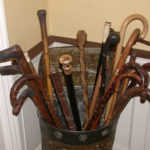
Canes are attractive displayed in an umbrella stand and make a nostalgic statement in an entry hall.
In honor of Father’s Day, I’m featuring canes. Not that I’m implying dads are limping along, but because collectible canes are much more than a walking aid. Canes, or walking sticks as they were formerly known, are a reminder of the pre-World War I era when gentlemen considered a proper walking stick necessary for dressing-up.
These sticks were not just for walking. Considered a fashion statement, walking sticks were also valuable as status symbols and even for self-defense. Yes, walking sticks were seen as a handy weapon during the age of dueling pistols and other refined moments of violence.
Used since ancient times, canes can be ornate and elaborate. Some collectors seek only canes with special features, such as hidden knives, swords, whiskey flasks or risque pictures seen through peepholes. Others seek canes that date to a certain era or certain design.
Canes and walking sticks are remarkably varied and include a variety of heads made of gold, ivory or exotic materials like animal bones. Common woods used in walking sticks include bamboo, ebony, maple, sandalwood and rosewood. Others were made of glass and many were trimmed in gold, silver or brass.
Walking sticks were often given as a gift or commemorative item. Civil War veterans were often presented with sticks commemorating battles. Apparently President James Madison’s favorite walking sticks were made from wood taken from the famous U.S. Navy warship, the USS Constitution during one of its renovations.
These commemorative canes, made from material taken from historic buildings, ships or forts, are also referred to as relic canes. Shipwreck relics were especially popular for this use.
The ladies, too, had clever canes that were meant to accessorize their outfits during the Victorian age. But ladies’ canes date back much earlier to the Middle Ages, when French women carried slender applewood walking sticks, according to cane collector and expert Jeffrey B. Snyder. Snyder wrote a definitive book on the walking stick habit called, “Canes From the 17th-20th Century.”
Condition, special features, exotic materials and the history or provenance of the cane is most important to collectors. Think about all the famous people who have used a walking stick: everyone from real-life leaders, such as President Abraham Lincoln, to fictional icons like James Bond.
But all walking sticks are attractive to display in an entry hall or umbrella stand. These elegant reminders of a slower, walking society, are often works of art and are classified as folk art today.
The handles of canes are most interesting and can take the form of dogs, eagles, staghorns, snakes and human heads. Probably the most common cane head is a simple curved crook handle. Another is a gold or brass knob with engraving that recalls the recipient — these were typically given as gifts at retirements or other milestone events.
Canes designed for females might include a perfume bottle in the handle or a vanity handle that included a comb and mirror done in Bakelite. So this collectible easily translates to female fashion tastes as well. Even Faberge created masterpiece canes.
There’s plenty to choose from, though, for beginning collectors, and at the time I wrote this column, 1,446 collectible canes showed up on an eBay search, priced from $2,790 for a rare silver-plated figurehead version to a group of five simpler canes for $10.
Actually a cane sounds like a great purchase for any man, dad or not, since it is a timeless treasure to enjoy!
For comments or suggestions on local treasures to be featured in Antique of the Week, Maureen Zambito can be reached via email at: zambitomaureen@hotmail .com or by writing in care of this newspaper.
Features

Showcasing the Past, Preserving the Future

Blockbuster Shows Taking Shape at the Capitol Theatre in the New Year

Why Doing Good Also Makes Us Feel Good, During the Holidays and Beyond

SLIDESHOW: Main Street Bank Fantasy in Lights Parade in Wheeling

Robert Plant’s Saving Grace Enraptures Fans at Capitol Theatre