
Salesman Samples Make Cute Collectibles
Salesman Samples Make Cute Collectibles
A few days ago, my sister Judy asked me to stop and see a few small antiques that she came across and wondered about. Well one of these trinkets was a little tin box that puzzled her because it had the word Bread painted on the front. Obviously it was way too small for even a slice of bread.
She was surprised when I told her it was a salesman sample. These perfectly made little products were actual scale models of real items that were sold by companies or traveling salesmen back in the early 20th century.
Many salesman samples are real working machines that today are often mistaken for doll or children’s furniture. Naturally, these are a fun collectible for antique enthusiasts.
Realistic in detail, these little stoves, gadgets and household items were made during the era when time was willingly spent creating a model that was perfect in every way to entice the consumer to buy.
Seems a quaint way to promote products today, but back then you couldn’t just pull up a high-definition image on your cell phone or computer.
Some people mistakenly think salesman samples are really patent models. The difference is difficult to determine unless you’re a real pro, but to antique collectors it is important.
Though both patent models and salesman samples are miniature examples of machines or new inventions, the patent model was actually made by inventors and their craftsmen to earn a patent in the American market.
They are often marked with the name of the model maker-workman and date of issue from the U.S. Patent Office. Beginning in 1790, any U.S. inventor had to show a working model to earn an official patent from the U.S. Patent Office.
Until the early 1900s this requirement continued. The skill and craftsmanship of these working models are amazing. Examples can be found of washing machines, tools, typewriters and lots of goofy gadgets, too.
Salesman samples followed and were used by salesmen to show their product line to buyers in department and hardware stores. Products as diverse as bathtubs, bedsprings, toilets and windows were sold with these precise samples.
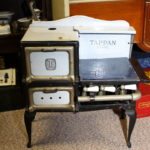
For example, the Tappan gas range shown in today’s column actually works if it’s connected to a gas line. It has all the parts down to an attractive paint job and was used as a salesman sample around 1900.
I have read in antique reference books that the definite sign of a salesman sample is the carrying case that goes along with any real sample. So if you come across a small model of a machine or household item in a case, you know you’ve got a treasure!
If you’re lucky enough to find a rare example (one not produced in high quantities), it can be worth thousands of dollars to collectors. But to get an idea of the value, you have to factor in condition, marks and identifying papers and the traveling case.
Most collectors stumble upon a salesman sample at an estate sale or auction and are intrigued by the careful workmanship and beauty of the design. Then when they realize the history and fun of displaying these little gems, they get hooked. My sister’s going to use her tiny little bread box in her modern kitchen, where it’s the perfect conversation piece!
For comments or suggestions on local treasures to be featured in Antique of the Week, Maureen Zambito can be reached via email at zambitomaureen @hotmail.com or by writing in care of this newspaper.
Features

Master Gardeners Help Create Habitats for Fireflies

Wheeling Heritage Highlights Celebrations, Events Around the City

WLU EdD Program Celebrates First Dissertation Defense of the Season
Program Welcomes Andrew Welsh-Huggins
WHEELING – The Ohio County Public Library's next Lunch With Books program will be “Justice for Some — ...
Laughlin Memorial Chapel Appoints New Director
WHEELING – Laughlin Memorial Chapel, an active community center with programs designed for young people, is ...
What’s Going On This Weekend
Saturday, March 28-Wednesday, April 1 Saturday, March 28 MUSIC & ARTS Wheeling Polka Festival – All ...