Showcasing the Past, Preserving the Future
The Mills Group Plans Revitalization of Historic Egerter Building
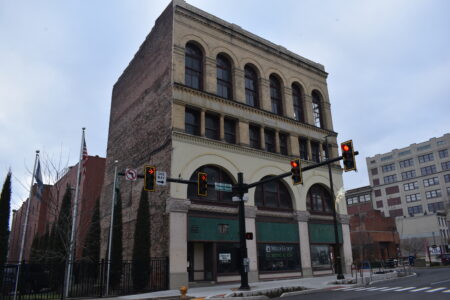
The Mills Group has acquired the historic Egerter Building at the corner of Market and 11th streets in downtown Wheeling. The architectural and design firm plans to renovate the 132-year-old building, relocate its Wheeling offices there and eventually revitalize and bring occupancy to the upper floors. (Photo by Eric Ayres)
WHEELING – An architectural firm that has helped design some of the most notable new construction ventures and historic preservation projects in Wheeling has ambitious plans for a landmark building in the downtown area.
The Egerter Building on the corner of Market and 11th streets has stood as a pillar in the heart of Wheeling’s business district since the 1800s. Its new owner, The Mills Group, is not only working on plans that will bring a new life to the grand old, four-story building, the company’s initial plan is to relocate its own Wheeling-based offices there.
Currently vacant, it is one key historic structure at the epicenter of an area where scores of privately owned buildings and public facilities are being revitalized to the tune of tens of millions of dollars.
If all goes as planned, the initial phase of the renovation and opening of the architectural firm’s offices there will take place in the coming months. The first floor renovation is estimated to cost around $250,000, company officials noted, but the renovation of the entire property will easily be a seven-figure investment.
“The overall goal would be to develop the whole building,” Chris Clark, principal at The Mills Group’s Wheeling offices, said. “That’s the intent. In the meantime, we’re looking right now to renovate and move into the first floor and to locate our offices there.”
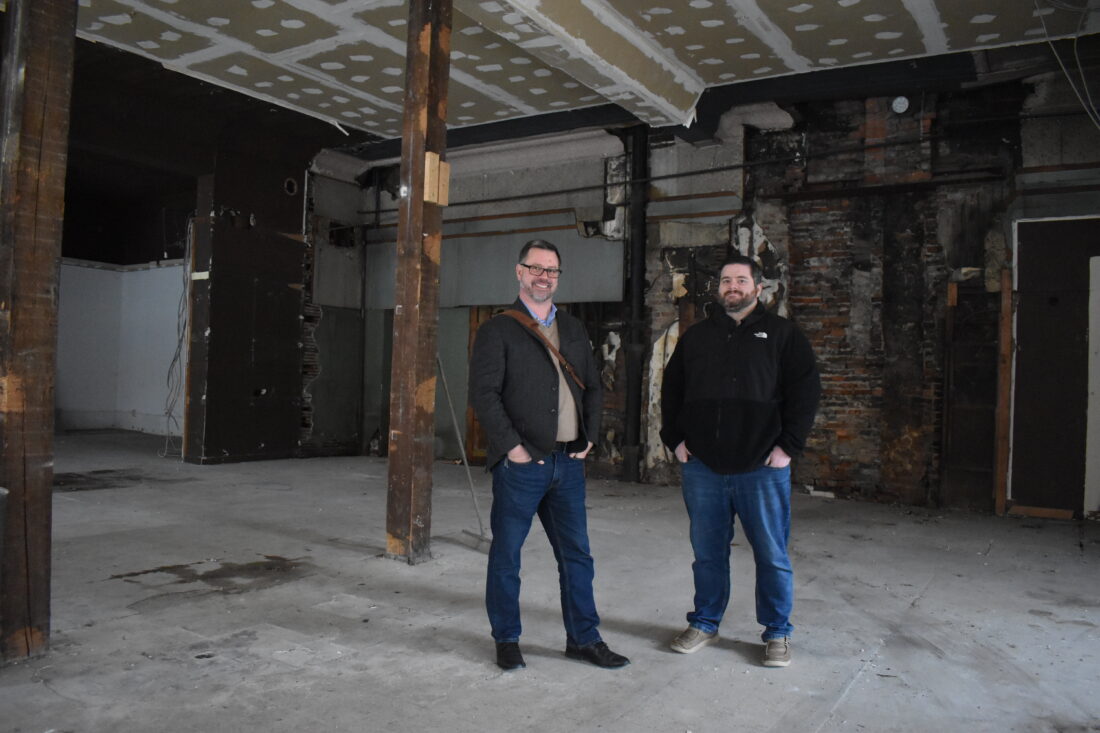
Principal Chris Clark and Project Manager Logan Patrick, from left, of The Mills Group stand inside the first floor of the historic Egerter Building on Market Street in downtown Wheeling. This area, where most recently a Subway store operated before scores of other businesses over the past century, is expected to be the home to The Mills Group’s Wheeling offices later this year. (Photo by Eric Ayres)
Construction of the Egerter Building began in 1893, according to historic documents. It is named after Alfred C. Egerter, former mayor of Wheeling who served the city government in that capacity from 1881-83 and operated a wholesale grocery store out of the hulking building with huge arched windows in the 1100 block of Market Street. It is listed on the National Register of Historic Places as being constructed in 1894 with a facade rehabilitation completed in 1999. A myriad of different businesses have operated out of the building over the decades.
In September 2023, The Mills Group purchased the Egerter Building for $270,000. The company also acquired the adjacent property that is currently home to a “pocket park” on Market Plaza where Louis’ Famous Hot Dog shop once stood between the Egerter Building and the existing facility that once housed Horne’s.
Clark said The Mills Group’s intentions to renovate and occupy the upper floors of the building will require the use of this adjacent lot that presently boasts public outdoor seating and tables, as well as displays of artwork.
“We’re looking at making that vertical addition,” he said, noting that an elevator and new stair tower will have to be built as an addition along the back wall of the building, opposite of the Market Street side, in order to create a modern access to the upper floors. Presently, there is only one original stairwell on the south side of the building that actually has a separate access from the first floor space.
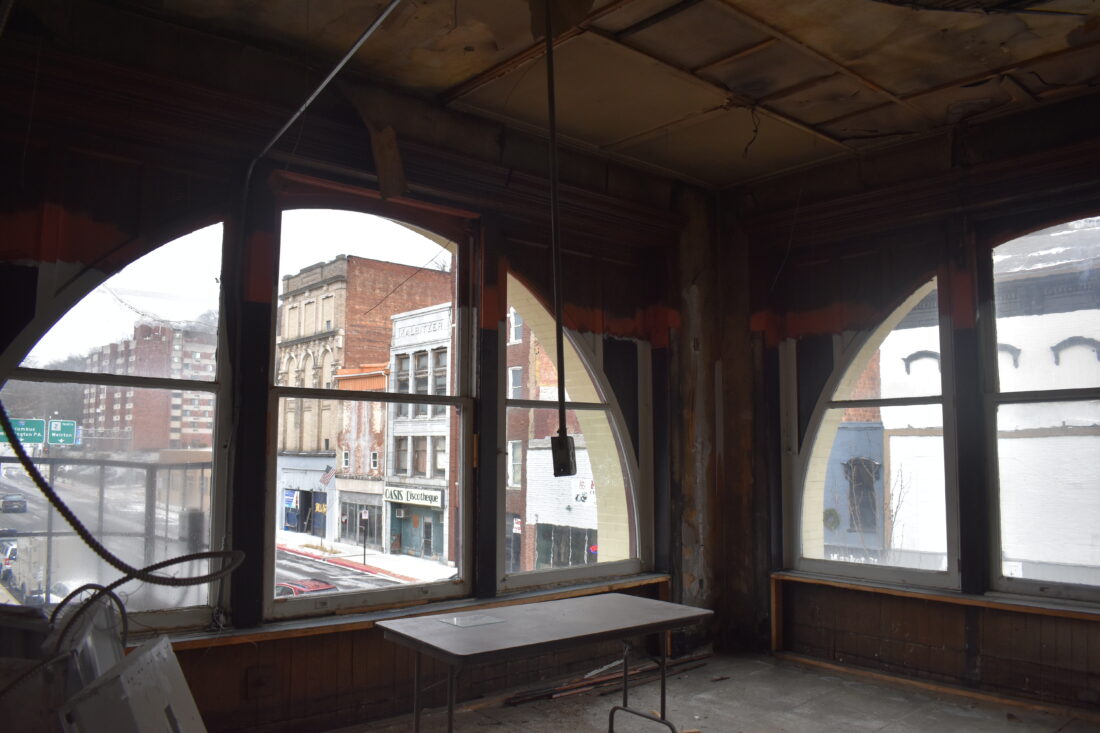
Huge arching windows are just one of the many unique architectural features displayed in the Egerter Building, which is listed on the National Register of Historic Places. (Photo by Eric Ayres)
The Mills Group is still looking at market studies, seeking grants and working on financial strategies that will help make future phases of the renovations to the upper floors come to fruition, Clark noted.
“Hopefully, we’ll be able to access the upper floors and occupy the whole building,” he said.
The Mills Group’s Wheeling offices are currently housed on the sixth floor of the Kaley Building on the corner of 14th and Chapline streets downtown. Although the firm intends to initially relocate its offices to the first floor of the Egerter Building this year, a future goal would be to potentially move the company’s offices to the fourth floor and make the street-level first-floor space available to other commercial tenants with mercantile or food service offerings.
Clark indicated that the second and third floors could likely be renovated for residential or office use. But the next big step would be to revitalize the first floor and move The Mills Group’s offices there.
“On a loose timetable I would say, conservatively, we would want to be in there by this summer,” Clark said. “We’re really looking forward to it. We’re really seeing a lot of good things happening and coming to life there on the square. Once we get moved down there, we want to be a part of it and to be a contributor to that.
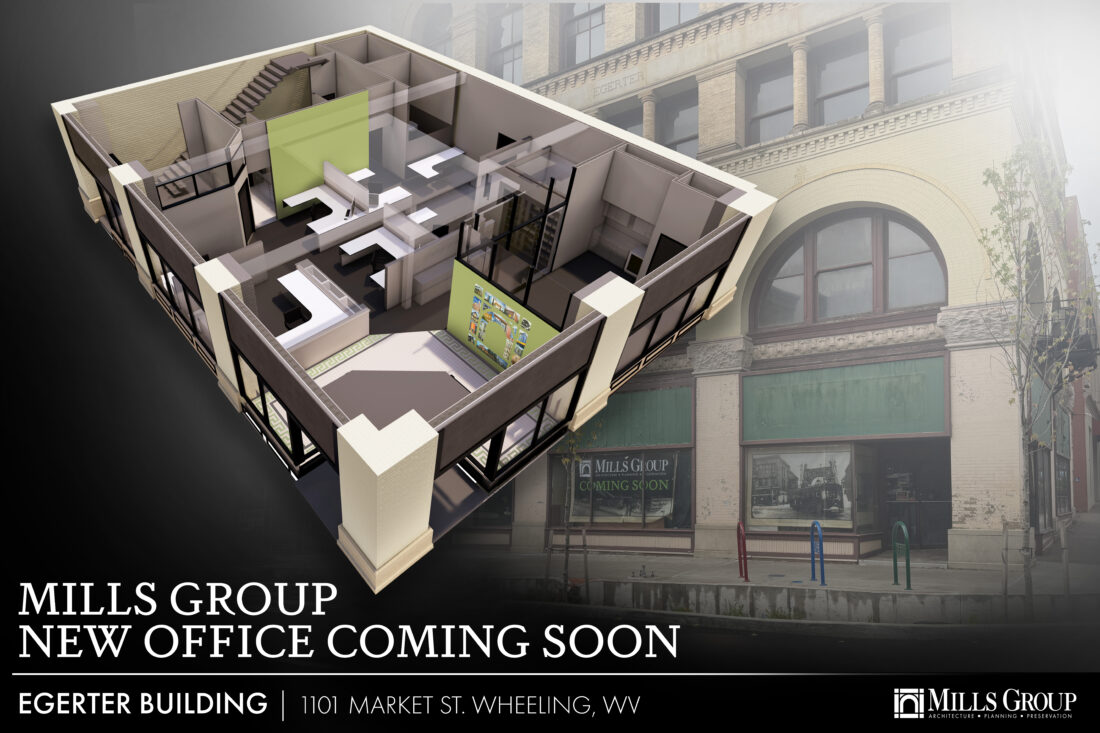
Initial conceptual designs show plans for the first floor of the building where The Mills Group plans to relocate its Wheeling offices. (Photo Provided)
“We think having a presence there on Market Street will create a lot of visibility, and we’re eager to be a part of the whole little community there.”
The Mills Group has played an important role in several historic renovations and new building projects in Wheeling and in other communities over the past two decades. The architectural and design firm has its two main headquarters in Morgantown and Wheeling, with smaller offices in West Virginia located in Shepherdstown and Elkins.
In the recent past, The Mills Group worked on major projects that brought new life to historic buildings in Wheeling, including Boury Lofts, The Flatiron Building and West Virginia Northern Community College (former B&O Railroad Building). The Mills Group also designed the new Market Street Parking Garage across the street from the Egerter Building, as well as the nearby headquarters for The Health Plan, along with several other notable ventures.
“For better or worse, what we do here in Wheeling is here to stay,” Clark said. “It’s kind of neat to be able to take my daughter on a walk through Wheeling, look around and say ‘we did that’ and ‘we did that, too.’ A lot of what we do will really have a lasting impact on the Wheeling city fabric.”
Not everyone can enjoy those kinds of rewards, Clark said, and as architects and designers, they don’t take it for granted.
“We get to walk through the fruits of our labor,” he said. “It’s very concrete, and we understand that not everyone gets that chance. We’re able to go through the spaces we create, and along the way, we’re creating relationships and a lot more. It’s neat to be a part of that.”
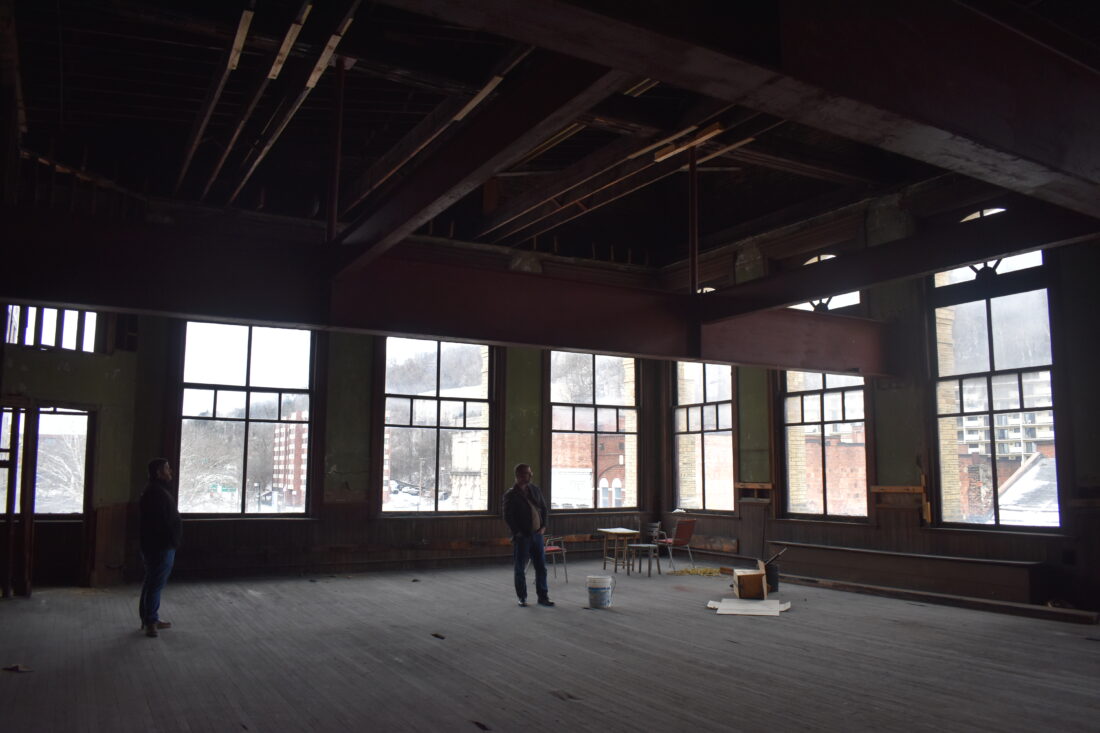
The fourth floor of the Egerter Building boasts views of Market Street with windows throughout – many with glass panels original to the building. Massive steel beams were installed to reinforce the building after a fire occurred on the fourth floor many years ago. (Photo by Eric Ayres)
A Rich History
The Egerter Building in downtown Wheeling has been home to numerous businesses, from its original use as a wholesale grocery store operated by its namesake and former city mayor back in the late 1800s to its more recent use by commercial occupants, including a Subway sandwich location.
Stephen DeNeui, preservation associate at The Mills Group, serves in many ways as an on-staff historian for the company. Perusing old maps used for insurance purposes and combing through other historic documents, DeNeui has unearthed an extensive profile of the Egerter Building and its role in the Wheeling community for more than a century.
“The Egerter Building has provided an anchor of cultural gravity to Market Street, where it has stood for 132 years,” DeNeui said. “Its Italian Renaissance/Romanesque Revival hybrid style provides a posture of strength and poise across its two street-facing facades that overlook the historic Market Plaza.”
Spaces inside the building changed to suit the needs of each era over the decades. The first floor served the original grocery outlet and was then converted into a pharmacy. Historic photographs from around the turn-of-the-century show a downtown bustling with horse-drawn carriages with the Egerter building and the old market building that once stood next door where the plaza is today.
The second and third floors of the building have changed the most over the years, but have typically involved occupancy by some level of education and medical practices, DeNeui said, noting that the Wheeling Technical School and Business Institute provided classes for adult education and even night classes for women dating back as early as 1897.
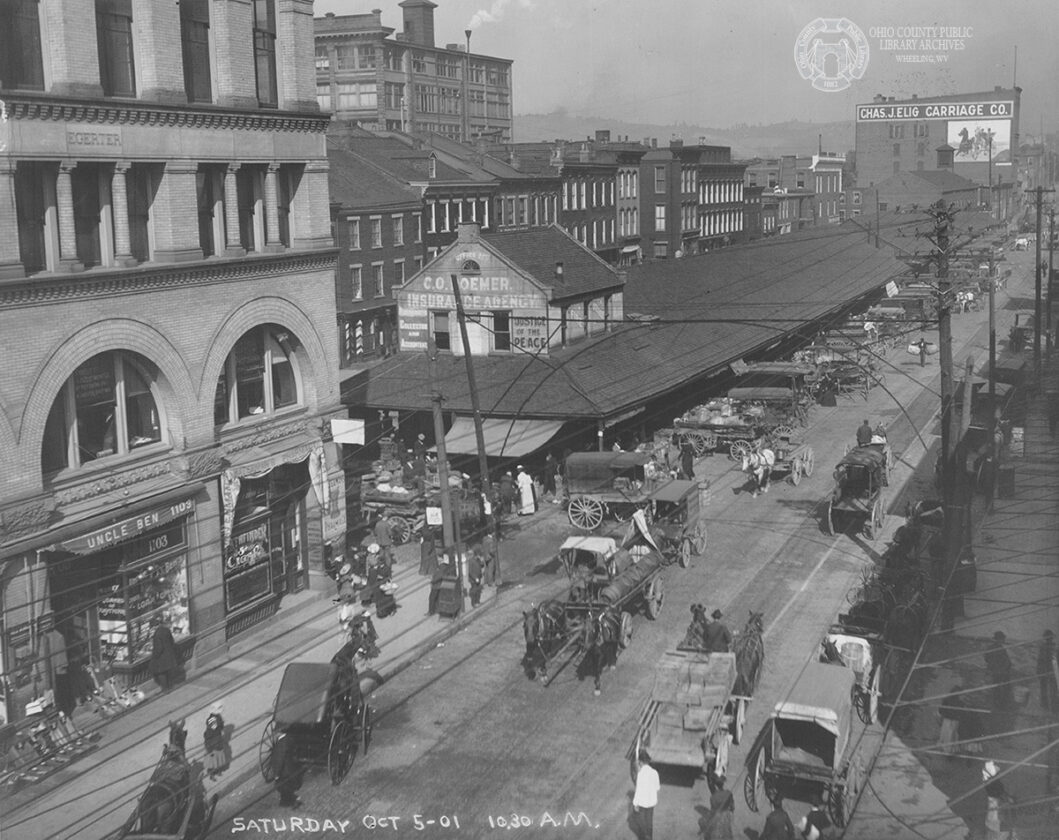
This archival photo provided by the Ohio County Public Library shows a bustling area along Market Street in downtown Wheeling around the turn of the century between the late 1800s and early 1900s when horse drawn carriages were the prominent mode of transportation. The Egerter building on the left is shown adjacent to the old market house that once stood in the area where the Plaza on Market is today. (Photo Provided)
On the fourth floor, the tall ceilings and large windows provided the scene for musical performances and for social gatherings and meetings of entities like the Beethoven Club, the Knights of Pythias, The Ladies Shield of Honor, local veterans organizations and a Moose Lodge.
“In the 1920s, the building housed a secret speakeasy, components of which are still preserved on site,” DeNeui noted, adding that the building once housed the first X-ray machine in West Virginia.”
The old building has housed a pawn shop (which was robbed), a cloak shop (which was also robbed), a sign shop, Democratic party functions, a loan broker, eyeglass fabricator, cigar chop, private investigator, a dentists office, a doctor’s office, service organization meeting rooms and much more.
The Mills Group plans to restore the large arched windows in the building and to maintain as much of the historic architecture in the building as possible. There are decorative tin ceilings installed overtop of previous decorative tin ceilings inside, original plumbing and electrical units, original ornate designs on the stairs, antique doors and a treasure trove of other features in the building.
There was a fire on the fourth floor that still shows some scars of the incident, but the supports were replaced and fortified by massive steel beams.
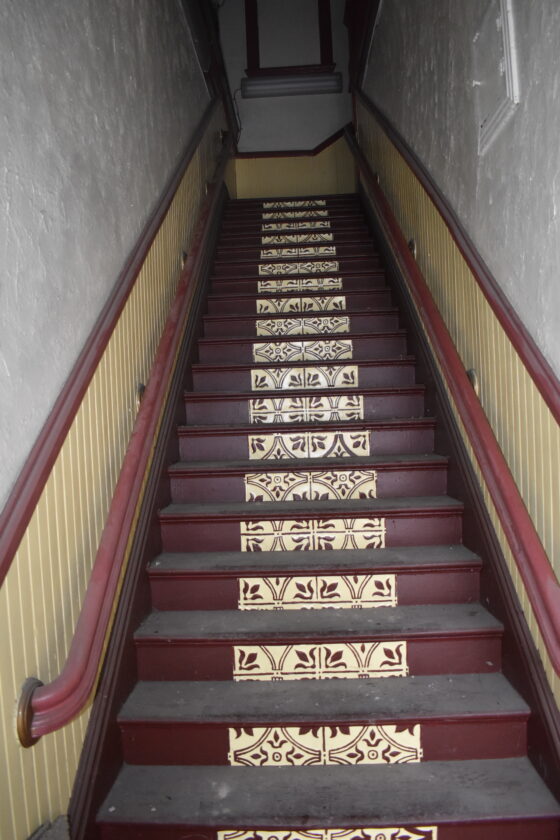
The ornate stairs leading to the upper floors of the Egerter Building are one of the many architectural features that still exist inside the historic facility. (Photo by Eric Ayres)
“The historical significance of the Egerter Building within the greater story of Wheeling cannot be overstated,” DeNeui said. “This building’s legacy and survival provide opportunities for rich storytelling while continuing to yield significant historical traces of the 132 years of Wheeling’s citizens from every walk of life.”
Since its construction, the Egerter Building has been an “active character in each chapter of Wheeling’s legacy,” DeNeui noted. “Now is the time to return it to its former glory and back into the service of the community, where it can continue to make history.”
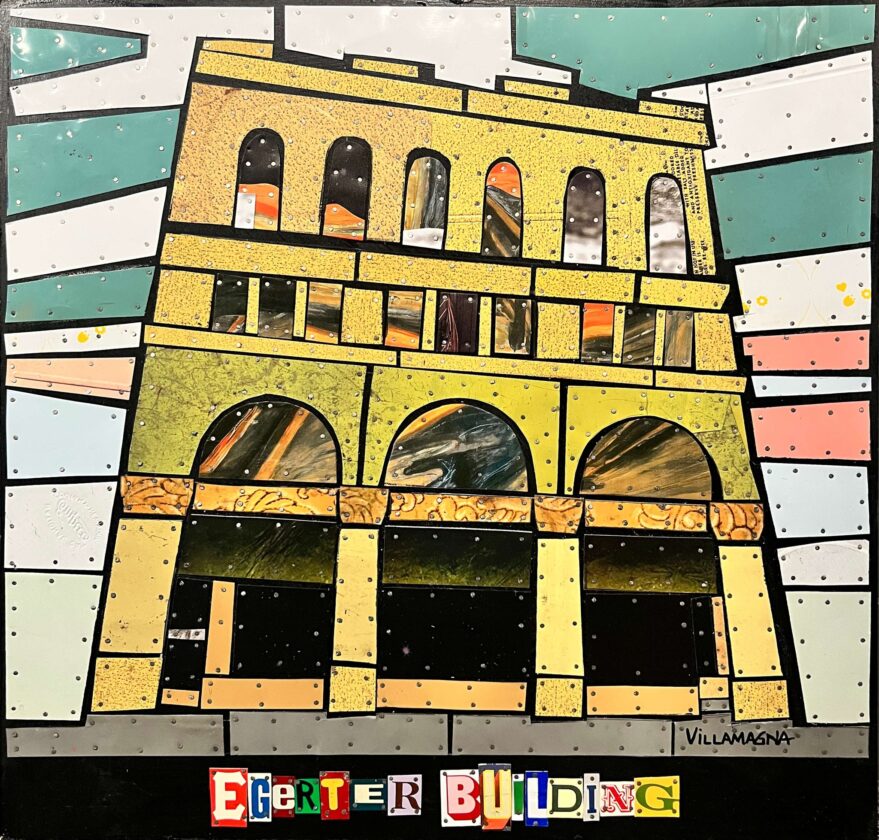
Wheeling-based artist Robert Villamagna created this work of art depicting the historic Egerter Building for The Mills Group’s commissioned anniversary collection of artworks submitted for bidding in support of the Preservation Alliance of West Virginia. (Photo Provided)
Features
Showcasing the Past, Preserving the Future

Blockbuster Shows Taking Shape at the Capitol Theatre in the New Year

Why Doing Good Also Makes Us Feel Good, During the Holidays and Beyond
SLIDESHOW: Main Street Bank Fantasy in Lights Parade in Wheeling
Robert Plant’s Saving Grace Enraptures Fans at Capitol Theatre