
Trending
By CHARLES D. DUSCH JR.
Acting Command Historian, USAF Academy
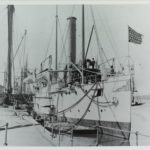
One hundred years ago, during World War I, the USS Wheeling -- a Navy gunboat named for Wheeling, West Virginia--fought a two-hour cat-and-mouse battle with two German U-boats (submarines) while protecting a Mediterranean convoy of merchant ships.
The Wheeling was one of seven gunboats that British First Sea Lord Admiral John Jellicoe requested from U.S. Navy Admiral William Sims after the U.S. declared war on Germany. Britain had plenty of battleships to bottle up the German surface fleet but lacked enough of the smaller, faster ships needed to stop Germany's unrestricted submarine campaign, which was gradually starving Britain of food and war material. If the US Navy could not stop the U-boats, Jellicoe told Sims, Britain would be forced to quit the war as early as November 1917.
Although launched in 1897, Wheeling was up to the challenge. The boat was a small target at only 189 feet long and 34 feet wide. It could make 12 knots, which was faster than submerged U-boats. The Wheeling's armament of six, 4-inch guns, four 6-pound guns, two 1-pound guns, and Colt machine gun were more than a match for any submarine that chose to fight on the surface. The boat carried depth charges that could sink U-boats that dove under water. Its shallow draft allowed her to operate close to the coast or in rivers, if needed.
For the first seven months of convoy duty, the Wheeling operated as part of the Azores Patrol Force, which means it escorted ships between the Azores and Madeira Islands. In April 1918, the boat was reassigned to the British fortress of Gibraltar. The Mediterranean route was important to the American Army in France, since the American Expeditionary Force was expanding to over 1 million soldiers and needed alternative port facilities in the south of France. Most of the northern ports were already crammed to capacity from British, French and American shipping. Failure to secure those shipping lanes put American doughboys and supplies at risk.
And German U-boats were determined to stop them. Taking advantage of dusk on the evening of May 17, 1918, the U-39 and UB-50 attacked the convoy escorted by the Wheeling, the armed yacht Venetia, and the survey ship Surveyor. U-39 fired first, torpedoing SS Sculptor, which exploded. The Wheeling immediately sounded general quarters and engaged the U-boat at full speed. U-39 dove for safety, while the Wheeling dropped six depth charges on the sub--two of which failed to detonate. Panicked, the convoy scattered, making the ships vulnerable to UB-50, which sank the SS Mavisbrook and damaged the SS Elswick Grange.
Having driven off U-39, the Wheeling hunted for the second assailant, and the U-boat made no more attacks that night. The Wheeling also conducted rescue operations with the Surveyor and collected the scattered convoy. They rest of the voyage was uneventful, though the next day a heavily damaged U-39 limped into Cartagena, Spain to be interned for the rest of the war. At first, the Navy credited the Wheeling with sinking the U-boat, but it seems likely U-39 was damaged mainly after it surfaced when allied warplanes attacked it on May 18.
Still, Admiral Sims commended USS Wheeling and its crew for their successful battle. Indeed, by war's end, the combined U.S. and Royal Navy Gibraltar Force had escorted 562 convoys comprising a total of 10,478 ships, protected commerce and frustrated German U-boats. A century ago, the Wheeling admirably contributed to winning the First World War's Battle of the Atlantic.