
Boat Building Once Flourished in Wheeling
Boat Building Once Flourished
Trending
The growing community of Wheeling was a beehive of boat building in the 18th and 19th centuries, according to history buff and author John Bowman.
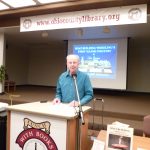
He returned Tuesday to the Ohio County Public Library's Lunch With Books series to present a Wheeling 250 program based on his latest book, "Boat Building: Wheeling's First Major Industry."
The Wheeling resident, who also makes models of historic local boats, traced the development of boat building in the city from pioneer times to the late 1950s.
Noting the role of boats in bringing settlers to the frontier, he said that Ebenezer Zane's family arrived in the area on flatboats in March 1770. The frontier community was known initially as Zanesburg.
"Wheeling established the first boat building yard on the Ohio River," Bowman said.
Zane's settlement remained quiet from 1770-74. Describing the relationship between settlers and Native Americans, he said, "Early Wheelingites were living a tenuous peace."
However, reports of shots being fired along the Little Kanawha River, and the massacre of the family of Cayuga leader Logan, precipitated Cresap's War, also known as Lord Dunmore's War. A need for boats to fight that war led to the opening of Wheeling's first boat building yard in 1774, he said.
The boat yard was set up above the mouth of Wheeling Creek. It turned out 60 pirogues -- a type of small boat, often cut out from a single log – and a similar number of barges in 1774, he said.
Later, by the mid-1780s, Wheeling's boat yards were serving the needs of people traveling from the East Coast and heading down river to Kentucky. When the Mingo Indian Path was widened into a wagon road in the early 1790s, pioneers traveled over land to Wheeling, where they bought flatboats to continue their journey by water.
"By the mid-1790s, Conestoga wagons were arriving daily in Wheeling," Bowman said. Goods from wagons were loaded onto flatboats and barges to be transported on the Ohio River.
In 1803, pirogues for the Lewis and Clark Expedition were built in Wheeling, he said. Bowman's ancestor, Patrick Gass, was a carpenter on the cross-country tour.
Thousands of keelboats and flatboats were produced and bought in the settlement. The community was emerging as a town, with a population of 1,500 by 1815, he said.
"As many as 5,000 wagons landed at Wheeling in a season," resulting in a booming business for firms that supplied travelers' needs, Bowman said.
Two ocean liners, the Dorcas and the Sally, were constructed in Wheeling, but this venture probably wasn't practical, he said.
A keelboat yard opened in North Wheeling in 1815,with two other yards established later in that neighborhood. The owner of a saw mill and lumber yard in North Wheeling also opened a boat yard and employed nearly 200 carpenters, he said.
Also, a new type of boat building -- the construction of steamboats -- started in Wheeling in 1815, he said. Steam engines were built at a plant on 22nd Street.
The steamboat Washington, launched in June 1816, was built along the banks of Wheeling Creek, on the site of the present-day surface parking lot south of WesBanco Arena. The Washington was a sternwheeler with a flat bottom; it was equipped with two steam engines.
Bowman's new book lists 225 steamboats that were built in the city. The last steamboat was completed in 1900.
In 1953, a boat yard was established on Wheeling Island to build diesel-powered towboats, he said. The yard was located adjacent to the Wheeling Suspension Bridge, on a site where a new park is proposed, he added.
Three Wheeling-built towboats are still in service on the Ohio River, he said. Bowman's father-in-law, John Sanford, worked as a welder at the towboat yard in the 1950s.