
Wheeling Hospital’s 170-Year History Is Highlighted
Trending
WHEELING -- Wheeling Hospital, which is celebrating its 170th anniversary, has had a fascinating history, as medical care has grown and evolved.
As a year-long observance launches today, here are some of the highlights from the institution's long history:
∫ The first Wheeling Hospital, incorporated in March 1850, was located behind the convent and academy of the Sisters of the Visitation at 14th and Eoff streets. The convent later became the convent of the Sisters of St. Joseph.
Patients paid 97 cents a day for ward accommodations at the new hospital, which was the first medical care facility along a 410-mile stretch of the Ohio River between Pittsburgh and Cincinnati. Paid nurses were on duty, as were hospital co-founders Dr. Simon Hullihen, Dr. John Frissell and Dr. M.M. Houston.
∫ Records indicate Wheeling Hospital operated at a net loss of $101.61 (about $3,360 in today's dollars) during its second year. Receipts totaled $2,407.73 and expenses were $2,509.34.
∫ Bishop Richard V. Whelan, the hospital's other co-founder, brought the Sisters of St. Joseph from St. Louis to care for hospital patients in 1853, when the institution twice moved to larger quarters: first to the Zane residence on Chapline Street, then to the Metcalf property at 110 15th St., a building that is still standing today. During the first year in its new location, Wheeling Hospital admitted 153 patients.
∫ The care of orphans was added to the Sisters of St. Joseph responsibilities in 1853. It became necessary in 1856 to move Wheeling Hospital to the former Michael Sweeney mansion on the banks of the Ohio River in North Wheeling. Bed capacity was increased from 30 to 50.
∫ Virginia seceded from the Union in early 1861, but 56 western Virginia delegates met in Wheeling and declared independence from Virginia, leading to the creation of West Virginia. During the Civil War, naval riverboats delivered wounded to a dock constructed below the hospital. When the river was at a low stage, a wooden ladder was extended to the shore.
∫ Civil War wounded from both the Union and Confederacy crowded the hospital. The federal government took over the facility as a "post hospital" in April 1864 and the Sisters became army nurses. To make room for the wounded, the orphans were moved to a house on Wheeling Island and the Sisters gave up their cots. In August of that year, the entire hospital was taken over as a U.S. Army General Hospital. It continued with that designation until early 1865, when the number of wounded soldiers dwindled and it reverted back to "post hospital."
∫ Under Bishop Patrick J. Donahue, the first addition was made to Wheeling Hospital in 1903. The $50,000 North Wing provided 35 more beds. Patients had the opportunity for scenic relaxation and fresh air on the hospital's new porches facing the river. Completion of the new South Wing in 1914 took the bed total to 200.
∫ In 1928, Wheeling residents were asked for the first time to contribute to a campaign to expand Wheeling Hospital. The hospital trustees sought $350,000 for a new Center Wing. The public responded by contributing more than $500,000. The hospital's center building -- the last trace of the Sweeney mansion -- was razed and a new structure built. It contained patient rooms, a modern operating suite, X-ray department, delivery units and other facilities. The new bed capacity was 230.
∫ In 1948, a department specializing in physical therapy was opened and two years later Wheeling Hospital began its outpatient department.
∫ In July 1960, the hospital launched a $1.5 million Center Wing expansion campaign. Including six floors and a basement level, the addition provided a modern kitchen, new central service department, 41 more beds, new maternity-labor-delivery facilities, expanded and renovated operating and recovery rooms. The expansion was completed in 1962.
∫ Wheeling Hospital's Intensive Care Unit, established in 1963, and the Coronary Care Unit, initiated in 1966, were the first such facilities in West Virginia. In 1965, the emergency room was tripled in size to include waiting room facilities, observation areas and an emergency suite to handle all types of major and minor cases. In 1967, the hospital opened its new orthopedic section.
That construction eliminated the last of the 12-bed wards. Now there were a maximum of four beds per room.
∫ The new maternity department opened in 1968, as did the expanded admission and diagnostic unit for outpatients. The modern laboratory also was begun in 1968. In addition to its School of Nursing, Wheeling Hospital established schools for X-ray technicians, lab assistants and nurse anesthetists, and initiated the area's first externship program to provide summer training for medical students.
∫ In the late 1960s, the hospital opened a department specializing in treating breathing diseases and disorders, and in the early 1970s a new X-Ray department was installed. By 1970, the hospital's staff numbered 425 full- and part-time employees.
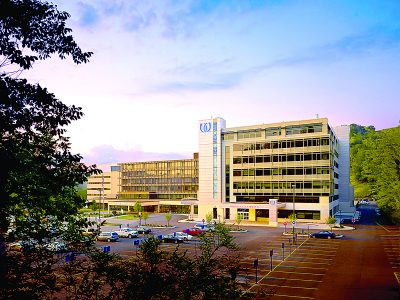
∫ Wheeling Hospital's directors and administrators accepted the recommendations of consultants who said a new hospital was needed because of the limitations on the North Wheeling facility's physical plant and site. The board of directors acquired a 212-acre site of undeveloped land next to Interstate 70 in Wheeling's Oak Park-Clator area.
∫ During a fundraising campaign, Wheeling residents came through with an astounding $6 million. Grading and preparation for the site began in January 1968 and on Oct. 23, 1972, ground was broken for the $25 million hospital.
∫ The new Wheeling Hospital was dedicated on Sunday, June 1, 1975. A little over one month later, a massive cloudburst hit the area, flooding the lower level and forcing the evacuation of more than 200 patients. Wheeling Hospital employees and volunteers pitched in for the flood cleanup, quite a formidable task.
∫ In 1981, the pulmonary laboratory opened and the pastoral care department was expanded. Ground was broken in 1982 for the $3.6 million Bishop Joseph Hodges Continuous Care Center and Kidney Dialysis Center. Opened the following year, the facility enabled Wheeling Hospital to transfer those units from North Wheeling.
∫ In 1986, the hospital began a $9.4 million expansion of its Outpatient Center.
∫ During the 1990s, Wheeling Hospital introduced the Schiffler Cancer Center, the Cardiac Surgery Center, the Women's Health Center, the 55,000-square-foot Howard Long Wellness Center and the Emergency Trauma Center.
∫ In 2012, Wheeling Hospital opened its seven-story, $50 million Tower 5 expansion, the most ambitious project in the long history of the facility. The addition features a new 23,000-square-foot Emergency/Trauma Center, a Center for Pediatrics, private patient rooms, physician offices and cardiovascular, surgical and medical intensive care units.
∫ Wheeling Hospital's medical education department includes residencies in family medicine and osteopathic medicine.
∫ The new Continuous Care Center of Wheeling Hospital was dedicated in July 2018. The three-story, 107,000-square-foot nursing care facility rests atop a hill overlooking Wheeling Hospital and the surrounding area.
∫ Last June, the boards of directors of Wheeling Hospital and the West Virginia University Health System (WVU Medicine) announced that they had entered into a management services agreement and named Douglass E. Harrison as Wheeling Hospital's new CEO. Under the agreement, WVU Medicine provides management services to the hospital, while Harrison oversees all hospital operations. Wheeling's board of directors continue to govern the hospital, with final responsibility for quality of care and financial oversight. Kareen Simon, executive vice president and chief operating officer for the hospital, had been serving as interim CEO and returned to her former position.
∫ The hospital's newest addition is the Ambulatory Surgery Center in Bridgeport, which opened this February. It holds three newly-renovated operating rooms for outpatient surgeries with state-of-the-art technology. The center offers a more convenient experience for patients receiving outpatient procedures such as gastroenterology, plastic surgery, cataract surgery, podiatry, gynecologic surgery, orthopedic surgery and other general surgeries.
∫ Wheeling Hospital is preparing to open Urgent Care clinics in downtown Wheeling and Bellaire, and a walk-in clinic in Martins Ferry. Operations are expected to begin in April.
∫ Affiliates of Wheeling Hospital include Harrison Community Hospital, the Wheeling Clinic and the Wellsburg Clinic. Health centers operated by Wheeling Hospital and HCH include: Bellaire, Bridgeport, Colerain, Powhatan, Scio, Shadyside and St. Clairsville. Physicians also see patients at East Cove Avenue and 1000 National Road, Wheeling. The hospital also operates Visiting Nurse Services of Wheeling Hospital and VNS of Wheeling Hospital-Belmont.
∫ A full range of medical care is available at Wheeling Hospital, including heart and vascular services, laser and robotic surgery, comprehensive cancer treatment, sports medicine, corporate health and wellness programs. Care also is offered in the Center for Women's Services, NICU, Center for Pediatrics, Sleep Center and Emergency-Trauma Center.
Wheeling Hospital Rules of 1852
Rules of Patients
Section 1 -- Persons seriously wounded or injured shall be received at all times provided be brought to the hospital immediately.
Section 2 -- No other persons shall be received without a permit from one of the medical board.
Section 3 -- No one shall be admitted as a charity patient when disease is deemed incurable and likely to be of long continuance and in no case without a letter of consent being previously guaranteed by the superior of the house.
Section 4 -- Such charity patients as are capable shall assist in nursing or other duties about the hospital whenever required.
Section 5 -- All patients shall be free to obtain the aid of whatever clergyman they may desire, previous notice being given to the superior of the house.
Section 6 -- Patients shall conduct themselves with decorum on all occasions, avoiding noise, smoking and whatever may disturb or annoy others; and shall submit to the directions of the nurses; they shall confine themselves to their own apartments unless otherwise permitted by the nurses, visit other rooms, or the grounds and never leave the premises without permission.
Section 7 -- No liquors, provisions or medicines of any kind shall be furnished the patients by friends without permission and no games of chance allowed on any pretense.
Section 8 -- Money, valuables and clothing must be given up for safekeeping to the superior of the house. Clothing of deceased patients not immediately claimed by friends shall be distributed to the poor.
Section 9 -- All charity or beneficiary patients shall be discharged as soon as cured or whenever upon reasonable trial that they may be deemed incurable, the medical board to decide in each case.
Section 10 -- Visitors may be admitted on Tuesdays and Fridays between the hours of 3 p.m. and sunset, and at no other time without cause and permission.
They must confine themselves to the place designated for the visit and not prolong it unreasonably.
Section 11 -- No visitor shall lodge in the hospital; and any meal eaten, these shall be charged for the hotel rates.
Section 12 -- Any breach of good order or of these rules, subjects the patient to immediate discharge from the institution.
Section 13 -- In case it may be deemed proper to discharge any patient immediately, it may be done by the attending medical office with the concurrence of the superior of the house.
Section 14 -- The rates for board vary between $3 and $10 per week according to the accommodation and attendance required; the ordinary rate being $3 to $4 which price includes board, nursing and washing when paid in advance and in certain cases medical attendance. In all cases the security of some responsible inhabitant of the city or county shall be required and no security shall be received for a limited period.
Rules of Medical Board
Section 1 -- The medical board shall consist for the present of two surgeons and one physician. The surgical cases shall be divided between the surgical wards or departments under an arrangement to be made by the surgeons, subject to the approval of the board of visitors, and the board of visitors may make such changes in the number of and arrangements of the medical board as may from time to time be in its judgment, required by the increase of patients or other necessities of the hospital.
Section 2 -- The medical board shall visit all the patients of their respective wards or departments at static hours; on Wednesday and Saturday; and at such other times as particular cases under their charge may require.
Section 3 -- They shall not sign permits for the admission of patients without personal examination of the case, not for charity patients whose disease they deem incurable and of long continuance, and in cases of charity patients the case shall first be submitted to the superior of the house, and her consent be given, before permits are granted.
Section 4 - Whenever a patient is admitted, under a permit from one of the medical board, not connected with the department to be occupied by the patient, notice shall at one be given by the superior of the house, to the medical officer of the proper department.
Section 5 -- The medical board may in case of sickness or other sufficient cause of absence select substitutes to fill the place thus temporarily vacated; all which selections or appointments are subject to the approval of the board of visitors.
Section 6 -- No surgeon or physician on his rounds shall visit the patients of a ward or department other than his own except by special request of the mother superior or the medical officer of the department.
Section 7 -- In all cases where no previous understanding has been had between the attendant, surgeon or physician as to fees the charge shall be per surgical or medical attendance not to exceed, for visits twice weekly $1.50 per week, thrice weekly $2.50, once daily $4 per week and twice daily when necessary $7 per week.
Section 8 -- In all cases of wounds or casualties brought to the hospital when no understanding can be previously had the charge for surgical attendance or operations shall not exceed in any case the minimum rate of charge established by the medical faculty of Wheeling.
Section 9 -- No charity patient shall be furnished with a permit without written evidence of having previously made arrangements with the mother superior (according to the provision of section three) before application has been made to any member of the medical board and when a permit is refused the cause thereof shall be endorsed upon the superiors ticket of consent.
Section 10 -- In all cases where application is made by outdoor charity patients for medical advice & medicine such advice shall be given without charge by any member of the medical board but medicines furnished must be paid for on delivery.
Section 11 -- The form of permit, bond and certificate of discharge now in use in the St. Joseph's Hospital in the city of Philadelphia are hereby adopted and ordered to be used in the Wheeling Hospital.