
LaBelle Greene Project Developer Asks Wheeling Planning Commission for Zone Change
Housing complex at former nail plant nearing completion
Trending
WHEELING -- Plans are moving forward to complete the fourth and final phase of a multimillion-dollar affordable housing complex near the site of the former LaBelle Nail Plant in South Wheeling.
This week, representatives of the LaBelle Greene Project appeared virtually before the Wheeling Planning Commission for a public hearing on a request for a zone change. The property in question consists of lots on the west side along McCollogh Street near W.Va. 2 to the south of the former LaBelle Nail Plant and to the north of 32nd Street.
The request before the planning commission was to have the zoning designation changed from I-2 General Industrial to C-2 General Commercial. The Industrial zone designation does not allow for residential uses, but the Commercial zone designation does.
Local attorney Ron Musser, representing the LaBelle Greene Project, and Thomas Simons, vice president of The Woda Group — the project developer, addressed members of the Wheeling Planning Commission this week during the public hearing on the zone change request. No other parties were present or provided comment on the matter during the hearing.
"This is just trying to finish up this overall housing development, which I think is something that's clearly needed in the community," Musser said.
As part of the initial three phases of the LaBelle Greene Project, new townhouse-style apartment complexes were constructed over the past few years at the site. When The Woda Group was first moving plans forward for the LaBelle Greene Project, they had applied for a competitive tax credit plan offered through the West Virginia Housing Development fund.
The Woda Group has spearheaded a number of successful developments in the Ohio Valley that not only created affordable housing but also helped improve unused or deteriorating neighborhoods or structures. In Wheeling, those projects have included the Stone Center Lofts and Boury Lofts, among other developments
Demolition of the historic LaBelle Nail Plant building was part of the overall plan for the LaBelle Greene housing development, and the bulk of that demolition took place in 2017.
For the LaBelle Greene IV project, a four-story, 38-unit apartment complex is expected to be constructed at the site.
Previous developments at the site through the first three phases of the LaBelle Greene project also required the same zone change.
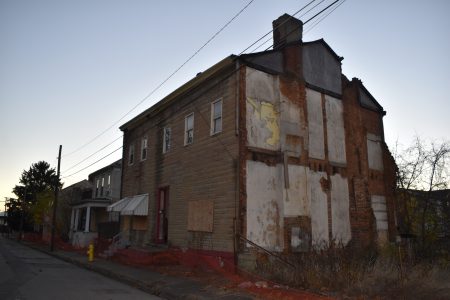
"This is going to eliminate a lot of the blight that lies out in that area adjacent to Route 2, and it's certainly consistent with the comprehensive plan to remove the blight and also to provide some additional affordable housing in that area," Musser said. "We'd like to keep this on the fast track and have a vote at this meeting so we can get it to council as quickly as possible, and hopefully construction can commence before we have some bad winter weather."
Members of the Wheeling Planning Commission unanimously approved a recommendation supporting the zone change request. This recommendation will be forwarded to Wheeling City Council in the form of a report, which will then be considered for approval. Once approved, final designs will move forward, and a site plan review will have to be approved by both the planning commission and city council.
Properties being considered at the site for Phase IV include former single-family and two-family dwellings which were non-conforming uses in the I-2 zone and many of which have been vacant for several years.
The LaBelle Nail Plant was an iconic symbol of Wheeling's industrial might for decades. Once the nation's top producer of cut nails, the plant was in production from the late 1800s and after coming under the umbrella of Wheeling Pittsburgh Steel.
The plan officially ceased operations in 2010 and was named to the National Register of Historic Places in 1997.