
New Lung Cancer Diagnosis Procedure in Use at WVU Medicine Wheeling Hospital
Trending
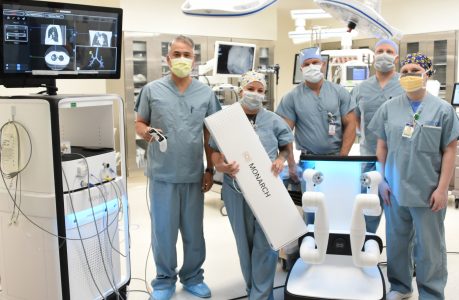
WHEELING -- A new innovation that holds promise to fight lung cancer is now in use at WVU Medicine Wheeling Hospital.
Used to view the inside of the lungs and obtain a tissue sample for biopsy, the goal of robotic bronchoscopy technology is to enable earlier and more accurate diagnosis of small and hard-to-reach nodules in the periphery of the lung.
The robotic bronchoscopy technology integrates the latest advancements in robotics, software, data science, and endoscopy (the use of small cameras and tools to enter the body through the patient's mouth). WVU Medicine Wheeling Hospital is among the first in the U.S. to use the platform, which was recently cleared by the U.S. Food and Drug Administration.
"Lung cancer is the leading cause of cancer deaths worldwide, in part because it has no symptoms in its early stages. Because the MONARCH Platform provides improved reach, vision and control for bronchoscopic procedures, it holds potential to make a diagnosis earlier," Kareen Simon, hospital vice president and chief operating officer, said. "We are excited about the promise of this technology to offer a more hopeful future for our patients with lung cancer."
More than 90% of people diagnosed with lung cancer do not survive the disease, in part because it is often found at an advanced stage. There are a variety of diagnostic options currently available for lung cancer, but all have limitations in accuracy, safety, or invasiveness.
These limitations can lead to false positives, false negatives or side effects such as collapsed lung and hemorrhage.
The Auris Health's MONARCH Platform utilizes a familiar controller-like interface that physicians use to navigate the flexible robotic endoscope to the periphery of the lung with improved reach, vision, and control. Combining traditional endoscopic views into the lung with computer-assisted navigation based on 3D models of the patient's own lung anatomy, the technology provides physicians with continuous bronchoscope vision throughout the entire procedure.
The design uses a minimally invasive endoscope to view deep inside the lungs. Robotic bronchoscopy provides a continuous, detailed 3-D view of the lungs' airway passages. With robotic technology, the doctor can use a controller to direct the probe, see exactly where it is going, and identify the best spots to take biopsy samples.