
Nursing Program Goes High-Tech at Franciscan University of Steubenville
 Warren Scott
 Trending
Visitors who stepped into a classroom of Franciscan University of Steubenville's Egan Hall Wednesday were greeted with the coos and cries of a pair of infants, recent arrivals to the school's nursing department.
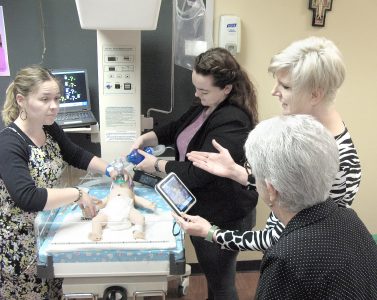
But the sounds of a newborn and a 9-month-old infant didn't originate from flesh-and-blood children. They were produced by computer-driven mannequins designed to simulate the life signs of a young patient in a maternity ward.
Kim Donnelly and Ashlee Minto, instructors for the nursing program, were aided by students in demonstrating how the two computer-driven mannequins can be used to simulate various health conditions that may be displayed by a real infant.
Donnelly said she and other instructors can control a "sim baby" from another room, activating blue lights within the mannequin's cheeks to indicate difficulty breathing, prompting a nursing student to administer oxygen.
The artificial infant's chest then rises to show that normal breathing has been restored, she noted.
Donnelly said the mannequins also are used to test a student's diagnostic skill by simulating conditions ranging from a heart murmur to a seizure. She said the students learn to listen for a weak cry, which can be a sign of various problems.
Laying on hospital beds elsewhere in the room were adult-size mannequins with electronic heartbeats measured by computer monitors.
Kaitlyn Baker, a senior nursing student at the school, said they have enabled her and other students to practice treating patients for various maladies without risking anyone's health.
She noted that she and others have learned about delivering a baby by using a female mannequin built to contain a "newborn" mannequin, though the childlike mannequin isn't able to function in the way the two new additions are.
Fellow senior Kaleigh O'Kane added, "The whole sim classroom has cameras so they (their instructors) can watch us the whole time."
Dr. Richard Antinone, who chairs the nursing program, said without their instructors at their side, the students are forced to make decisions on their own.
Donnelly added the instructors meet with the students afterward to discuss mistakes they may have made and actions they might have taken instead.
"The students may participate in simulations that are four hours long and involve multiple patients," said Antinone, who added "sims" have been in use at the university for about 11 years.
"We're continuously adding to our sim program because it's very helpful in preparing the students," he said.
Antinone said the nursing program has grown during the years, with about 15 in its first graduating class in 1983 to about 60 this year. He said the students receive instruction from several instructors with many years of experience in the medical field.
Antintone added there are plans to build a new academic building with one floor dedicated to the nursing program, which will allow the department to create five simulation rooms while also providing additional space for classrooms and labs.
Christin Jungers, the university's dean of professional programs, expressed thanks to the Mary Jane Brooks Charitable Trust, a private foundation that awarded about $115,000 for the two infant sims, and to members of the nursing department staff who worked to secure the grant.
The university celebrated the children's arrival by throwing a baby shower in which guests were invited to make a monetary or other donation for the Aim Women's Center in exchange for a chance to suggest names for the sim babies.
The nursing department's staff is expected to select names from the suggestions next week.