
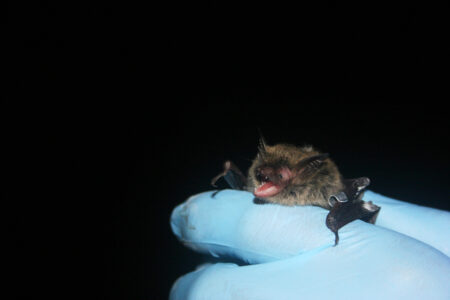
WHEELING -- A species of bat native to West Virginia and other states will soon be listed on the endangered list because its numbers continue to decline.
The U.S. Fish and Wildlife Service announced Tuesday the northern long-eared bat will be reclassified as endangered on Jan. 30 because it faces extinction. The bat type has been classified as "threatened" since 2015.
The main reason for the change in status is a deadly disease, white nose syndrome, that continues to kill the bats.
"This listing is an alarm bell and a call to action," U.S. Fish and Wildlife Service Director Martha Williams said in a press release.
"White-nose syndrome is decimating cave-dwelling bat species like the northern long-eared bat at unprecedented rates.
"The service is deeply committed to working with partners on a balanced approach that reduces the impacts of disease and protects the survivors to recover northern long-eared bat populations."
White nose syndrome is caused by a fungus that attacks a bat's skin including the skin on their noses. The condition often wakes the bats while they are trying to hibernate in the winter, leading to them using up their energy stores prematurely and often leading to death.
"Bats are the only species of wildlife known to be affected by white-nose syndrome, which has been confirmed in 38 states and eight Canadian provinces," according to the wildlife service.
"White-nose syndrome has spread across nearly 80% of the species' entire range and is expected to affect 100% of the species' range by the end of the decade.
"The change in the species' status comes after an in-depth review found that the northern long-eared bat continues to decline and now meets the definition of an endangered species under the ESA.
"Data indicate white-nose syndrome has caused estimated declines of 97 to 100% in affected northern long-eared bat populations."
Bats may not be some people's favorite wildlife creature, but they are an important part of the environment. They eat tons of bugs, which helps farmers' crops.
The bats are also considered pollinators of plants, too.
Alexander Silvis, endangered species coordinator for West Virginia Department of Natural Resources, said before white nose syndrome, northern long-eared bats were found across the state and were among the most common bat species in West Virginia.
"We do not know exactly how many northern long-eared bats were or are in West Virginia, but based on the relative capture rate during summer surveys, we can say that the number of northern long-eared bats has declined significantly," Silvis said.
"We similarly have observed a decrease in the number of known active maternity colonies and the sizes of known colonies."
According to the DNR, the state is home to 14 different kinds of bats: little brown bat, Indiana bat, gray bat, small-footed bat, silver-haired bat, Eastern pipistrelle, big brown bat, red bat, Seminole bat, hoary bat, evening bat, Virginia big-eared bat, Rafinesque's big eared-bat and the northern long-eared bat. Three are already on the endangered list: gray bat, Indiana bat and Virginia big-eared bat.
Research is ongoing on how to stop the fungus from spreading and impacting the bats.
Along with white nose syndrome, other things killing the bats include wind turbines used to generate electricity; summer habitat loss caused by highway construction and commercial development; winter habitat loss caused by gates or other structures at the mouth of a cave or mine, which causes air flow and temperature disturbances harmful to bats; and climate change.
People can help the bat population by setting up bat boxes to provide homes for bats.
The best kind for northern long eared bats is the rocket style bat box. If a bat enters one's home people can have them removed humanely.