
Wheeling Middle School Earns Award in NASA Competition
Trending
Wheeling Middle School students "shot for the moon" in a recent plant growing challenge for NASA, and they took home an award.
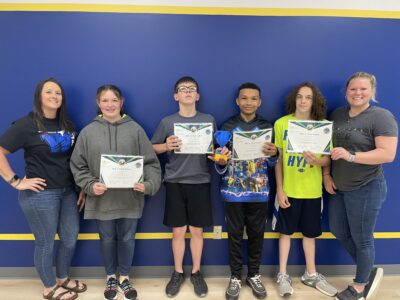
"Wildcat Green Team 4" -- one of four teams at the school competing in the "Plant The Moon" challenge for NASA -- was awarded the West Virginia State Level Experiential Best in Show Award for Plant Growth. Members of the winning team were Megan Wheeler, Devon Quinn, Ivan Rodriquez and Michael Kuthy.
The project involved students in grades 6-8 taught by Jenny Craig and Reiley Parker. Their assigned mission from NASA was to find a way to grow vegetables in soil void of nutrients much like you would find in a lunar environment.
There were 700 teams participating in "Plant The Moon" from across the nation, according to Craig. The challenge is in preparation for NASA's "Artemis Mission: Return To The Moon" planned for next year.
The students raised their plants in regolith, an earth-made substance supplied by NASA meant to be similar to the dirt found on the moon. The students engaged in activities and experiments pertaining to the project for eight weeks beginning at the start of March and concluding at the end of April.
Team 4's focus was on testing the effect of light on their plants growth, Craig explained. They explained their experiment and their hypothesis in a preliminary video submitted to NASA.
The students had multiple pots, and filled half of them only with regolith. The others were filled with a 50-50 mixture of regolith and regular earth soil.
Red Russian kale was planted in all the pots, which were placed in windows at the school. Some of the plants received four hours of natural light a day, some eight hours and some 12 hours.
Team 4's hypothesis was that the plants with a mixture of regolith and earth soil would grow better, and that those receiving the most sunlight would grow the best.
It turned out they were half right, Craig explained.
The plants in the hybrid soil did grow better, yet those getting the most light didn't grow the best because the sun dried out the soil, she said. This was all detailed in the students' weekly report submitted to NASA, in which they explained their observations and summarized results.
They were exposed to many skills along the way, Craig continued. To start, the students had to learn video production and editing to send their beginning and ending reports to NASA.
They next discovered all NASA missions have a team patch designed, and they utilized the Canva online graphic design tool to accomplish their own. The middle school teams were challenged to design a patch that represented their school, their state and their experiments.
They learned about NASA's Artemis lunar base camp plans and designed their own digital base camp using Google Slides.
They discussed the members of the upcoming Artemis Mission, and found out Christina Koch would be the first woman to land on the moon; and Victor Glover, first person of color.
A lesson on famed West Virginia-born mathematician Katherine Johnson and her contributions to the space program followed.
The students also learned about food and food safety on the International Space Station as each group was challenged to create daily menus keeping in mind nutritional needs, taste, and food safety, according to Craig.
Team 4 learned they were winners and were presented with a trophy on May 19 during a ceremony at the school.
"I would love to do this again. It was a great project," Craig said. "It taught them a lot of responsibility. They became good at making a scientific hypothesis and recording data. This project incorporated so many things - reading, social studies, math, writing, digital design, and nutrition. It gave them a sense of pride."