
Wheeling Native Part of 3D Printing Research at WVU
Trending
Research from West Virginia University students and faculty into how 3D printing works in a weightless environment aims to support long-term exploration and habitation on spaceships, the moon or Mars.
The group conducting that research includes a Wheeling native, Ronan Butts.
Extended missions in outer space require the manufacture of crucial materials and equipment onsite, rather than transporting those items from Earth. Members of the Microgravity Research Team said they believe 3D printing is the way to make that happen.
The team's recent experiments focused on how a weightless microgravity environment affects 3D printing using titania foam, a material with potential applications ranging from UV blocking to water purification. ACS Applied Materials and Interfaces published their findings.
"A spacecraft can't carry infinite resources, so you have to maintain and recycle what you have and 3D printing enables that," said lead author Jacob Cordonier, a doctoral student in mechanical and aerospace engineering at the WVU Benjamin M. Statler College of Engineering and Mineral Resources. "You can print only what you need, reducing waste. Our study looked at whether a 3D-printed titanium dioxide foam could protect against ultraviolet radiation in outer space and purify water."
Necessary equipment includes shields against ultraviolet light, which poses a threat to astronauts, electronics and other space assets.
"On Earth, our atmosphere blocks a significant part of UV light -- though not all of it, which is why we get sunburned," Cordonier said. "In space or on the moon, there's nothing to mitigate it besides your spacesuit or whatever coating is on your spacecraft or habitat."
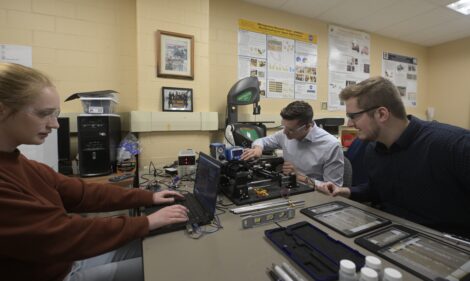
Butts, an undergraduate, led experiments in contact angle testing to analyze how changes in temperature affected the foam's surface energy. Butts called the research "a different type of challenge that students don't always get to experience," and said he especially valued the engagement component.
"Our team gets to do a lot of outreach with young students like the Scouts through the Merit Badge University at WVU. We get to show them what we do here as a way to say, 'Hey, this is something you could do, too,'" Butts said.