
Wheeling Officials Explore Ways to Maximize Land Value
Trending
WHEELING - Officials in the city of Wheeling are looking at ways to maximize the potential of land use in the community to get the best return in the future of investments being made today.
This week, members of the Development Committee of Council listened to a remote video presentation from Asheville, N.C.-based consultant Urban 3. The in-depth study conducted in Wheeling provided a per-acre analysis on the taxable value of the land.
Urban planning expert Joe Minicozzi founded Urban 3 as a tool to explain and visualize market dynamics created by tax and land use policies in different communities.
"Asheville achieved the highest debt per capita in the United States by the 1930s," Minicozzi explained. "We basically fell on our face. When the depression hit, we never really got out of it until the 1990s or 2000s."
But Asheville underwent a renaissance over the past 25-30 years through thoughtful investments and by maximizing the value of its assets in land and property. Today, Asheville’s tourism economy is going "gangbusters," Minicozzi said, noting that Wheeling is poised to take advantage of its many assets, as well. "The architectural quality of the community makes it unique. You have strong shoulders that you stand on."
He said buildings in Wheeling - many of which have been around for 100 years or more - can be rehabilitated and reused. Minicozzi indicated that big box retail buildings are often designed to depreciate in value over the years and are built for one use by the business that built them. Some big box retail buildings have an expected lifespan of as little as 15-20 years.
Historic buildings have the ability to bounce back and offer a new use, a new revenue source and potentially more value per acre.
"It’s like the gift that keeps on giving," the urbanist said. "A lot of American cities don’t have these jewels the way that you do. This is really an important asset in your community. Small buildings can have a big impact."
Minicozzi noted that large retail outlets undoubtedly contribute to a community’s tax base, but in terms of land use, a sprawling commercial retail site that generates $700,000 per acre should be compared to a downtown building on a much smaller footprint that generates $3.4 million per acre.
"We don’t talk about cars by miles per tank," Minicozzi said as a comparison, noting that the miles-per-gallon figure is what’s important, not the size of a vehicle’s gas tank.
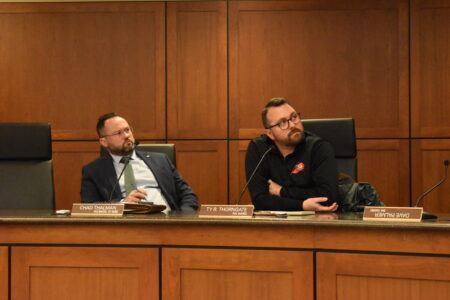
"I think it’s important when we’re looking at development and when we’re looking at land use that taxpayers are getting the biggest bang for their buck," Wheeling Vice Mayor Chad Thalman said.
"Downtown redevelopment helps everybody," Minicozzi said, noting that Wheeling’s downtown area accounts for a fraction of the total amount of land in the city and in Ohio County, but it accounts for a much larger portion of the overall tax revenue generated for both entities. Downtown takes up 1 percent of the city in terms of space, but is producing 7 percent of the city’s taxes. It makes up 0.1 percent of the county’s land area, but produces 4 percent of the county’s property taxes, Minicozzi explained.
"That’s a good ratio of productivity," he said. "The city takes up about 7 percent of real estate of the county, but is producing about 37 percent of the county’s property taxes. It’s because of the density of what is in the downtown."
The county would benefit from shared investments in Wheeling’s downtown, Minicozzi added.
"What’s good for downtown is great for the city, because it’s like a fertile garden of wealth," he said. "But it’s not only good for the city, it’s great for the county. What does the county do to invest in that asset to get its yield like this? It’s worth collaborating with the county, as they are in position to reap a great return on investment there.
"The downtown - in the state that it’s in right now - is actually still doing alright. It’s still potent. The good sign here is you can bring that back because those buildings are still here - that potency is still there. You have an incredible downtown that just needs some polish."
Minicozzi recommended that the city consider filling in vacant parcels and continue working with private investments into residential development such as cottages in single-family residential areas.
The city is currently under contract to developed the latest 10-year update for its comprehensive plan, a documented long-term strategy used for zoning and for planning a municipality’s growth as it relates to land use and other regulated policies