
Trending
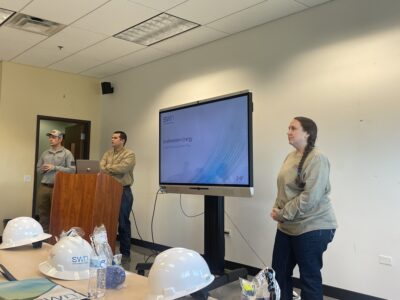
Leadership Wheeling participants got an inside look into how the second largest natural gas producer in the country powers homes nationwide during a lecture and well pad tour.
The leadership from Southwestern Energy who led Tuesday's presentation focused on explaining the technical work of the company's drilling process in layman's terms for their audience.
"A common misconception is that when people say gas, they're referring to gasoline, which is a product of the oil that we produce," said SWN Operations Foreman Corey Schilling. "When we say gas, we're referring to natural gas."
SWN Operations Engineer Stanley Churchwell elaborated that this means the price for gasoline one sees at the pump is not caused by SWN. The company acts as a "farmer" of natural gas by pulling the product from the ground.
"We're pulling natural gas out of the ground and getting it to the midstream companies who process it and send it further down the line," described Churchwell. "It costs money for us to process the gas and get it to market, but we're not the ones driving that cost you see at the gas station at the end of the day."
Churchwell outlined that the drilling the company performs at a single oil field will provide 30 million cubic feet of gas to serve the energy needs of 45,000 homes for a month.
The economic impact of the company in the area is vast, with $10-20 million going into the creation and production of each oil well, according to Churchwell. SWN contributes $545 million in state and local taxes and has 367 employees.
Apart from an overview of the basic ins and outs of the company, the SWN employees also provided an overview of their drilling process.
Churchwell explained drilling begins with a geologist selecting a well site. After an extensive approval process that includes receiving permission from landowners, the site can be prepped and drilling can begin.
Modern drilling technologies allow SWN to drill up to two miles below the earth's surface and two miles horizontally from there, outlined Churchwell. This deep drilling allows the company to unlock more oil and natural gas reserves.
"Once drilling is finished, the well is completed through a process known as hydraulic fracturing or fracking," outlined Churchwell. "This technique is used to create or restore small fractures in the rock formation to stimulate production from the well."
After drilling and fracking are completed, the well is prepared for production. Churchwell explained the preparation for production includes running tubing down the deepest part of the well where oil and natural gas will be extracted from. The tubing is then connected to local pipelines and storage units to collect the natural gas and oil.
SWN Health and Safety Supervisor Matt Boggs Field explained employees at a well pad will work 50 to 70 hours a week, sometimes during extreme weather conditions.
"In wintertime this February, our guys were working in negative 15-degree temperatures," recalled Boggs.
However, Boggs outlined that despite the tough conditions and long work hours, compared to other industries, the number of injuries per million hours worked at an oil and gas extraction site is lower than at a coal mine or bookstore.
"Our injury rate per million hours worked is on par with shoe stores," added Boggs. "As dangerous as our industry is with many moving parts and high-pressure areas, we encourage our workers to stop, pause and reassess if something doesn't feel right."
Churchwell advised the group to do the same and "speak up if something doesn't feel right" as they headed out to tour one of the company's oil rigs. Apart from following the safety protocols of SWN employees, Leadership Wheeling participants also suited up in goggles, hardhats and steel toe safety covers.
The tour of the rig served as a deeper look into the work an SWN employee performs at a rig. SWN Community Relations Manager Stephanie Paluda emphasized that "no employee is stopping what they're doing because we're here."
"It's a great opportunity to not only learn about what we do but see a day in the life of an employee," said Paluda.