
Soldier From Steubenville Laid to Rest After 80 Years
Trending
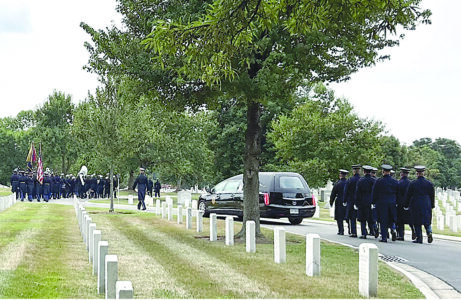
On July 25, the remains of Army Tech Sgt. William F. Teaff were laid to rest at Arlington National Cemetery, a little more than 80 years after Teaff, a Steubenville native, died while serving in World War II.
Occurring roughly two years after the soldier's remains were positively identified by the Defense POW/MIA Accounting Agency, Teaff's funeral was conducted with full military honors. Present were 16 family members who never knew him but were deeply moved by the ceremony and remembrance of their forebear's sacrifice.
Teaff's granddaughter and nearest of kin, Michelle Lesutis, recalled thinking during the funeral: "They are doing all of this for my grandfather, and without my grandfather, none of this would even be happening. ... We're lucky to see this. It's a once-in-a-lifetime event."
Teaff was a radio operator assigned to the 351st Bombardment Squadron, 100th Bombardment Group (Heavy), 8th Air Force. During a bombing mission on March 6, 1944, Teaff's B-17 Flying Fortress was shot down by German fighters over the Netherlands. Teaff and the crew, apart from the pilot, bailed out before the plane exploded in midair.
Captured, Teaff and several crew members were brought to Stalag Luft 6, a prisoner of war camp in Heydekrug, Germany. Teaff would die at the age of 26 on July 10, 1944, while receiving medical treatment for diphtheria in the nearby village of Macikai, Lithuania. He was one of only three Americans to die in that camp.
Following the war, the American Graves Registration Command -- which searched for and recovered the remains of American personnel in the European Theater -- could not recover the three Americans' remains in Stalag Luft 6 due to post-war border shifting that left them deep within Soviet-occupied space. Despite AGRC providing information to the Soviet government, the remains still could not be found, and Teaff was declared non-recoverable March 25, 1954.
When Lithuania became independent in 1992, Teaff's case was reopened. Using dental and anthropological analysis, Teaff was accounted for by the DPAA on April 20, 2022, and the U.S. Army Human Resources Command's Past Conflict Repatriations Branch set to work locating Teaff's primary next of kin.
Michelle Lesutis, Teaff's eldest grandchild, and her sister, Amy Sleeman, both remember being shocked upon hearing about their grandfather's being accounted for, believing the calls to be a fraud. But when officials were able to recall so much historical information, reality began to set in for the sisters, who both reside in the Pittsburgh area.
William Teaff and his wife, Ruth, were married just two years before he enlisted in the military, Lesutis said. The two shared a young daughter, Patricia Ann, who would later become Lesutis and Sleeman's mother.
Teaff's wife and other immediate relatives have since died, and Patricia Ann Kramer died about 17 years ago from cancer. Herself being a toddler when Teaff died, Kramer had little memory of her father.
Still, Teaff's story lived on, even after his wife moved to Pittsburgh, remarried and had three more children. The family has kept a photo of Teaff with his flight crew and their aircraft, the Lucky Lee, as well as a box full of letters Teaff sent to his wife while serving.
"He was pretty romantic," Sleeman said, based on the letters she'd read. "He would ask about my mom, who was the baby at the time. It was typical of what we think of when a soldier is overseas, him pouring his heart out and realizing what's important."
Lesutis added, "It sounds like he was very loving and very caring and missed the heck out of my grandmother."
The family also was contacted by an individual from the Netherlands who's part of an adopt-a-soldier program, members of which pray for and bring flowers to the graves of fallen World War II service members. The individual assigned to Teaff excitedly called the family about Teaff's identification and noted that Teaff's name on the Walls of the Missing in the Netherlands American Cemetery in Margraten will now be marked with a rosette to show he's been accounted for.
After much consideration, the family decided to honor Teaff by having his remains interred at Arlington cemetery.
Teaff's eldest great-grandson, Zach Lesutis, is an Army staff sergeant at Fort Campbell along the Kentucky-Tennessee border. He was invited to be the special escort for Teaff's remains during their transference from Omaha to Washington, D.C. -- an opportunity Lesutis called a "huge honor."
Come the funeral day, Michelle Lesutis and Amy Sleeman attended with their children and grandchildren, along with an aunt who is the wife of Patricia Ann Kramer's step-brother. Michelle Lesutis recalled feeling overwhelmed and inspired during the service, noting, "The respect for my grandfather from all these men and women in the military who didn't even know him, going through the whole entire ceremony, was awesome."
A band processed with the family and the hearse, and cemetery visitors stood respectfully as the procession traveled by, Sleeman recalled. Lesutis and Sleeman were presented with a folded American flag, followed by a 21-gun salute that left more than a few people tearing up.
"It's a really inspiring story that (Teaff) had," Zach Lesutis said, "and it was a huge sacrifice that he made. Knowing especially how dangerous being a bomber in World War II was at that time made the service a little emotional."
Although not presented that day, the family received Teaff's medals, which include the Purple Heart, Air Medal with Oak Leaf Clusters, POW Medal, Army Good Conduct Medal, European-African-Middle Eastern Campaign Medal with a Bronze Star, a World War II Victory Medal, Presidential Unit Citation, Army Aviation Badge and Honorable Service Lapel Button.
Sleeman acknowledged the military and funeral organizations that made the day "immaculate."
"It was breathtaking," she said. "There were moments when I was really trying to slow everything down to imprint it on my memory and realize who (Teaff) was."
Sleeman also recalled a moment that held religious significance in her eyes -- when the hot and dry day suddenly turned to rain as soon as the funeral ended.
To Michelle Lesutis, the whole situation was a reminder about how unexpected tragedies can bring about good in the end. While at the visitation, Lesutis stood before Teaff's casket and prayed in thanksgiving for her life and her family, which wouldn't exist without her grandfather.
Without knowing that's what she'd prayed for, Lesutis' aunt reportedly told her later: "Michelle, do you know that if your grandfather hadn't passed away the way that he did, I wouldn't know you, and I wouldn't have my family because (my husband) would've never been born."
"Not that we wanted him to pass, of course," Lesutis said, "but we think God has his plan, and we have to just believe in that plan."