
Union Local School District Takes Out $2.6 Million Loan for Operating Expenses
Superintendent Says $30 Million in Needed Repairs on the Horizon
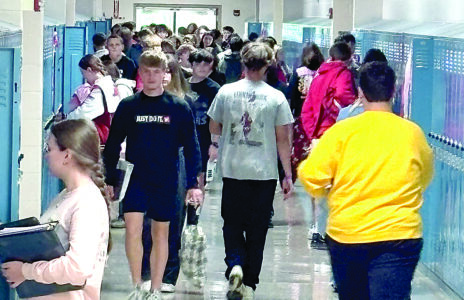
Union Local School District students walk through the hallways between classes. The district has received a $2.6 million tax anticipation note loan to help with general operating costs. (Photo Provided)
Union Local School District received a $2.6 million tax anticipation note loan from Belmont Savings Bank, which will be repaid from the expected $4.7 million to $4.9 million tax settlement the district will be receiving in March.
Superintendent Zac Shutler said that the loan will only be used for general operating costs.
“In the past and as well as presently, the district has done a great job managing the budget, but we can’t continue to operate effectively and provide the services that we do to our students at what we’re currently bringing in, which is the lowest millage in Belmont County,” Shutler said.
He added that the district needs a three-mill, five-year permanent improvement levy to address $30 million in essential repairs, including roofs, HVAC systems and electrical upgrades. The levy would help maintain the district’s low millage rate and ensure local control.
“There’s $30 million in essential repairs that have to take place at some point in the near future, from roofs being replaced on all three buildings to HVAC systems being replaced in all three buildings, to the electrical capacity and electric efficiency being upgraded to 2026 expectations, to plumbing to asphalt and sidewalk repair,” Shutler said.
In the spring, the 3-mill, five year permanent improvement levy will be back on the ballot and Shutler believes that if it doesn’t pass the district will once again have to have serious conversations about how it plans to keep the school open for the future.
He added the loan will bridge the gap between the fall and spring tax settlements the district receives.
Shutler said that the TAN loan is a safe and secure loan that’s protected by Ohio Revised Code.
He added that he believes former superintendent Ben Porter’s original bond planwould have been the cheapest option in the long run.
“It was expensive, but that was actually the cheapest way to get everything done. And the reason why is that, consider it like a house loan. It might be a 25 year bond, the rate is locked in, the district gets to borrow all of that money right up front, and everything gets fixed, say, in a span of three years at whenever the bond was on there. Once it’s paid off, it goes away and everything gets upgraded, ” Shutler said. “So even though it’s expensive right away, long term, that’s the cheapest option. The community voted that down. It was a big ask and nobody’s debating that. It would have taken our millage pretty high right off the jump.”
He added that after the 8-mill bond failed, the district sent surveys to residents and held public meetings to try and scale down to just the essentials. What came from those meetings and community discussions was the 2-mill permanent improvement levy that district residents voted down in November.
Shutler said that he believes the district needs a continuous levy which would ensure a permanent stream of funding.
“The reason why a continuous levy is important is that when we go to borrow money, everything’s just scale. If you go to borrow money and you don’t have a job, or you tell them ‘hey, I might lose my job in three months,’ how much are they going to let you borrow? So when we have a continuous (permanent improvement) levy, we can go to the bank and say we’d like to borrow $15 million which would get the roofs done, the HVAC is done, and they’re going to say ‘yes,'” Shutler said. “We understand finances are personal and finances are complicated. We understand that. I understand that. But at the same time, this is a need for the district. It’s not a want. We’re not asking to put in athletic facilities with it. We’re not asking for a lot of fancy things. We’re talking about roofs, HVAC, plumbing, electrical capacity, safe sidewalks and safe parking lots for people who come and visit.”
He added that the goal is for the district to be the best value for Belmont County, and believes – even with this added millage – the district would still be able to have the lowest millage in Belmont County.
“We can still do it at the best value, but we can’t do it at these current rates. And I just want to reiterate, at some point we’re not going to be able to do it at these current rates. And we really need to start looking at what happens next,” Shutler said. “What could happen next is, and it’s not immediate – I don’t want to press anybody’s panic button – but in five, six or seven years, when the HVAC will completely go down and we don’t have $8 million to replace it, we’d probably have to start looking at consolidation and then we lose control of the local sense of this.
“I think that’s what people need to understand is that we can still be the cheapest rated district in Belmont County, and we can still be the cheapest and provide a great service, but not at the rates that we’ve been stuck on for a long time.”
Community
West Virginia Board of Education Sets Emergency Meeting To Consider Intervention in Fiscally Strapped Hancock County Schools
‘Shot in the Park’ Archery Tournament Starts Today at The Highlands
TRIADELPHIA — High school archers from throughout the region will take their “shot in the park” today and ...
Union Local School District Takes Out $2.6 Million Loan for Operating Expenses

Election Filings for Jan. 13-15
Weirton Council, Water Board To Clear The Air With Work Session
Following recent comments about transparency in the operations of the Weirton water system, Weirton Council and the ...
Belmont County Sheriff Says Bellaire Drug Trafficking Probe Nets Five Arrests
Detectives with the Belmont County Sheriff’s Office Criminal Interdiction Unit assigned to the Attorney ...