
Murals Lost As Steubenville building Comes Down
Trending
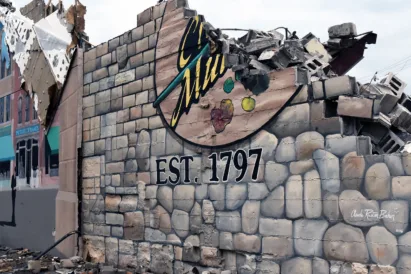
STEUBENVILLE -- The old Elks Lodge in downtown Steubenville and two murals that once graced its exterior walls have both been reduced to rubble.
The building, located at the corner of North Fifth and Washington streets, was purchased by the College of St. Joseph the Worker at an auditor’s sale after years of severe water and structural damage. The roof had leaked for years, there was an inch or two of water in the basement and the building was filled with the smell of mold. Having stood vacant for an extended period, it also became a target for vagrants looking to steal copper pipe.
"It was putrid," said Mayor Ralph Fletcher, who walked over to watch the demolition. He said the stench was overpowering even from a distance and made him physically ill.
"I was about 20 yards away -- there was an intense mold and mildew smell as it was coming down. It was so bad."
But removing the dilapidated building also meant losing two of the city’s vaunted murals -- the 1897 Centennial Arch, painted in 1992 by Eric Grohe, and the Tuskegee Airmen mural, painted in 2019 by the late Claude "Rusty" Baker and refurbished a year ago by artist Kyle Holbrook.
Holbrook has made no secret of his disappointment over the mural’s destruction.
In a statement released Tuesday, Holbrook said, "No one contacted me. I received no written notice and was given no opportunity to protect or preserve my artwork before demolition began."
Holbrook said the federal Visual Artists Rights Act affords important protections to creators of qualifying works of visual art, "including certain rights concerning the destruction of their artwork." Federal law also establishes specific provisions involving artwork incorporated into buildings, including, under certain circumstances, written notice and a 90-day period during which an artist may have an opportunity to remove or preserve the artwork.
"This isn’t about whether the building should or shouldn’t be redeveloped," he said in his statement. "This is about the rights of the artist. If I had been properly notified, there could have been a conversation about preservation, documentation, removal or other options. Instead, I found out after portions of my artwork had already been torn down."
Chad Rosamont, vice president of finance for St. Joseph the Worker, said the college has worked to preserve historic buildings in Steubenville and has successfully renovated several properties downtown. But, he said, the Elks building was beyond saving.
"We are disappointed to lose these murals on the Elks building as they were an important part of the City of Murals Project," Steubenville Visitors Center Executive Director Paul Zuros said. "We had hoped that the murals could be saved and met with the owner toward that end but were unsuccessful."
The City of Murals program, now overseen by the Visitors Center/Historic Fort Steuben, has been a community project since 1986, when the first mural was painted.
"The project, which we inherited and decided to continue, was intended to be a driver for economic development, revitalization and to bring tourism to Steubenville," Zuros said. "We believe this program is still very vibrant and successful."
Zuros said it is unlikely the Visitors Center will be able to afford to recreate either mural.
"The loss of these two murals was unexpected, so there are no plans to replicate the murals currently due to lack of funding," he said. "There is a need also to restore many of the other 22 murals in the City of Murals program."
Zuros said the committee considers several factors when looking for potential locations for murals, including the condition of the wall and whether it is capable of supporting a mural.
"We don't generally have access to the inside of the structures," he said. "We also look at location, whether the site is in a visible location so visitors from out of town can appreciate them, and whether the owner is willing to have a mural on their wall."
"When the Centennial Arch mural was painted 34 years ago, the Elks were still using the building and there was activity and use in that structure," he added. "In 2019, the Tuskegee mural was added to the building, but the building was owned by an individual who gave permission. I was not part of the decision-making process for those murals, so I couldn't speak to it at that time."
Holbrook had called for an "immediate halt to demolition of what's left" of the building "while his rights under federal law and options for preserving what remains of the artwork are addressed."
Those hopes ended Wednesday, however, when the remaining walls bearing the murals were demolished.
A statement from the College of St. Joseph the Worker was not received before press time.