
Sunday Sit-Down: Wheeling Native Matt Smith, Dean and Director of The Ohio State University at Newark
Trending
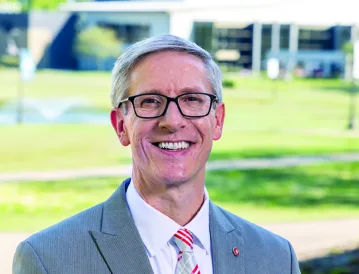
Editor's note: On Tuesday, about 100 miles west of Wheeling, students attending The Ohio State University at Newark will be starting their first day of the 2026-27 school year. Leading that campus is Matthew Smith, a Wheeling native, first-generation college graduate and one of the hardest workers in higher education. Smith discusses his life in Wheeling, his higher education career and more with us today as he joins the Sunday Sit-Down.
You're right at the start of your third year leading Ohio State University's Newark campus. What has surprised you the most in your first two years here about the campus and the community?
SMITH: John, I've been at five different higher education institutions in my career, and one of the most pleasant things I've discovered about Ohio State Newark is the connection it has to its community. I say that because I've literally been at institutions where the town versus the gown was a real thing. There was tension and division between the two entities. This is the polar opposite of that. The town and the gown are interlaced with one another and completely and totally supportive of each other.
It's been a real pleasant experience to not just be welcome to this campus, but to be welcome to this community, and to be looked at as the envoy of Ohio State in Licking County. …
We had the good fortune to bring Ross Bjork, the athletic director of Ohio State, here for a Rotary event. You would have thought I had delivered to them the President of the United States. That was great fun. Ross is phenomenal. He's a great speaker. He's a great person to bring into a space. But the connection, right? People were genuinely excited to see him, to know that Ohio State's engaged with them in this county.
And this county invests in this campus. Every one of these buildings has been built in part because of fundraising that has occurred within Licking County. We know our community is there for us, that they support us in ways that aren't just, "Hey, it's great! It's Ohio State." It's, "We're investing in Ohio State. We want to see it succeed here in Newark."
What are your top three priorities for the campus here over the next five years?
SMITH: Students are always our top priority. We have a mission to keep education accessible and affordable. So one of the things I like to talk to prospective families about is the fact that the regional campuses are significantly less expensive than the Columbus campus. We want to make higher education affordable to them.
Unlike the Columbus campus, we are open access. So if you have a high school degree and an interest in getting a higher education, we can assist you. We also have an incredible set of tools that have come into our possession in the last year. Columbus is committed to something called the Regional Campus Commitment, which says if a family has demonstrated need after filling out the FAFSA and makes less than $100,000, we will make up the difference in tuition.
So essentially, for those families in that particular financial situation, a college education can be absolutely affordable because it's effectively free, and we're really proud of the fact that we are continuing to pursue students in this way.
So that's first priority: students.
Second is we have the blessing of being a residential as well as a commuter campus. We currently have dormitory and apartment space to accommodate about 300 residents. We have demand consistently across the years for more residential experiences. Our waiting list runs anywhere from 160 to 250 names per year. So these are students we cannot accommodate in terms of providing them with a residential experience.
Building additional housing for them is a top priority. If not only to satisfy that, but we know that residential students tend to be more successful in college because they have community, because they have support, because they're here and they're focused on their education. We love our commuters. We'll continue to support them, but the more of them that we can make residents, we want to try and facilitate that.
Third thing is, I want to continue to build good relationships with the Newark community and to create on-ramps for our students to discover opportunities in the community itself. We have initiated a program called the Licking County Learning Lab, which is about introducing our students to some of the organizations in our community.
We're starting small with places like the Dawes Arboretum, The Works Industrial Museum, and the Ohio History Connection, which manages the earthworks from the Hopewell people. And our hope is that as we continue to grow that particular model, we'll have our students discovering and understanding what Licking County has to offer in terms of a place that they might want to come and practice their craft once they have degrees in hand.
Colleges across America are facing enrollment challenges with the demographic cliff. What makes you optimistic about Newark's future?
SMITH: Central Ohio is experiencing some of the most dramatic growth in the country. Certainly, it is the center and locus of growth in the state of Ohio, and we are beneficiaries of people wanting to be a part of Franklin, Licking and Delaware counties.
As more people find opportunities in Central Ohio, it means more people will need education in Central Ohio. As those families relocate, as those students start to look for opportunities to better themselves and increase their credentialing, we are here to provide that open-access opportunity for them.
Economically, we're seeing a lot of that kind of possibility moving forward. The other thing is this is a phenomenal resource itself. The campus is fantastic. Twelve buildings. I taught on regional campuses early in my career. They tended to be one building built in block style. This campus looks like you're going onto a small private liberal arts college, and I love the fact that we are able to accommodate students with residency options, with programming options, with activities, with career services. We have most everything you'd find at a traditional university setting, but we've got it at a much smaller scale.
So whereas Columbus has 60,000 students, we have just under 3,000 students, and I think we're able to maintain that high-touch experience for students, even though we're a part of this phenomenally large and well-resourced institution.
What shifts are you seeing in student demographics, particularly among first-generation students and adult learners here at the Newark campus?
SMITH: It's really interesting to me that we tend to attract a very traditional student, and so most of our recruiting happens at the high school level, bringing students in directly from that experience. We are partnered here with Central Ohio Technical College, and they are more keen to recruiting people in their 20s, 30s, perhaps coming back for a second career, wanting to do something. So, we have a wonderful dynamic on this campus because we can service a more traditional student; they can service a more non-traditional student in pursuit of higher education.
Our student body is the most diverse student body at Ohio State, and I say that with some confidence. And even despite the fact that Columbus is so much larger, about 40% of our students identify as a non-majority group, and so we're pulling in all kinds of populations that are looking at higher education as a way to break into or break free from certain economic conditions, and we're pleased to be able to provide that.
I think our faculty and staff established a norm here that we are open and accepting and welcoming to all kinds of students, and that message, I think, is getting back to communities, particularly among immigrants or first-generation students. This is a place where you'll feel connected. This is a place where you'll feel welcomed.
What do you see as the biggest barriers here in Central Ohio that still prevent students from pursuing higher education?
SMITH: I think the biggest barrier is a perception they cannot afford it, and I say that very carefully. It's the perception that they cannot afford it. And so students think that, OK, I can't spend that kind of money to get a credential. I need to go make some money first.
With initiatives like the Regional Campus Commitment, I think that we're trying to lower those barriers and the perception that education is out of reach for people.
We, like most other institutions across America, are encountering a new phenomenon for us, which is the cultural shift in doubting the value of postsecondary education. It's something that's challenging all of us to re-frame and re-state what that value is.
Certainly, on an economic level, we know that people with college degrees will earn more in their lifetime than people without. That's still the case today, but we also know there's that intangible difference it makes in being an educated person, being a civically engaged person, being someone who has the ability and the agency to make decisions that allow you to break free from whatever geographic or sociocultural constraints might limit you with only a high school diploma.
Let's talk about the campus' role within the broader community. Licking County is arguably one of the most economically dynamic places in the Midwest. Intel, Meta, Google, all these investments that have happened over the past few years. How and where does Ohio State at Newark fit into that story?
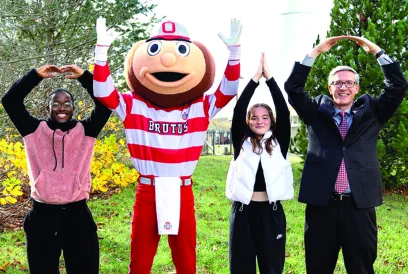
SMITH: The growth in Licking County is tremendous, and one of the things that we're very conscious about doing is we are trying to make sure that we are connected with these industries.
Quarterly, we host a luncheon for community leaders who are in these industries, our political figures, leaders at other nonprofits. We bring them in and we sit them down, and we talk about what our opportunities are, what our engagement activities are, and we listen to them for what they're interested in, what they need in terms of their workforce development.
So that dynamic process of exchanging with those other leaders, of bringing them into our orbit, of placing ourselves within theirs, is really a conscious effort on our part.
We just spent some time this summer reaching out to Anduril, and though that's not in Licking County, that's in southern Franklin County. We want them to know we're here. We want them to know that we're preparing students for the kinds of jobs that they're going to be offering in advanced manufacturing. We want them to think of us when opportunities for internships or opportunities to sponsor scholarships might come along in their sphere, because as any new developer, any new organization in the community is involved, we want them to know we're here to help service their workforce needs and be aware that our students are prepared to take on those careers.
Do you see opportunities to tailor programs specifically to these industries that can help fill the jobs that these companies will need?
SMITH: We are in the fourth year now of a new program called Engineering Technology here on the Newark campus, and the idea is to prepare the engineering managers of tomorrow. Our students take not a specific engineering track; they don't take just mechanical or just electrical. They take mechanical and electrical, and it's an add-on. Plus, they all take courses in teamwork and in communication and interpersonal relationships.
They're prepared to oversee manufacturing lines. They're prepared to work in teams. They're prepared to lead within these larger industrial settings. We'll graduate our first class at the end of this year. And we have a number of partners in and around Licking County who are eager and ready to take these students on as their new employees.
And right along that line is how do you balance being a traditional liberal arts college while also responding to those workforce demands? I think part of it is in thinking creatively about where you are preparing a workforce. Because the needs are diverse. It's not all engineering, although that's going to be a substantive portion of the future.
We're looking at adding a couple of new majors over the course of the next several years to our curriculum, and one is more squarely fixed in traditional liberal arts, and one is definitely in health sciences.
We're bringing to campus a new program in leadership that is born out of the College of Arts and Sciences, and it's informed by philosophy, by communication, by history, by a host of disciplines that provide would-be leaders with an understanding of the processes as well as the practice of leadership.
On the other side, we have a conversation going on with one of our partners in Columbus about bringing a medical laboratory science degree here. These are the folks who do the lab work at the hospital. We've got a great partner here in Licking Memorial Hospital. It'll be a phenomenal program when we get it started. We'll do the first two years of foundational education for the students. Columbus will provide online instruction in the upper-level courses in the field, and then Licking Memorial will actually become the site for their senior-year experiential learning.
I think what we're trying to do is build a portfolio of experiences and opportunities, building on the strength of the faculty we have, but also with an eye to the future of how we can serve the population that's going to be growing here.
Do you see Ohio State Newark playing an even bigger role in retaining local talent and preventing brain drain from Central Ohio?
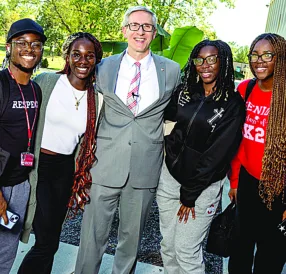
SMITH: It's kind of interesting, John, because when I arrived here, I assumed we served Licking County and maybe the contiguous counties. We have representation this academic year from 68 of Ohio's 88 counties in our first-year class.
We know that we have an opportunity to introduce these students to Licking County, to Central Ohio, to the opportunities that are here, and so being very conscious of that, we have a number of programs that connect our students to the community. One of the coolest, I think, is something called the LeFevre Fellows Program, which is a program for our sophomore-level students that introduces them to nonprofits in and around Newark. They have an opportunity to work with these nonprofits to understand the pressures of our homeless community, to understand the outreach that comes from United Way, to see the processes of living in and building community with one another in an urban setting.
I think that we're going to capitalize on this. We're going to continue to find ways to connect our students, even if they're just commuting in for the day, to see the community in which we're situated and the one in which we hope that they'll think more about becoming a part of.
Let's focus a little bit on the regional campuses. What role does this campus play in Ohio State's overall mission?
SMITH: Ohio State is a phenomenal institution. We are serving 60,000 students on the Columbus campus, and then another 5,000 students at the four regional campuses.
Columbus is an institution that is looking to be competitive nationally in higher education, and I totally respect that and appreciate how that is core to the direction that we're moving in. But we also want to be responsive as an institution to all the citizens of Ohio.
As a land-grant institution, in fact, it's written into our charter that we are there to service the state of Ohio. The regionals perform a very important function in that regard because we are open access. We allow people to come in and get access to higher education from the get-go.
If a student applies to Columbus and does not get accepted into those programs, they're introduced to the regionals, and what we tell students is very simple: come out, earn 30 credits with us, get a 2.0 GPA, and you can campus-change to Columbus and pick up with any program there that you're interested in.
We provide the foundational courses for any one of those 200-plus majors that we offer in Columbus. You're not even behind by coming out to the regional. We're helping you to get ready for that transformation and to make the trip to Columbus and be successful in those upper-level courses.
There's been the perception that branch campuses are just stepping stones to Columbus. What do you think of that narrative? Is that true?
SMITH: I've certainly heard that, and it was my experience at previous regionals I've been a part of. I think for a good number of our students, their eyes are squarely focused on Columbus, and they may look at us initially as the barrier they need to clear in order to get there.
I think what they find is we're a lot more helpful than they expected us to be, and a lot more welcoming. They find themselves kind of charmed by the regional campus experience because it is so supportive, it is so personalized, it is so focused on them. We have six majors you can complete in their entirety on this campus. We're hoping to add a couple more in the coming years.
There are a population of students who are either place-bound for whatever reason, or for whom Columbus is not attractive. The size and scope can be overwhelming to certain young people, and so they don't necessarily want to go to Columbus. We have a lot of students who try to split the difference in some ways. They know there are major courses they can only get in Columbus, but they might do their minor and their general education courses with us. …
I think there are people who are often surprised that they find that they really do like the regional campus experience, but we also want to support students who want to go into industrial engineering or biomedical science. We can't offer those upper-level courses at scale, and so anything we can do to help prepare students to be a success in Columbus, we want to.
Ohio State Newark has deep roots here in Licking County. In your opinion, what responsibility does this branch campus have to the community beyond simply educating students?
SMITH: I think the campus has built a model of being a good citizen in the community, and so there are a number of organizations in and around Licking County that we are active supporters of.
One example is Grow Licking County. Grow Licking County is the nonprofit agency that helps to attract businesses to Licking County. We're a partner with them. We believe in that mission, and the value of setting up students for potential careers is benefited by the fact that there might be even more careers here, even more job opportunities once they're finished with their degree program.
We see ourselves as really responsible for participating in the life of the community and giving back.
It's kind of a fun feature of this campus that we host the Newark fireworks every year, and so we welcome 20,000 of our neighbors to our campus to enjoy the 3rd of July because we celebrate the day before. We get 24 food trucks out here. We have concert bands perform for us. It is an amazing experience, but it is the way in which we see ourselves connected to and through that community.
Growing up in Wheeling, could you ever imagine someday sitting here leading an Ohio State campus?
SMITH: Absolutely not. You know, my father did not complete high school. My mother did complete high school, graduated from Wheeling High, wanted to go to college, but her family could not afford tuition and fees. The fact that their son would go to college, get multiple advanced degrees, find himself a college professor, and then have the opportunity to go into administration and ultimately lead a campus, that was far beyond any of our abilities to see as a possibility.
But it is a testimony, I think, to the power of education, right? Because I went and got my bachelor's, I could get my master's, I could get my doctorate, I could get a job as a professor.
Conceptualizing that, you know, 11-year-old Matt in Warwood, W.Va., would not have envisioned that someday he'd be blessed to be working at an Ohio State regional campus.
What did Wheeling and Wheeling Park High School teach you that still influences your leadership style today?
SMITH: You know, I think the thing that -- and I've met other people from the valley who have come out and found careers elsewhere -- I think the thing we all have in common is we have that solid work ethic.
My dad was the hardest-working person I knew. My mother worked for 40 years at a job. My siblings, my extended family, everyone understands the value of work, and if you want to achieve something, you're going to have to work at it to get to it.
I think that lesson was imparted at Warwood Grade School, at Warwood Junior High School, at Wheeling Park High School, at West Liberty State College. I saw that at every turn in the valley -- that hard work paid off, and I think that's what inspired me to just keep going.
As I got one degree and went to the next, it was like, if you keep working at it, you can do the next big thing and the next big thing. In some ways, I think that's why I got into administration.
I got to the level where I was a tenured full professor at a university, and I'm like, well, what's the next challenge? And so, in some ways, it almost hardwired me to be looking for challenges. What's the next thing I can do? What's the next hardest thing to take on? And I think I learned that in Wheeling.
How did West Liberty University help shape your career path?
SMITH: West Liberty really created the opportunity for me to think outside the classroom. One of the things that I often talk to students about is how you've got to get involved in college. If all you do is go to your classroom, you will get a college education, but it won't be nearly as meaningful as if you get involved in something along the way.
At West Liberty, I was on the campus newspaper. I got involved in student Senate. I did a few theatrical productions. I was on a committee. I got into the honors program. I did things there.
Half my education at West Liberty was what I learned in the classroom and the value I got out of the instruction I received there. But the other half, and perhaps the more enduring half, has been being involved in the institutions you're a part of, being involved in a community, growing, challenging yourself in ways that you would not if all you did was show up and sit in a classroom.
I value that very much, and I tell students, I don't care what you do -- do an intramural, join the newspaper staff, come out to a lecture -- but do something in addition to the coursework because that's the thing that's going to enrich the experience, and that's the thing I think that's going to be transformative to you because you're going to find who your person is, who you are, by expressing it in ways that aren't just absorbing knowledge or taking tests or building projects. It's doing things that really make you part of a community, make you part of an institution.
As you mentioned earlier, you're a first-generation college graduate from a normal family in Wheeling. How much of your own story influences the way you think about access and affordability for college students today?
SMITH: Tremendously so. I see myself in these first-generation students time and again.
We actually have what we call a learning community, which is an opportunity for first-year students to take classes together, to get support together, to come together as a community, and I'm very privileged to be asked to address them every year.
And I go and I talk to them about my journey and the travels, the way I got to where I am, and I see in them that hunger, right? That, like, I'm wanting something more, I'm wanting something better, and any opportunity I have to kind of fan that flame, I want to do it, and I want to show them it can be done.
There was nothing special about Matt Smith other than he got the break to go to college, that he got the break to go to graduate school, that he got the right--like, I got these breaks, but I put the work in, right? And you can do that too.
And if I can get that message across to students that once they're here, it's like, you can do it. If I did it, you can do it.
Is there something uniquely Wheeling about you you've carried through your career?
SMITH: When I think about Wheeling, I think about hardworking people who take care of themselves, their families, and their community.
I saw this modeled in the school system. I saw it modeled in my church. I saw it modeled in events like the Italian Festival. Time and again, what I saw was people taking care of one another, and I've always tried to reciprocate that in my roles, taking care of my family, taking care of my institutions, taking care of my communities.
Final question: Ten years from now, what do you think people will say was accomplished during Matt Smith's tenure at Ohio State University at Newark?
SMITH: Wow. This place was pretty good when I found it. I joke with my wife that my number one job is not to mess it up. That seems like a pretty low bar to clear because there are so many great things going on here. …
If you were looking for a metric, how would I measure that? How would I determine that? I think if we are more successful at not just attracting students, but helping them to progress through their education, that'll be the mark of our success.
I would really like to see them stay and finish their degrees. And if we are able to do that, whether that's here on our campus or transferring to the Columbus campus, if those numbers show improvement, I'll be particularly proud of what we've done.