
Wheeling’s Part In Steamboat History Detailed During Wheeling Rotary Club Meeting
Trending
WHEELING — Wheeling Rotary Club members learned Tuesday about the history of the Ohio River’s steamboats, their significant impact on the growth of the nation, along with the future of the river and its border states.
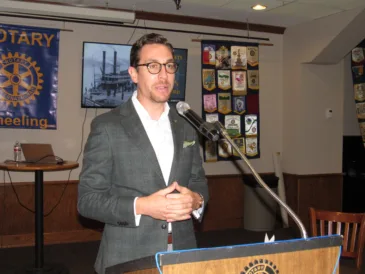
Clarington, Ohio, resident Taylor Abbott, who is executive director of the Ohio River Commission, provided rotarians with a history lesson on the steamboats and their impact on the Ohio Valley and beyond.
Abbott, an Ohio River historian and former treasurer of Monroe County, also designed Ohio and Mississippi River exhibits for the Kennedy Center.
Abbott spearheaded the creation of the Inland Waterways Academy, which is Ohio’s first dedicated Ohio River training school, slated to open in 2027.
Abbott said the Ohio River Commission is focused on economic and workforce development, recreation and tourism related to the river.
“The goal of the commission is simply to be a unified voice along the Ohio River,” he said.
He noted the commission represents 14 counties in Ohio, but also reaches across the river to work with West Virginia, Pennsylvania, Kentucky and Indiana officials.
“Because we all benefit equally from the river,” Abbott said. “It takes both sides of the river to work; that’s why we have bridges and we need to use them.”
He noted it is an exciting time for the river as there is much interest in maritime development on the federal level.
“From our standpoint we see the next decade as being one of the most crucial,” he said, noting the SHIPS Act recently passed the House and will likely pass in the Senate by year’s end.
He noted the act will provide funding related to river development, student training and ship building. Abbott believes there will also be an increase in plants, manufacturing and energy development along the river.
“This region is a powerhouse when it comes to energy, with the natural gas we have and the coal. … It’s really impressive. If you take those three states, Ohio, West Virginia and Pennsylvania, and combine them, they would be the third-largest gas-producing country in the world. That says something about our region that we don’t often get enough credit for. We need to capitalize on that.”
Abbott also talked about the history of the region as it relates to the Ohio River and the invention of the steamboat.
He said Robert Fulton developed the first steamboat, the Clermont, in 1807. It ran from New York City to Albany.
“Vessels like this is what expanded the United States at a rapid pace,” Abbott said. “And it all began with the age of steamboats.”
Fulton’s steam boat was the first to be able to go against the river current and make decent time.
“It was over 150 miles that this vessel covered in its voyage, and that was the first commercially successful steamboat trip in the U.S. and proved the viability of steam power,” he said. “And with that it changed the entire age and face of the country.”
In 1811, Nicholas Roosevelt and Robert Fulton built the New Orleans, which was the first steamboat to navigate the Ohio River. It started in Pittsburgh and powered south.
“That revolutionized everything because at that point your only movement of vessels was on the East Coast where most of the U.S. population was,” Abbott said. “That westward expansion really started in our region.”
Later on in 1816, Capt. Henry Shreve of Wheeling improved on the steamboat hull design. He made it flat with the sternwheel in the back so it could traverse the river.
“That allowed these steamboats to go in even 3 or 4 feet of water uninterrupted,” he said. “That’s a game changer and that all happened right here in Wheeling. So, take pride in the fact that inland river steamboats and their design and inland river towboats having a flat hull, and their propellers being no deeper than the hull, that all originated right here in Wheeling, West Virginia.”
Abbott said Shreve’s new steamboat left Wheeling “allegedly carrying the flag of George Washington from his days of the Revolutionary War.”
“If you look back at old newspapers, people were very proud to see this banner flying from a vessel as it came down the river,” he noted. “It was really an anomaly for pioneers and settlers in the region.”
Abbott said Shreve’s design also helped with an even more rapid expansion of commerce and development of the country. He noted a tragic and sad part of U.S. history is that these same boats were used to transport slaves. He said slaves were forbidden in Ohio, but were still being sold in West Virginia, including in Wheeling.
“It’s a part of history we have to acknowledge. … It’s a dark side of history that unfortunately plays into our history in this region,” he said.
Abbott said his third great grandfather worked as chief steamboat inspector in Wheeling in the late 1800s.
“Prior to that he served during the Civil War and he helped build some of the gun boats that eventually would go south,” he noted.
Abbott said the ironclad boats were used in battle on the Mississippi River during the war.
“That really brought things to a halt and ended the Civil War,” he said.
Abbott noted the Ohio and Mississippi Rivers were the first highway system as everything moved on them.
There were six shipyards, including one in Clarington, Ohio, that built thousands of steamboats. Some steamboats were opulent in their design and looked like fancy hotels on the inside.
Today, Abbott said there are two sternwheeler steamboats operating on the Ohio River, the Belle of Louisville and the Natchez. The Delta Queen is not operating at the moment. And the American Queen is facing being sold for scrap metal, he added.
In the late 1800s, Mary B. Green took over her riverboat captain husband’s company after he died. She already had experience navigating the boats.
“It was her company that would buy the Delta Queen steamboat that many of us who live along the Ohio River knew and loved. She actually passed away on the vessel in 1949,” Abbott said, adding she was the first female riverboat captain in the U.S.
“Some say her spirit still haunts the boat or protects it. I’m not much into that type of thing, but the story still stands,” he said.
The Wheeling Rotary Club is always looking for new members. The club typically meets at noon Tuesdays at WesBanco Arena in the lower-level club room. Wheeling Salvation Army Capt. Kevin Justice is the scheduled speaker for the Oct. 6 meeting.
For more information, one can attend a meeting, visit rotarywheeling.org, visit the "Rotary Club of Wheeling, West Virginia" Facebook page or call 304-280-6212.