
Opening Testimony in First Day of Kinney Murder Trial
Trending
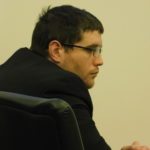
ST. CLAIRSVILLE -- The murder trial of David Carl Kinney saw its first day of testimony Tuesday, and it falls to the jury to determine if the fatal shooting of Brad McGarry, 43, at his Bellaire residence, was an act of self-defense or murder.
The answer hinges on what occurred during a span of about 16 minutes when Kinney, 31, of Brilliant, met McGarry at the house and they went inside.
Belmont County Chief Assistant Prosecutor Kevin Flanagan presented his opening statement, emphasizing Kinney's behavior after the shooting and his attempt to conceal the facts.
"Without a crime, you don't need the cover-up," Flanagan said. "David Kinney shot Brad McGarry two times in the back of head. From there, we see a tangled web. From there, we see deception on the part of the defendant to avoid detections."
Flanagan outlined his version of the facts of the case, saying Kinney and McGarry were in a romantic relationship, while Kinney was also married. Flanagan said the trial would illustrate some of the details by presenting the jury with text messages and phone calls between them.
On May 6 and May 7, McGarry was with family in Monroe County when he received a message on his phone and abruptly left.
"On May 7, he has conversation with the defendant," Flanagan said.
McGarry went to his Bellaire home on Wagner Avenue. Surveillance footage from the home of Bellaire Police Chief Michael Kovalyk shows both the victim's and defendant's vehicles, and when Kinney's vehicle leaves.
"After the act itself, the defendant fled the residence. He's caught on surveillance camera doing so, and now he needs the cover-up," Flanagan said.
"Now he needs to cover his tracks, so this is what he does: he goes home and gets his wife and his young daughter, and he puts them in the car," Flanagan said, adding that Kinney told them they were delivering a weed trimmer to McGarry. "This is part of the ruse. This is the deception now to avoid detection."
They arrived to find the house apparently disturbed, as if in a burglary. Authorities later received a 911 call from Cheri Kinney, his wife, who went into the basement while Kinney said he was searching the house, and there she found McGarry's body. Flanagan said the evidence in the case will include footage from law enforcement body cameras when they arrive close to 6:30 p.m.
"You will see how he played the grieving friend. You will see the deception," Flanagan said.
Defense attorney Christopher Gagin then gave his opening statements, maintaining the forensic evidence would uphold Kinney's claim that he acted in self-defense.
"David's actions after the shooting complicated this investigation, there's no doubt about it," he said. "It's the forensic evidence that's going to prove what happened during those 16 minutes. During those 16 minutes, Brad McGarry pointed a loaded gun at David, after David broke up with him. At the end of the day, this is a break up that went terribly, terribly wrong. It was Brad's fury that put David's life at risk by drawing the gun…It's David's reactions that we are going to look at in this trial."
Gagin outlined Kinney's and McGarry's relationship, which was kept secret from Kinney's family. Gagin said that while Kinney was conflicted, McGarry would eventually demand Kinney leave his wife.
"Being David's best friend wasn't enough for Brad," Gagin said. "David was heading to Brad's house to save the friendship, but end the relationship."
Gagin added that there was a separate issue where McGarry believed money had been taken from his house some weeks prior. He said this led to an argument in which McGarry pulled open his own drawers and disturbed his own belongings.
Gagin said the argument continued into the cramped basement, so that McGarry could obtain an overnight bag from his car.
He said a physical altercation then took place, where McGarry struck Kinney, who pushed him backward in the direction of a hot tub, where McGarry kept a .22-caliber pistol. He said McGarry picked up the pistol and brandished it threateningly, while Gagin said Kinney was unarmed at the time. He said the two men wrestled for control of the gun, and it was fired twice in very quick succession, sending one fatal shot and one non-fatal shot at McGarry.
Gagin said prior texts and messages between the two men do not indicate any building tension. In addition, Gagin said Kinney had planned to visit McGarry with his family to deliver a weed eater that day, and in his distress afterward he followed that schedule.
Gagin said Kinney was still in distress, and had not slept Sunday or Monday night before going to the sheriff's department.
"David does make up some of the worst stories you will ever hear," Gagin said.
Gagin said the forensic evidence will support Kinney's account of how McGarry died, and prove there is no DNA evidence that Kinney touched the drawer handles in the house. The jury will also hear a forensic psychologist's testimony that Kinney's irrational behavior following the shooting stemmed from acute stress disorder. He said he expects Kinney to testify in his own defense.
After opening statements, the jury heard testimony from Belmont County 911 Director Bryan Minder and a recording of the 911 call, as well as from Hank Martin, Bellaire police officer who responded to the scene, and McGarry's family members.