
House Committee Considers Bill to Create Intermediate Court of Appeals
Trending
CHARLESTON -- The chairman of the Senate Judiciary Committee crossed the hall Thursday to make his case for an intermediate court of appeals before members of the House Judiciary Committee.
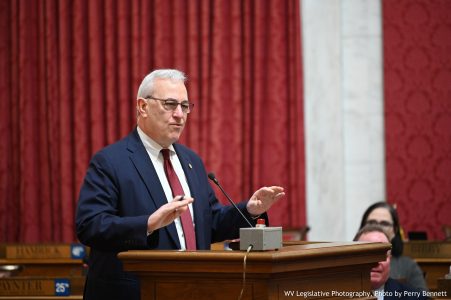
Sen. Charles Trump, R-Morgan, addressed the committee during a public hearing Thursday morning on Senate Bill 275 that would create an intermediate court of appeals.
Twenty-four people had registered to speak about the bill, though several donated their time to Trump, the lead sponsor of SB 275. Similar bills that have passed the Senate have wound up trapped in committee on the House side and Trump said he was pleased the House was considering the bill this year.
"Having a thorough, efficient, predictable system of justice and appellate review is good for all the citizens of West Virginia," Trump said. "I'm delighted that the House of Delegates is giving this bill consideration. I consider it to be one of the most important measures that has been or will be considered in the 2020 session."
SB 275 would create an intermediate court of appeals between the circuit courts and the state Supreme Court.
The proposed court would divide the state into northern and southern districts with elected judges. The court would hear appeals of circuit court civil cases, guardianships and conservatorships, family court cases and decisions made by administrative law judges, the Health Care Authority and Workers' Compensation Commission.
The state Supreme Court adopted a rule in 2011 where it provides a written decision for every appeal. Prior to the Supreme Court's rule change, three-quarters of all appeals that came before the justices were not heard, with the court issuing a no-reason refusal order instead. Trump said an intermediate court of appeals would help take the load off the state Supreme Court so the justices can focus on precedential cases.
"What we have since 2001 and the rule change that the Supreme Court has put themselves on a hamster wheel to issue an opinion in every single case, and it's not the highest and best use of their talents and skills," Trump said. "It should go back to a discretionary docket...giving that court the chance to address important issues public policy."
According to Trump, 10 other states do not have intermediate courts, all with smaller populations than West Virginia. According to the Senate Finance Committee, creating an intermediate court of appeals would cost $7.7 million starting in fiscal year 2021.
"There is a cost, but justice is not free. We have to invest," Trump said.
Trump was joined in support for SB 275 by several pro-business and legal reform groups, including the West Virginia Chamber of Commerce, the West Virginia Business and Industry Council, West Virginia Citizens Against Lawsuit Abuse, the U.S. Chamber of Commerce Institute for Legal Reform and the American Tort Reform Association.
Opponents of the bill included the West Virginia American Civil Liberties Union, Mountain State Justice, West Virginia Citizens Action Group, the West Virginia chapter of the National Association of Social Workers, the West Virginia AFL-CIO, and West Virginia Citizens for Clean Elections. Several attorneys spoke against the bill, including the West Virginia Association of Justice that represents more than 500 trial lawyers.
"We do not need an intermediate court in this state," said Kristina Whiteaker, president of the Association of Justice. "It makes no sense to create another layer of the court to hear (civil) cases."
Whiteaker said the Legislature should focus on helping the court eliminate the backlog of abuse and neglect cases. She said the intermediate court is a pet project for out-of-state groups wishing to tie up civil cases and force settlements.
"Out-of-state special interests are pushing for this court because it will delay justice in civil cases, ultimately reducing the value of claims," Whiteaker said. "If a case can be caught up in appeals for two to three years, injured people and small business will be forced to settle for less than what they're owed in order to avoid the delay and expense of litigation. That's the only reason for this court."
Two studies have recommended the state implement an intermediate court of appeals, one in 1998 under the late Republican Gov. Cecil Underwood and another in 2010 under former Gov. Joe Manchin – a Democrat – and chaired by the late U.S. Supreme Court Justice Sandra Day O'Connor.
Anthony Majestro, legislative chairman for the association, said those two reports are not applicable today.
"The docket numbers that motivated the prior recommendations are based on stale data," Majestro said. "If you look at this data from years and years ago, we did have a problem with our court. We had an explosion of workers' comp cases. We had an explosion of litigation, but our state's population has declined. Our state's litigations have declined. The data that made the court necessary before doesn't exist now."
Gov. Jim Justice called for the creation of an intermediate court in his Jan. 8 State of the State address. Mike Graney, director of the State Development Office, said the administration still supports the idea.
"We believe that this body, along with the Senate and Legislature in general, has done a great job of creating a greater business environment over the years," Graney said. "We need predictability, and (the court) would be another tool in our tool box."