
Sign, Sign — Everywhere a Sign
Trending
WHEELING -- Officials in Wheeling are hoping to modify a city code in an effort to improve public safety and enhance the aesthetic appeal of commercial and residential areas within the city limits.
If the effort comes to fruition, it also could change the landscape of future election seasons in the city -- literally.
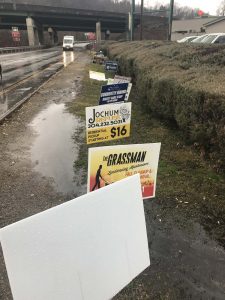
During their regular monthly meeting earlier this week, members of the Wheeling Planning Commission discussed proposed modifications to the city's sign codes. Officials said many public rights of way in the city have become cluttered with signs promoting everything from commercial businesses and real estate sales to various fundraisers.
"All of these signs in the right of ways start to take on an unsightly appearance," Tom Connelly, assistant director of economic and community development for the city, said. "We want to protect property values and improve aesthetics in these areas where the right of ways just end up being cluttered."
Connelly noted that the proposal to tweak the city's sign code stems from a U.S. Supreme Court case that basically rendered many municipal codes across the country in non-compliance with federal law.
The Reed vs. the Town of Gilbert case in Arizona saw the high court rule that municipalities cannot restrict free speech through content-based regulations on signage as stated within a municipality's codified ordinances. Although the Supreme Court case came down in 2015, officials noted that many affected communities across the nation have been in the process of taking action in response, seeing what other municipalities are doing to bring their codes into compliance with the new federal law.
Wheeling's current language in the code differentiate signs placed in a public right of way to be with or without a "commercial message." This is a content-based restriction that must be re-worded, Connelly noted.
In the wake of the Supreme Court ruling, city officials put a hold on enforcement against these signage violations until the issue of code compliance can be addressed. The pause on enforcement has only highlighted the need for it, officials indicated.
Planning Commission members on Monday night were shown photographs on a projector of areas around the city where sign clutter has become a noticeable problem.
"The pictures speak volumes," City Solicitor Rose Humway-Warmuth said, noting that rewriting and enforcing the code pertaining to these signs will enhance the local business climate and benefit the city in other ways. "This will allow us to clean up what has become an aesthetic problem and a distraction problem in the right of ways. It will reduce distractions that can contribute to traffic accidents."
Wendy Scatterday, 4th Ward councilwoman and member of the planning commission, agreed. She added that citizens have expressed similar concerns.
"It is a safety issue," Scatterday said. "A lot of these signs create a visual barrier. They don't get removed, and then they just become trash in these areas that are basically a 'no man's land.' Personally, I've witnessed signs in gutters, and they end up in our storm sewers. It's gone a little bit out of control. Quite a few constituents have commented on how 'trashy' it looks. Folks have noticed and have inquired about what we can do to clean it up."
Most of the signs are placed during warm-weather months, which coincides with grass-cutting season -- resulting in yet another problem for the city.
Connelly noted the proposed modification to the city's sign code applies only to public property, not private property, and aims to allow the city to enforce the section of the code that addresses rights of way. Officials are proposing language that will still allow sidewalk signs to be placed in commercial and industrial zones, such as signs adjacent to a business placed on a sidewalk adjacent to the building and displayed during business hours.
But otherwise, the rules regarding signage in public rights of way have to be "all or nothing," and planning commission members are suggesting that no signs be permitted in right of ways.
"We feel it has to be very black and white," Humway-Warmuth said.
"A lot of people are about to spend a lot of money on political signs," planning commission member Martha Wright said, noting that if a new restriction went into effect as city leaders hoped, placement of political signs would be greatly affected during election season.
Connelly said the proposal would have to go through the public hearing process and eventually be approved by city council. This will likely take several weeks and would not be in effect before the primary election.
While it is being proposed that no signs be allowed in public rights of way, officials stressed that many of these signs can still be placed on private property. Connelly noted that signs on private property are more likely to be placed on a temporary basis and removed promptly.
Officials are seeking public input on the matter before the tweaked language is finalized for approval by the planning commission and sent on to city council for consideration.
The public can provide comment at a public hearing or via email to Connelly at tconnelly@wheelingwv.gov.
A public hearing on the proposed amendment to the sign ordinance text has been scheduled to take place during the next regular meeting of the Wheeling Planning Commission at 5 p.m. on March 2.