
Sunday Sit-Down: Dr. David Roby, Morgantown Native, Current Resident of China

Trending
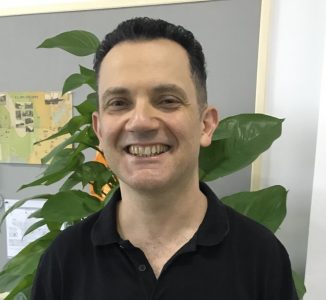
Editor's note: David Roby, Ph.D., is a Morgantown, W.Va. native currently living in China. He has spent the past month essentially quarantined in his apartment as the COVID-19 coronavirus brought life in China to a halt. He said life there slowly is returning to normal, and agreed to answer a series of questions about what life in China has been like over the past few months.
∫ Dr. Roby, where are you currently located, and how far are you from the perceived center of the COVID-19 coronavirus outbreak?
ROBY -- I live in the city of Shenzhen. It is located on the southern border of mainland China in Guangdong Province just across from Hong Kong. The region where I live is known as the Pearl River Delta. Ground zero of the Covid-19 outbreak is Wuhan, which is the capital of Hubei Province. It is located in central China around 650 miles north of Shenzhen.
∫ Describe your experience when you and the rest of the world were first becoming aware of the severity of the coronavirus outbreak as it was reaching its peak in China.
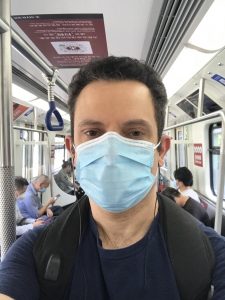
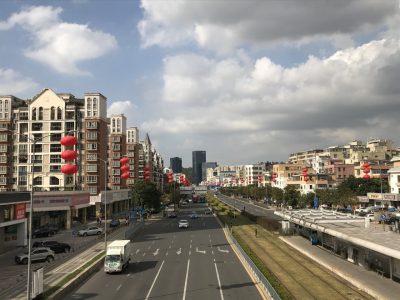
ROBY -- In late January, as reports of an outbreak in Wuhan became more frequent and more serious, my winter vacation from work began, and most residents of Shenzhen were leaving town to visit family during the two-week Chinese New Year holiday. The Guangdong Province government issued an ordinance requiring all persons to wear masks in public, and attendants working the metro and light rail system began taking the passengers' temperature with an infrared thermometer gun to check for possible coronavirus infections. I left China, flying out of Hong Kong, to visit Vietnam for 10 days, a trip I had planned months in advance. When I arrived in Vietnam, very few people were wearing masks. With each day, reports from Wuhan began spreading throughout the globe and became even more alarming. By the end of my trip, everyone in Vietnam was wearing a mask. I did manage to buy a box for myself while I was there. Administrators from my school began sending messages to me and my colleagues requesting that we notify them daily of our location and our health. We were also told that our school would be closed and that we would be teaching all of our classes online for at least the first couple weeks of the spring semester. Almost all of my fellow foreign colleagues were also outside of China at the time, and most of them opted to wait until the coronavirus outbreak subsided and was under control before returning to the country. My computer, teaching materials, and most of my other belongings were in Shenzhen, and my return flight was already booked. Flights in and out of China were beginning to be canceled, and I did not want to be stuck outside the country. To save money and to be able to teach my classes online properly, I decided to fly back to Hong Kong as scheduled in early February, cross the border into Shenzhen, return to my apartment to rest, work at home, and ride this crisis out. The Shenzhen border crossing that I always use is normally a noisy, bustling place with hundreds of people. That day, it was eerily quiet and a little unsettling, and I saw workers wearing hazmat suits. There were only a few dozen people there, and almost all of them were exiting China. Medical workers in Hong Kong, many of whom had experienced the SARS outbreak up close 17 years ago, had gone on strike demanding that their border with China be closed. The very next day, that border crossing was closed, and the remaining ones followed. When I returned to Shenzhen, Chinese New Year break had not yet ended. The streets were almost completely empty, and nearly every single business was closed. It was like a ghost town. It was challenging to buy food for the first couple of days. Few supermarkets were open, and their hours were shortened. The only two restaurants that I saw open anywhere were McDonald's and KFC, and you could not order at the counter; you had to order with a phone app instead. For the most part, the only people on the streets were food delivery guys on motorbikes, and many streets and neighborhoods were blocked off. Any time I entered or exited my apartment community, the grocery store, or just certain neighborhoods, I had to have my temperature taken.
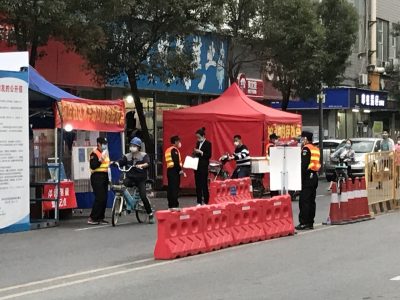
I will admit, it was a bleak and scary time, like nothing I had ever experienced before. This coronavirus truly was novel to everyone during those days. That said, I was impressed and put at ease by how everyone in the community was poised, focused, unified, and calmly working together to protect themselves and each other at a time when there was so much fear and uncertainty about what was happening and what the future would hold.
∫ Describe the mood in China right now -- at least where you're located.
ROBY -- The coronavirus epidemic appears to be much more under control in China at this time. Guangdong Province has had the second highest number of confirmed COVID-19 cases in China, albeit a distant second, behind Hubei Province, of which Wuhan is the capital. When it was at its peak and no one knew if the situation would improve or worsen, the mood in Shenzhen was tense and everyone was quiet. As businesses have slowly been reopening over the past few weeks, and life has somewhat begun to return to normal, the mood here has improved a lot. People are more conversant and beginning to laugh again, and children are outside playing. Though there are many more people out in public, everyone is still practicing social distancing and wearing a mask, and no one is gathering in crowds. Most restaurants only allow take out orders, and those allowing dine-in service only allow very small parties and require that people sit far apart from each other. The mood has lightened, but it is still quite serious. China is not out of the woods yet.
∫ What led you to living in China?
ROBY -- I am originally from Morgantown. I have a bachelor's degree in Spanish and a master's degree in linguistics from WVU. I left Morgantown in 2000 and earned a Ph.D. in Hispanic Linguistics at The University of Texas at Austin in 2007. I taught Spanish at the university level in the US for 18 years. Before moving to China, I co-founded a Spanish major program and was an assistant professor of Spanish at the University of Pikeville, in eastern Kentucky. In 2015, though satisfied with what I had accomplished in my career, I had grown restless and decided that it was just time to move on and do something else. The number of available tenure-track professor jobs for a theoretical linguist had become practically nonexistent. I was still carrying a six-figure student loan debt balance, my parents had passed, I was not married and had no family, and I was not getting any younger. For years, I had toyed with the idea of moving to Asia to teach, experience a new culture, learn a completely different language, and possibly pursue better financial opportunities. Simply put, I needed an adventure. Thus, when I was offered a teaching position at the Dalton Academy, the international liberal arts academy at the Affiliated High School of Peking University in Beijing, I gladly accepted it, and I would work there for 2 years. In 2017, I moved to Shenzhen, where I now teach Spanish and serve as the Coordinator of Institutional Research at a high school called the Houde Academy. Moving to China energized my career and has turned out to be the best decision I have ever made. I have fully embraced being an international educator in Asia.
∫ You're currently teaching your students online. How challenging is that?
ROBY -- Nothing can replace face-to-face interaction with the students, and though unexpectedly having to convert all of my normal classes to online ones on such short notice was somewhat challenging at first, the students and I have adapted quite well. For many years now, I have set up my courses like hybrid courses, with much of the instruction, content, and grading being managed online to complement the face-to-face class meetings. Also, having taken Chinese courses online myself has proven to be a valuable experience to draw from.
There have been some drawbacks. It requires more class preparation time, and sometimes, there are technical difficulties. In a country with a population of nearly a billion and a half people, the internet can significantly slow down when most of those people are in home quarantine using the internet, too. Moreover, several of our faculty and administrators who left China on vacation during the Chinese New Year holiday still have not returned. Many are located in different time zones, some of which require them to teach their classes in the middle of the night.
Teaching online is still teaching. You have to love what you do, work hard, make adjustments as needed, and be willing to improvise and try new tools and ideas. Some ideas work well and others flop. There are days when the students are fully engaged and respond well, and there are days when I hear mostly silence coming from the other end of the connection. That's teaching.
∫ What are you doing to protect yourself?
ROBY -- I have done several weeks of self-quarantine, staying at home as much as possible. For the most part, the only time I leave my apartment is to go buy groceries and other essentials. As the current law requires, I always wear a mask when I am not at home. As a teacher with a lot of experience around sick students, I am an avid hand washer, and I am good at not touching my face. When I do things like press elevator buttons and push open doors, I use my elbow, because you can't touch your face with your elbow. Until it is again legal to be out in public without wearing a mask, I am not going to eat at any restaurants. Given this type of virus in particular, I make it a point to take plenty of Vitamin D, get sunlight if possible, and keep windows open to allow fresh air into my apartment. I also take plenty of Vitamin C and eat some fresh garlic and ginger to keep up my immunity. The key is prevention, not panic. Leaning on my faith helps, too.
∫ What is the government there recommending you do to protect yourself?
ROBY -- What the government is ordering everyone to do during this ordeal and what they are recommending varies from city to city and province to province. Again, everyone in Guangdong Province, where I live, is required to wear a mask in public. The government recommends that we stay at home and work at home if possible, avoid large groups of people, wash our hands, not touch our faces, not handle wild animals, and cook meat thoroughly. Quarantine is mandatory depending on a number of factors. I was required to carry out a 14-day home quarantine, which I have far exceeded, so that I will be able to return to my school when it reopens. All students, faculty, and other personnel are required to take their temperature and submit a health report to the school every day. Also, all residents are required to register information with the local government about their health, where they have traveled recently, and when they have returned to town. Most people register their information by using the all-purpose social networking phone app, WeChat, and an individual QR code is generated. To enter an apartment complex or certain residential areas, your QR code must be scanned, or you scan a code with your phone to pull up that very information from a government database so that you can gain access. You also have your temperature taken with an infrared temperature gun. It sounds like something out of a dystopian science fiction movie, but the scanning of QR codes has been a part of everyday life in China for several years now. QR codes linked to people's personal bank accounts through WeChat and another app called AliPay are mostly used for payment instead of cash or cards in China.
For better or for worse, China has become a mostly cashless society, and thus many people carry a cellphone but not a wallet. During this entire crisis, I have not handled cash one time, which is an advantage when trying to avoid potentially contracting an illness from other people who have touched it.
∫ Have any of your neighbors been diagnosed?
ROBY -- To my knowledge, there have officially been 34 documented cases in the district where I live, in northern Shenzhen. In fact, I do believe that there have been a few cases in my apartment community and possibly one in my building, but I do not know anyone personally who has been diagnosed with the coronavirus.
∫ Have you spoken to any of your neighbors? Are they afraid? Are they still going to work? Are most people working from home?
ROBY -- My neighbors seem like very brave people, especially the elderly. Though they are all wearing masks, you can see the seriousness in their eyes and hear it in their voices, but they are not afraid. The Chinese people are as tough as nails. Rather than fear, there is a spirit of a oneness of purpose in the community to get through this. Some people have returned to their workplaces, but many are still working from home if they can, especially educators. Of course, there are those who never stopped going to work every day such as medical personnel, police and security guards, grocery store employees, DiDi (Chinese Uber) drivers, and delivery drivers, who have been touted as the unsung heroes during this lockdown on Chinese social media.
∫ Basic essentials -- food, toiletries, etc. -- are they in short supply, or are you able to get what you need?
ROBY -- As I mentioned, at the peak of the outbreak, especially during the Chinese New Year holiday, many supermarkets were closed or had limited hours of operation. The supply chain was severely disrupted within China and thus in the countries to which it exports goods as well. However, I have had very little difficulty procuring food, toilet paper, and other basic necessities. Stores have run low on certain items at times, especially toilet paper, bottled water, and hand sanitizer, but only temporarily. Masks and thermometers have been quite scarce for a couple of months now. With everyone spending most of their time at home, people have been ordering a lot more items online and a lot more food to be delivered.
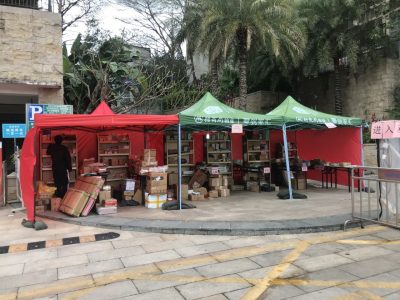
Most people in China live in high-rise apartment buildings situated within large apartment communities. During the last couple of months, to keep any possible contamination from the outside to a minimum, delivery people have not been permitted to enter apartment communities to deliver door-to-door. Residents have to pick up food at the community gates. Large tents with shelves and tables under them are set up outside the gates to receive packages for the residents to pick up on their own. Over the past several weeks, I have been witnessing the Chinese perform this balancing act of survival, maintaining the exchange of retail goods and food service as much as possible, while at the same time, becoming an even more "touchless" society to avoid spreading the virus.
∫ How often do you get out right now?
ROBY -- I still only leave my apartment every other day or every few days to go buy groceries or other essentials or to just take a walk to get some sun and fresh air to stay sane. Until everyday life returns to normal, I am going to spend the majority of my time inside, not just to stay safe, but also because I still cannot get used to wearing a mask at all times. I am not against mask wearing in principle; I just find them uncomfortable.
∫ Are the Chinese people talking about this outbreak?
ROBY -- The Covid-19 outbreak has disrupted the entire country and its ramifications have pervaded every aspect of life here. For the first several weeks, it dominated TV, radio, print media, social media, and everyday conversation. The public was understandably nervous. At this point, with the epidemic now more contained here, it is still the number one topic, and I believe it will be for several months to come. However, as people are now making an effort to resume their normal lives, it is no longer the sole focus of the Chinese people at large.
∫ How concerned are you right now?
ROBY -- At this current time, as China has mostly managed to control the spread of COVID-19 within its borders and life is slowly returning to normal, I am much less concerned about my health and safety here than I was before. However, I am concerned about the spread of the virus globally and how it has disrupted life on such a grand scale. Every summer, I visit the United States to see friends and family. I think about those back home every day, and I hope and pray for their safety and well-being during this health crisis. I am concerned as to whether or not I will be able to fly home this summer due to possible travel restrictions, required quarantining, or other unforeseen circumstances. It is too early to tell.
∫ COVID-19 is believed to have originated from an open-air market in China, where animals are sold and slaughtered. Have you ever visited such a market, and if so, could you describe the atmosphere?
ROBY -- I have visited a few open-air markets in China and in other countries in Asia as well. In my experience, they are excellent places to buy fresh seafood and produce. They are almost always very crowded, noisy, and often smelly -- very stimulating to the senses. In a strange way, the atmosphere can almost be described as festival-like. Essentially, they are wholesale farmers' markets that can be quite massive, and often, they have food stands where you can order meals that you can sit down and eat there.
In addition to seafood, many have livestock that is slaughtered and sold on site. There indeed are markets of this type that sell certain species of wildlife, exotic animals, and other creatures that we in the West would not consider food. Personally, I have not visited a market where such fauna is sold.
I am adventurous when it comes to food. Two of my favorite foods in China are donkey meat and pigeon meat. However, there are creatures that some consume for food in certain countries that I would be reluctant to try based on considerations of flavor, and above all, safety. The bottom line is: Nature can be deadly if mishandled. That said, it should be noted that the Wuhan seafood market story is only one of a number of different theories regarding the possible origin of COVID-19.
∫ Any other thoughts you'd like to offer to those of us back in the Mountain State?
ROBY: It is a great honor to represent the state of West Virginia and West Virginia University in China. And yes, when I tell people where I am from, they respond by trying to sing a few bars of "Country Roads" here, too. WVU has a strong presence in China. In Shanxi Province, with which the state of West Virginia has a formal friendship agreement, similar to a "sister-state province" relationship, WVU leads cutting-edge research operations at the US-China Energy Center in its capital, Taiyuan. WVU also has an alumni chapter and Global Portal in Shanghai. Amid the strained relations between our two countries, my main goal here is to do my part to promote friendship, goodwill and intercultural understanding. One way I wish to accomplish this is by building research connections between my Chinese high school students and the educational outreach and extension efforts of my alma mater both here and back home in the future.
To my fellow West Virginians, stay strong and stay safe. If you are stuck at home, turn off the news every once in a while.
Read, do research, and learn something new. This virus does not care who you are. So, be good to one another, care for your neighbors, and don't hog all the toilet paper. We are all in this together, and we all need each other.
The key is prevention, not panic. We will prevail. Montani Semper Liberi. Peace.