
U.S. Army Corps of Engineers Takes Assessment of OVMC Hospital Site
Trending
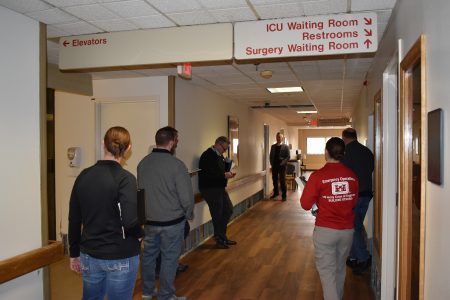
WHEELING --A team of representatives from the U.S. Army Corps of Engineers performed a site assessment at the former Ohio Valley Medical Center's west tower Monday afternoon in preparation for a possible surge in COVID-19 cases in the region.
Representatives of the property, now owned by Medical Properties Trust, along with Wheeling Mayor Glenn Elliott and Vice Mayor Chad Thalman, joined the team of engineers to tour the newer wing of the former hospital. Since OVMC was fully operational before it closed its doors just in September, officials have targeted the site as one that could be quickly repurposed and opened in the case of an emergency that would require additional medical treatment facilities if local hospitals were to be flooded beyond capacity with coronavirus patients.
The data collected Monday will be reviewed by the Federal Emergency Management Agency, which along with officials from the State of West Virginia will decide whether or not OVMC should be used as a regional alternate medical location in the event of a pandemic surge.
"Under a federal planning mission assignment that we share with the states and FEMA, site assessments like the one being conducted today are an effort to shape possible missions to provide West Virginia with alternate care facilities," said Mark Thompson, representative of the U.S. Army Corps of Engineers.
Thompson said teams from the U.S. Army Corps of Engineers already have looked at other locations in the southern part of West Virginia, but OVMC is the only site in the Northern Panhandle that has been considered.
Engineers from the crew that toured OVMC on Monday were from the Huntington District of the U.S. Army Corps of Engineers. Thompson, who resides in Wheeling, works out of the Pittsburgh District office of the USACE. Representatives from electrical, operations and other logistical divisions of the USACE were on hand gathering information about the building, its utilities, the overall number of rooms and types of rooms, available medical equipment such as negative pressure capabilities and an array of other technical data.
"All the phases of what it would take to put together one of these alternate care facilities together and up and running," Thompson said. "They've got a list of very technical questions, and they're just working around that with the subject matter experts here from the hospital and property owners. They want to make sure everything that we would need to get this up and running is something that we would have access to here."
During emergencies, the U.S. Army Corps of Engineers is the federal government's lead support agency for civil works and engineering projects, Thompson explained.
"Given our extensive experience for building medical facilities for the military, we're uniquely qualified to take on engineering challenges," he said. "That's the main reason we're selected to perform this work and why we are here today."
Elliott noted that the city simply has worked as a facilitator for these efforts and has been assisting the U.S. Army Corps of Engineers since the coronavirus pandemic crisis began to take root in West Virginia, which went from being the last state to record a single COVID-19 case to having more than 124 confirmed cases in the state in less that two weeks.