
Youth Services System Adopts Online Resuscitation Training
Trending
WHEELING -- Employees of Youth Services System Inc. are learning resuscitation skills through a combination of online learning and hands-on training.
Youth Services System is the first agency in West Virginia to utilize this form of training offered through the American Red Cross and HealthStream, said Betsy Bethel-McFarland, YSS communications manager and grant writer.
Bethel-McFarland is one of the initial staff members to use this method of instruction to complete the requirements for certification in Basic Life Support.
Julie Cunningham, human resources director for YSS, said the online component developed by the American Red Cross gives multiple scenarios to help employees develop skills for critical thinking and problem solving. The adaptive learning module consists of several sections.
Each section contains a pre-test "to see how much you know," Bethel-McFarland said. "Then you take the course depending how much you know. It saves time and aggravation."
Through the online testing, "I learned a lot more than the last time I took CPR training," Bethel-McFarland said.
The course teaches trainees how to respond to a respiratory or cardiac emergency and explains when to administer naloxone for an opioid overdose, she added.
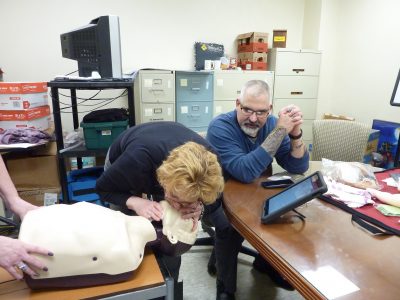
After successful completion of the online written test and doing an online evaluation, employees must demonstrate their proficiency in performing cardio-pulmonary resuscitation, using manikins. YSS has acquired two manikins: an adult male torso and a baby-sized model.
YSS staff have dubbed the baby manikin "Hazel" and the male manikin "Atlas," in a nod to the name of the agency's headquarters in the Hazel Atlas Building in East Wheeling.
The practical part of the test "measures the depth and speed of chest compressions," Cunningham said. Using the manikins, an employee must perform 60 chest compressions, 12 mouth-to-mouth ventilations and then do "real CPR" by performing ventilation and compression together.
A specified percentage of proficiency must be achieved for each portion of the practical test. The tester's rate is recorded on a computerized screen, plus the manikin's head "lights up" if the procedure is being done correctly, Cunningham said.
"This forces you to do it (CPR) right," Bethel-McFarland said, referring to informative messages that appear in real time on the small monitor near the manikins.
In addition to the effectiveness of the training, the HealthStream system saves time and money for employers. The new method takes a couple of hours to complete, as opposed to four hours for a traditional CPR class.
YSS, which has about 200 employees, is implementing the HealthStream online training for its administrative and residential care staff, Cunningham said. The agency needs to get approval from state authorities in order to use the online program for workers at the Ronald C. Mulholland Juvenile Center.
In 2019, the American Red Cross and HealthStream signed a long-term agreement to work together to improve resuscitation outcomes in health care organizations. As part of this collaboration, the Red Cross Resuscitation Suite program provides a fundamental element of HealthStream's overall resuscitation solution for hospitals and health care professionals.
HealthStream also offers many courses on a wide range of topics of interest to various organizations.
"You can assign different courses to different people," Cunningham said.