
Unconventional Treatments Were Attempted During Spanish Flu Pandemic
Trending
Editor's Note: This is the third part of a six-day series about the 1918 Spanish Flu Pandemic in Wheeling. It was written and researched by Sean P. Duffy and Erin Rothenbuehler of Archiving Wheeling (www.archivingwheeling.org), a collaborative community project of the Ohio County Public Library in Wheeling.
Part 3: Cures, Preventives, Treatments and Folk Remedies
In addition to vague hopes that things like rain would somehow "purify the air," businesses and people came up with a wide range of schemes and potions to stop the dreaded virus.
Nurses at Ohio Valley General Hospital reportedly wore masks "not unlike the gas masks used by the soldiers in France" while treating influenza patients at the hospital. This was confirmed in OVGH Superintendent Pliny O. Clark's report to the OVGH board. Ordinary citizens were advised to wear gauze masks, which could be procured free of charge from the Red Cross.
Anti-expectoration and well-functioning bowels became something of an obsession, as this October 23 Intelligencer piece confirms:
"When a fellow spits or blows the mucous from his nose on the floor or sidewalk the germs soon become part of the dust of the air and will be breathed in by others. If you cough, sneeze or laugh in another man's face you cause him to breathe your germs. Ventilate your sleeping quarters well. Avoid crowds because the air in crowded rooms just now is certain to contain the germ. Take plenty of exercise, keep bowels open and avoid all excess."
At no point, however, in reading hundreds of articles about the Spanish Influenza in Wheeling's newspapers or other sources, did we encounter the suggestion that people should simply wash their hands.
Local businesses like Baer's Drug Store made efforts to contain the virus. Baer started using "sanitary paper cups" at its soda fountains, and local barbers were said to be considering the "wearing of masks." The Wheeling Traction Company and West Virginia Traction & Electric Company started fumigating their street cars with eucalyptus oil every morning before the cars left the barns.
They also vowed to keep windows open during transit, though there seemed to be a few complaints about unopened windows.
In addition to national brands like Vick's Vaporub (who suggested that nature combined with a good laxative and, of course, Vaporub, was the cure), bizarre things like Bulgarian Blood Tea (yes, Bulgarian Blood Tea) were said to help ease symptoms of the Spanish Flu.
Offered at local druggists like Griests, Coleman's, Baer's, Irwin, and Hoge-Davis, Nostriola brand balm or liquid was said to "open air passages" to keep an acute cold from somehow becoming an attack of Spanish Influenza.
Keeping the bowel open with calomel or saline draught was recommended, along with ten grains of Dover's powder (an opium-based concoction used to induce sweating) at night.
Coleman's drugstore promoted its own "Magic Balm," which would "prevent and attack by keeping the nose and throat clean," as well as its own "Antiseptic Solution" for gargling, as "the nose and throat are the seat of the infection for this dreaded disease."
Meanwhile, Wheeling's Nostriola Balm Company was pushing its "Mus-Tur-Pep," a frightening mixture of mustard, turpentine, and pepper marketed as the best and surest way to relieve Grip pains. And C.H. Griest & Co. Druggists touted Phosphated Iron as a "blood tonic" to "Get the blood right."
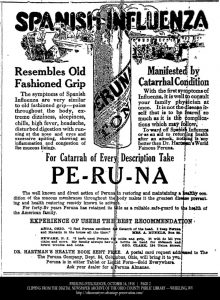
Dismissing the novelty of Spanish Influenza as just like "Old Fashioned Grip," Dr. Hartman's world famous Peruna anti-catarrhal boasted the ability to restore and maintain "a healthy condition of the mucous membranes" which, of course, was the best way to ward off Spanish Influenza. Another insidious ad disguised as a recommendation from the "Health Board" provided more dubious advice when it recommended running to the drugstore for a "Hyomei outfit" [another type of anti-catarrhal] consisting of a bottle of the pure Oil of Hyomei and a little vestpocket, hard rubber inhaling device into which a few drops of oil are poured."
Liquor sales jumped as temperance advocates blamed propaganda about "coffin varnish" being a powerful flu preventive.
Recommended disinfectants included exotic sounding herbal potions like perfume of carbolic acid, asafoedtida (a pungent member of the celery family also known as "stinking gum" or "devil's dung"), and old fashioned formaldehyde.
On Oct. 11, a Pittsburgh based homeopathic physician named George F. Baer claimed to have experimentally discovered a successful treatment and "inoculation against the malady." But Baer's "preparation," comprised of an odious sounding mixture of iodine and creosote, apparently failed to save the day.
Remedies were not limited to potions or concoctions. McFadden's Men's Store on Market Street advertised its thermal underwear line known as "Heavies" as "Influenza Armor," based on the unscientific assumption that "body chilling" caused influenza. The same ad pushed the company's "rubber footwear" line because: "There is danger in damp feet...Better wear rubbers than become an object of interest to undertakers."
Industrial laborers, many of whom had habitually shared public drinking cups at work, began to carry individual folding drinking cups in their pockets--a wise move.
Home remedies included fried onions and sugarless, hot lemonade, which was touted as both therapeutic and patriotic.
We may find these desperate efforts and snake-oil myths amusing, but 100 years later, the desperate myth-making continues.
The series continues Wednesday.