
Wheeling’s Economy Rebounded Quickly After Spanish Flu
Trending
Editor's Note: This is the final part of the six-day series about the 1918 Spanish Flu Pandemic in Wheeling. It was written and researched by Sean P. Duffy and Erin Rothenbuehler of Archiving Wheeling (www.archivingwheeling.org), a collaborative community project of the Ohio County Public Library in Wheeling.
Part 6: The Economic Impact in Wheeling
One of the major concerns about the effects of the COVID-19 pandemic is the probable national and global long-term economic impact, including record unemployment, bankruptcies, stock market collapse, and the possibility of recession or even depression.
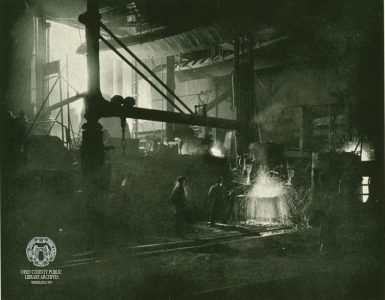
In 1918, war production may have boosted the economy, but by forcing store closings and quarantine, the pandemic still had detrimental effects.
On August 31, 1918, Bradstreet's Weekly, a business journal published in New York, reported "Trade at a Glance" in Wheeling positively, noting "Whole & job trade" and "Retail trade" in the district as "Good," and "Manufacturing & industry" as "Active."
As the flu pandemic began to spread in West Virginia, the economic effects began to show. On October 19, 1918, Bradstreet's Weekly was reporting of Wheeling, "Mild weather with the epidemic of influenza have served to slow up retail trade." A week later, the publication reported of Wheeling, "The slowing up in all lines of trade, due to influenza, is very noticeable. Coal production has fallen off about 20 per cent. Houses dealing in electrical and mining supplies report many new orders and an active business. Dealers in confections are behind on orders. Building is quiet. Collections are good. Pottery production has been ordered cut 50 per cent."
The Wheeling Intelligencer reported the following on October 22, 1918:
"The 'flu' has put quietus on business in this city good and hard. Last week is said to have been the quietest in practically every commercial line. Across the river towns issuing quarantine against Wheeling has put the kibosh on commercial activities between this city and 'over there.' A veteran produce dealer said yesterday that last week was the quietest in his line in the past score of years."
By November 2, the Bradstreet's update for Wheeling had worsened: "Business is lagging, due to interruptions caused by influenza. Retail trade has been noticeably curtailed."
The "Trade at a Glance" this time reported Wheeling's "Whole & job trade" as "Quiet," "Retail trade" as "Dull," and "Manufacturing & industry" in the district as "Restricted," with the following remarks: "Influenza restricts trade and industry."
A week later, though Wheeling was still in the throes of the pandemic, the economic situation seemed to have stabilized. "Trade at a Glance" reported that the Wheeling district on November 9 showed the "Whole and job trade" as "quieter" and "Retail Trade" as "Fair," with "Manufacturing & industry" returning to "Active." Though the local businesses were recovering from the spread of Influenza through the workforce, Wheeling industries were hit with another blow. Bradstreet's reported that week, "Wholesale business shows some falling off and retail trade is only fair. Manufacturers continue working full time, but orders have fallen off, due to the possibilities of early peace." Armistice would be announced just two days later, and the end of the Great War added to the economic impact of the Influenza pandemic.
Isaac M. Scott, President of Wheeling Steel & Iron Co., released a statement in the trade publication, The Iron Age, reviewing the company's disappointing operations for the year of 1918. "The loss in production for the year, as compared with the two previous years, can be accounted for (a) to shortage of raw materials; (b) shortage of labor, due to the draft, and later in the year, to the effects of the influenza; (c) curtailment of operations in certain departments under orders from the Government, and (d) falling off in demand after the signing of the armistice," noting that "There was an active demand for the company's products up to the time of the signing of the armistice."
By the end of December, "Trade at a Glance" had returned to reports of "Good" and "Active" in Wheeling, with Bradstreet's reporting, "Wholesale trade is good and manufacturers are still operating full time. There has been unprecedented holiday trade with retailers."
What About the Public Library?
Wheeling's public library remained open until at least mid-October, providing fodder for attempted levity in this October 15 piece in the Intelligencer's "About Town" section:
"Merchants and manager of shops and business places have put the ban on loafers during the Spanish influenza epidemic. Many of the evening loafers are now all dressed up and have no place to go -- not even a motion picture house , and it's too cool to sit in the park, and they can't even while away the time in the evenings in the Ohio side bar rooms. A suggestion: The Wheeling public library is still doing business at the old stand."
The library apparently closed around the 20th of October.
But that did not stop the Intelligencer from making dubious jokes like this one, on October 23:
"Speaking of magazines, the village wit circulated a report the other day that the Wheeling library was not closed on account of the 'flu' epidemic, but it was to prevent pro-Germans from blowing up the magazines."
Epilogue: 1919
Not surprisingly, the reports of diagnosed 1918 H1N1 cases and deaths were wildly inconsistent at every level. Dealing with our own pandemic 102 years later, it seems few lessons have been learned. If testing is woefully inadequate now, imagine how it must have been in 1918. Even looking internationally, the 1918 death estimates range from 50 to 100 million, a rather massive range.
Consider, for example, the numbers published in 1919 by the West Virginia State Health Department:
"Reported in Wheeling from Oct. 5-17: Cases, 110; Deaths, 4
Reported in Ohio Co. from Oct. 15-Nov. 15: Cases, 1177; Complications, 127; Deaths, 75
Reported Statewide from Oct. 15-Nov. 15: 71,079 cases; 7,675 complications; 2,818 deaths."
The following caveat was included:
"This report is necessarily incomplete and does not represent the total number of influenza cases, complications and deaths which occurred in West Virginia during the epidemic. It is based upon reports from doctors in their respective communities and also upon reports from other sources. Doubtless in a number of instances the reports are based on estimates rather than correct observations."
Indeed.
It's fair to say that, for all the suffering and carnage it caused, the 1918 influenza pandemic motivated positive changes in public health policy.
In 1957, the West Virginia State Nurse's Association called 1919 a "fateful year" noting that "the 75-year history of public health work in the state contains no other single year that had more concentrated efforts on so many fronts. It was in that year that: the Legislature finally took steps to abolish panaceas for venereal disease...the state assumed supervisory control of water supplies, sewage and drainage projects with an eye on the growing evidence of links between such matters and epidemics...sanitation posters appeared in rural districts; the marking of water supplies as "safe" or "unsafe" was begun; legislation enabled three-mill taxes to allow a county to support a full-time health officer and his assistants..."
Wheeling city council minutes confirm that on Nov. 6, 1918, an ordinance "providing for the appointment of a Health Commissioner and constituting a Department of Health, providing regulations for communicable diseases, vaccinations, ...reporting of births and deaths, disposal of the dead, collection and disposal of garbage, ...supply and sale of water... and keeping of clean of premises within the city of Wheeling," among other things, was presented to the Wheeling City Council.
The massive 26-page ordinance was adopted on April 29, 1919.
Conclusions
Some have argued that the most important lesson we can learn from the H1N1 pandemic of 1918 is that governments must tell the truth, gain public trust, and gain compliance for things like "social distancing" and closures to "flatten the curve." By studying Wheeling's experience in 1918, we learn that city officials and media did not always tell the truth, preferring a false optimism in order to lift morale for the war effort. When this happened, the result was always the same: the bans and quarantines had to be brought back, and the time for containment was pushed forward, resulting in more infections, and more deaths.
As many have correctly noted, we are all in this together. And the sooner we comply with the necessary steps for suppression of COVID-19, as they have been laid out via many sources, the sooner we will be able to return to normalcy.
The good news is, despite many mistakes, we survived 1918, and we will survive 2020. The only question remains, how much time and how many people will we lose before we heed the vital lessons of our history?