
Education Savings Account Bill Sails to Passage in West Virginia House of Delegates
Trending
CHARLESTON -- A solid majority of the West Virginia House of Delegates approved a bill Thursday creating the state's first education savings account program over the objections of Democrats and a handful of Republicans.
House Bill 2013, creating the Hope Scholarship, passed 60-39 Thursday. The bill heads to the state Senate next.
The Hope Scholarship would give parents the option to use a portion of their per-pupil expenditure from the state School Aid Formula for educational expenses, such as private school tuition, home tutoring, learning aids and other acceptable expenses. If passed, West Virginia would become the seventh state with an ESA program.
"What it does is it provides choices and opportunity for people who otherwise would not have the chance to be homeschooled or (attend) private school," said House Education Committee Vice Chairman Joshua Higginbotham, R-Putnam.
The amount of state funding for the program was no less than 2 percent of the net public school enrollment or the total number of eligible Hope Scholarship applicants received by the State Treasurer's Office, whichever is greater. It was originally capped at approximately 5,000 students for a potential cost of $23 million per year when implemented.
An amendment expanded the program to all eligible public, private, and homeschool students by 2026, raising the cost of the Hope Scholarship program to as much as $101 million if 22,000 students participate.
Qualifying expenses under the Hope Scholarship include tuition and fees at participating private schools, tutoring, standardized testing and advanced placement exam fees, and ongoing services provided by a public school. The bill creates the Board of Hope Scholarship, which can remove recipients for failure to comply with agreement terms.
Efforts by House Democratic lawmakers to amend the bill failed. Those failed amendments would have limited eligibility for the scholarship to middle-to-low income families; capped students; and added language prohibiting discrimination of students on the basis of race, sex, sexual orientation, gender identification, religion, and disability.
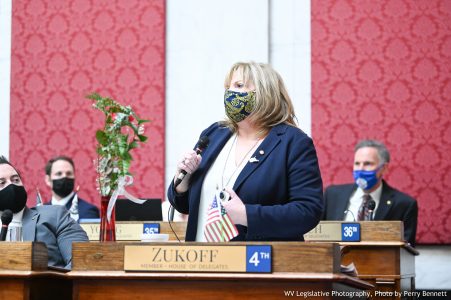
Del. Lisa Zukoff, D-Marshall, said the bill would violate long-standing traditions of not using public funds for religious purposes if scholarship recipients use their funding for private religious schools.
"We're trying to impose our beliefs on others by giving this money to religious schools that allow them to then discriminate against children," Zukoff said. "That's not the role of government. We shouldn't be using public funds for religious education. We have a separation of church and state, and the Establishment Clause of the first amendment of the U.S. Constitution that we also took an oath to uphold when we took the oath of office to be a House of Delegate member."
House Education Committee Minority Chairman Sean Hornbuckle, D-Cabell, called the program the "Hoax Scholarship."
"We are chipping away at public education and it's going to affect us all because as many kids that we might be able to help with some of these pieces of legislation -- and believe you me, we will help them -- just as many we're going to hurt, if not more with hurting our public education system," Hornbuckle said. "I think we should probably subtract the 'P' and the 'E' from 'Hope' and add an 'A' and an 'X.'"