
Moundsville Examines Municipal Building Funding
Trending
MOUNDSVILLE -- City leaders heard from a pair of consultants to decide how to approach funding a redesign of the municipal building, an endeavor which will likely see the city sending payments out for decades.
The municipal building's floor plan was approved by council at their last meeting of 2020, and the city finance subcommittee met Tuesday evening to hear possible funding solutions for it.
A packet of financing scenarios, assembled by Crews and Associates, proposed two outcomes, depending on if the city opted to go with a $7.5 million project fund or an $8 million one, as assessed by McKinley and Associates Architecture and Engineering.
The assessment provides rough debt service structures over 15, 20 and 30 years for each project fund.
The $7.5 million project fund projects expenditures of $9,771,481.38 for 15 years, $10,790,537.54 over 20, and $13,333,162.68 over 30. The $8 million project fund structure projects $10,405,56.26, $11,502,743.92, and $14,206,437.70, respectively.
Funding for this building is to come out of the city's one-percent sales tax, which came to $632,127.32 in the last fiscal year. Crews and Associates Director Rob Steptoe said this means that Moundsville's taxpayers will not see an additional burden, since the sales tax has been collected for several years at this point.
"That's the great thing about it — you're getting revenue from people in Wheeling, ... or McMechen, Middlebourne, whatever," he said. "It takes pressure off of the city residents and taxpayers."
Steptoe pointed out that since Moundsville was among numerous municipalities in West Virginia that had implemented a sales tax under the home rule pilot program, which went into effect in July 2017.
Attorney John Stump, with Steptoe & Johnson, said Moundsville getting ahead of the game with this municipal building was likely a good sign, as COVID-19 relief funding from the federal government and other stimulus money down the line would likely gradually inflate the cost of contracted construction work in years to come.
"I think you're in a good position, because I believe all this stimulus money, COVID money, is going to hit the streets and drive up construction prices. I think you have a real advantage getting out early," Stump said. "What folks at the federal level don't understand is that 'shovel ready' is impossible, at least for municipalities in West Virginia. We're not sitting around with a bunch of designs just ready to go; San Francisco, maybe, but we're not ...
"The reality is, if that money comes in in May, you essentially have two and a half years to spend it," he continued. "Getting a project designed, to construction, and completed in two and a half years can be challenging. I bring it up only because I think it works to your advantage."
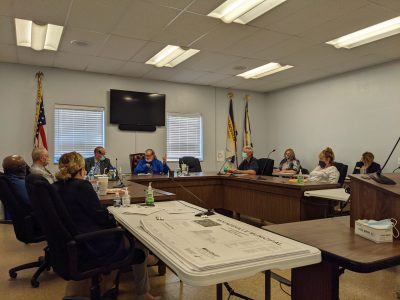
The committee took little action Tuesday evening before adjourning, only forwarding a recommendation to the April 6 council meeting to move forward drafting an ordinance to begin taking steps to put the project out to bid. The finance committee, consisting of Randy Chamberlain, Ginger DeWitt, and mayor David Wood in lieu of absent committee member Judy Hunt voted 2-1 to recommend the council draft the ordinance, with DeWitt dissenting.
The bulk of discussions with Stump and Steptoe were held in the Building Commission's meeting, consisting of Dave Rickman, Brianna Hickman and William Mentzer. Members of council and other interested parties were present in the audience for this meeting and spoke freely to clarify and ask questions.
City Manager Rick Healy said that by the time council revisited the issue several weeks down the line, before voting on which financing option to pursue, the city would have more clear guidance on whether or not it can utilize funds from the American Rescue Plan toward this project, which was currently unclear. A rough timeline projected that the project would consist of at least nine weeks, which Stump said assumed a near-breakneck pace.