
Wheeling-Ohio County Health Department Seeks Guidance on Needle Exchange Program
Trending
WHEELING -- The Wheeling-Ohio County Health Department's needle exchange program is one of many in the state which will be affected by new regulations signed into law earlier this month, and health officials are waiting to see how those rules come down.
Gov. Jim Justice signed SB 344 into law earlier this month, adding numerous stipulations to needle exchange programs operating in the state. Among them is a licensing process, which includes a fee, a one-to-one exchange of "unique" needles, and a penalty for violation of these procedures.
Wheeling-Ohio County Health Administrator Howard Gamble said the local health department was waiting to hear from the state what the specifics of the regulations are, as vague wording left some things up in the air. The legislation requires needle exchange programs to track each needle "uniquely," which Gamble said was unclear as to exactly what was meant.
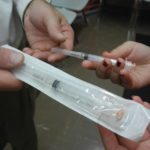
"We need to find, what do they mean by 'unique syringe?'" he said. "From medical supply, you get a syringe, it's very standard. What in specific do they want? Is it labeled, is it documented when they're purchased -- the rules are going to have to be developed to be a little more specific on what we are to do."
The wording on "unique" was a sticking point for Gamble, who speculated on a few interpretations of what a "unique" syringe would be but that the department would need to wait for specific guidance on what that entailed.
Gamble said the fee to acquire a license from the state was a hardship for many exchange programs operating in West Virginia. It would require the local governmental entities to foot the cost of the fee. This, Gamble said, is in addition to the other services the health department provides, such as contraceptives and educational materials.
"You do have to apply and pay the $500 fee," he said. "When you're running your program on no state support, whatever local funds we were using to buy the needles, alcohol prep, condoms, educational material, you now have to have another $500. That's not a lot of money for some agencies and organizations, but it is $500."
The legislation allowed for penalties ranging from $5,000 to $25,000 per day for agencies in violation of the program. Gamble said that needing to ensure the program operates within this framework would prove to be a priority.
"Unlike a lot of our other programs, there are penalties," Gamble said. "Other programs — environmental, mental, homeless outreach — don't have penalties associated. This is going to be one where we have to follow this, because there is a penalty, and that is a little more concerning for us."
Additionally, legislation requires individuals coming to exchange dirty needles for sterile ones to provide proof of W.Va. identification, such as a driver's license. Gamble again wondered to what extent ID would be required and tracked. Proof of ID is already common for other medical procedures, but at the needle exchange program, Gamble said he historically only kept track of demographics, rather than identities.
"Right now, we ask for ID when you get your vaccine — I got your address, I put it in the system, you get vaccinated," Gamble said. "With this, is it an ID they provide me, or are we providing them, so that when Bob walks in, he's 'Patient 72?' ... You then have somewhere that Bob is Patient 72, how this is done, and how it's documented. ... Right now, my data sheets are X'es — how many males, females, condoms, how many tests were done.
"We have a little bit to work on," he continued. "It's going to be a challenge. It's not going to be easy for us, or anyone, to meet this. All the ones done in the state will have to evaluate the legislation and see what can be done."