
Community Leaders Say Historic Rehabilitation Tax Credit Will Be Catalyst for Development in Wheeling
Trending
WHEELING -- Community leaders in Wheeling and throughout West Virginia are applauding the state's recent decision to make permanent the 25% historic rehabilitation tax credits, and officials predict it will spur future development in historic neighborhoods.
In 2018, the West Virginia legislature temporarily the state's historic rehabilitation tax credit from 10% to 25%. That beneficial bump was set to expire in 2022, but in light of the tremendous success and feedback, state officials removed that sunset date during the most recent legislative session.
The bipartisan bill passed both chambers last month, and Gov. Jim Justice signed the bill into law.
According to Wheeling Heritage, more than $51 million worth of investment has been completed or has been planned for the Friendly City since that tax credit boost just three years ago.
"Wheeling has already seen a great deal of historic rehabilitation since 2018, when the historic tax credit was increased to 25%," Alex Weld, executive director of Wheeling Heritage, said.
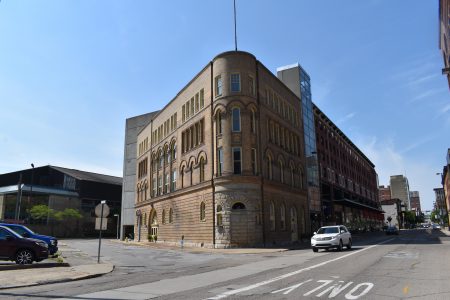
Weld noted that projects such as the rehabilitation of the Flatiron building and the building that houses the new Mugshots coffee shop, both on downtown's Main Street, are among the many structures in historic districts of the city with building owners who have taken advantage of the credit and have made their own private investments.
The city's tallest building -- originally the Schmulbach Brewing Co. building and most recently the Wheeling Pittsburgh Steel corporate headquarters -- is currently undergoing a $30 million renovation, thanks to the higher historic rehabilitation tax credits. The Historic Wheeling-Pitt Lofts are now being developed after years of anticipation, with building owner Dr. John Johnson and developer Steve Coon noting that projects like this would not be possible under the state's previous tax credit scenario.
"I said if we were going to make this work -- when Doc and I first started talking -- I said the tax credit here sucks," Coon said previously. "I said at 10%, nobody's ever going to develop in Wheeling. They're just not."
Since the increase, Coon has jumped on a number of development opportunities in the city, and local officials expect even more to follow with a permanent higher tax credit.
"From 10 to 25%, this would open up the door to projects in Wheeling and West Virginia on a larger scale," Wheeling Mayor Glenn Elliott said this past week, noting that local officials -- including Weld -- were part of the group that lobbied to get the historic rehabilitation tax credit raised in 2018. "There was a lot of pushback, but we got it through. But they did it with a sunset date, and also with a bunch of caps on it."
The local group also was behind the effort to get lawmakers to ditch the sunset date on the measure.
"This time we lobbied to make it permanent," Elliott said. "With this in effect moving forward, that's a big win. Now developers will have certainty that it's going to be here so they can look at our architecture with a fresh set of eyes."
Previously, West Virginia could not compete in the arena of historic preservations, because developers could invest their money in neighboring states and get more bang for their buck. Wheeling is the perfect example of a community that can benefit from this type of investment, with its wealth of historic structures, old Victorian homes and architectural connection to the past, the mayor noted.
"Any city with old architecture is going to be at a competitive edge with that, because it makes our buildings more competitive now that buildings elsewhere -- or at least as competitive," Elliott said.
The historic rehabilitation tax credit can be used on structures that are deemed to be "contributing" properties within historic districts or that are individually listed as being historic. Wheeling presently has a total of 11 historic districts throughout the city.
Weld said Wheeling Heritage has already been receiving inquiries about available properties, noting that the 25% credit can often fill a financial gap and allow a project to move forward.
"When developers are crunching the numbers, the historic tax credit is frequently the deciding factor, because it makes the project feasible," Weld said, adding that the permanent status of the credit opens the doors to more long-term plans by developers and investors.
Weld and her husband -- W.Va. Sen. Ryan Weld, R-Brooke -- were both part of the advocacy team that pushed to solidify the future of the historic tax credit.
"Over the past several years, this program has led to a substantial number of buildings all across the state -- many of which have sat vacant for decades -- to finally be rehabilitated and given a second life," Sen. Weld, a lead sponsor for the legislation, said. "I firmly believe that this program is one of the most significant pieces of our state's economic development plan, and ensuring it continues into the future is vital to the next chapter of our cities and towns."
The state historic credit is capped at $30 million of income tax credits per year, officials noted. The program also offers a 20% residential rehabilitation credit for historic homes, which has also been made permanent.
Officials added that some developers have been talking and getting excited about a proposal in the Biden infrastructure bill that could increase the federal component of the historic tax credit from 20 to 30% -- which in West Virginia would make the total credit 55 percent.
"That could really open up development," Elliott said.