WVU Study: Wheeling Area Needs More Workforce Training
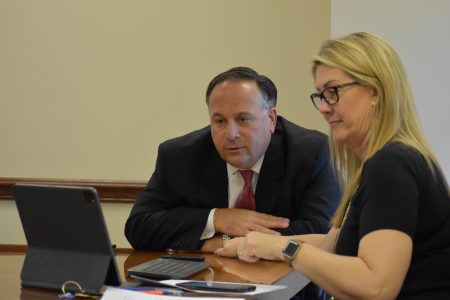
Photo by Eric Ayres Wheeling Area Chamber of Commerce Executive Committee member Andy McKenzie and President Erikka Storch listen to a presentation Thursday by research officials from West Virginia University who have developed a Greater Wheeling Regional Action Plan for Economic Development.
WHEELING — The greater Wheeling area must better define its identity, and its workforce needs to be trained for jobs available in the Ohio Valley, according to a study released Thursday by West Virginia University.
These two key points were among other recommendations made during a presentation of the Greater Wheeling Regional Plan: Action Plan for Economic Development. It is considered the centerpiece in a series of reports completed by WVU researchers tasked to analyze economic development efforts in the multi-county region surrounding Wheeling.
The Wheeling Area Chamber of Commerce funded the study, performed over the course of the past 18 months by researchers from WVU’s Bureau of Business and Economic Research and the WVU Extension Services’s Family and Community Development.
“Eighteen months of diligent research has uncovered many economic-related issues,” Tanner Russell, chairman of the Wheeling Area Chamber of Commerce Board of Directors said, “as well as a set of steps that can be taken to improve the areas where those issues have been located.”
While the economic development study focused on an eight-county area around Wheeling — including Brooke, Hancock, Marshall, Ohio and Wetzel counties in West Virginia and Belmont, Jefferson and Monroe counties in Ohio — researchers noted that the Northern Panhandle region lacks a clear and cohesive identity.
“One thing that became apparent as we looked at this is: What is the Wheeling region?” said Dr. Michael Dougherty, WVU Extension Specialist for Community Resources and Economic Development, noting that 71% of respondents in the eight-county survey area were from the Wheeling and Ohio County area only. “You have to define the Wheeling region. There are so many different ways to define it.”
Dougherty said this could be the entire Northern Panhandle or could include only the counties in the Wheeling MSA. It could also include more Ohio Valley counties in Eastern Ohio or may be defined by areas involving various regional partnerships or programs administered by RED (the Regional Economic Development Authority) or Belomar Regional Counsel.
“Essentially, depending on where you are may depend on what you are able to do,” Dougherty said. “Once you know the ‘where,’ the ‘what’ becomes much more clear.”
Wheeling Area Chamber Executive Committee member Andy McKenzie, who was committee chairman when the study was launched, noted that although Western Pennsylvania often is not considered part of the local community, much of the local workforce commutes from the Keystone State.
The geographic dynamic of the Northern Panhandle — sandwiched between two states and within an hour’s drive of the Pittsburgh metropolitan area — makes the Wheeling economic region very unique, officials noted.
Researchers recommended that local leaders continue to monitor and pursue “industrial clustering,” watching local trends in industries such as health care and oil and gas, which are major employers in the region. Redevelopment for long-term goals was another recommendation.
Economic growth depends not only on attracting businesses and workers to the area, but also working to maintain what is already here, officials said.
“People like the Wheeling region,” Dougherty said. “They like what is here. They like being here. They feel it’s a good place, but there are things that need to be improved.”
This doesn’t mean reinventing the region, but reinvesting in it, Dougherty said.
Researchers compared the supply and demand for skilled workers in the area. They noted an imbalance in training and education, indicating that many local students are preparing for careers that do not exist in abundance locally, while the local workforce has positions for which training is not always available in the area.
“We have more people who are coming out of the area’s colleges and universities that are able to meet the demand we are expecting,” said Dr. Eric Bowen, research professor for WVU’s Bureau of Business and Economic Research, “which may mean that those people need to look elsewhere to find a job that matches their skills.”
This data coincides with West Virginia’s continued population decline and significant decline in available jobs in recent decades, and those numbers are continuing to slide, researchers said.
“We have a lot of work to do, obviously,” Erikka Storch, president of the Wheeling Chamber, said. “We really need to reach out to our extended communities and get their buy-in.
“I’m a firm believer that rising tides raise all ships. We don’t want just Wheeling and Ohio County to be successful. It’s very important for us to grow as a region.”
Complete reports from the WVU study on the Greater Wheeling Regional Plan can be found online at business.wvu.edu/bber.
Top Headlines
WVU Medicine Talks New Cancer Center With Community Leaders
Fitzsimmons Foundation $1M Gift To Benefit New Oglebay Sports Center
Chamber Clocks In On School Start Time Debate
WHEELING – The Wheeling Area Chamber of Commerce wants to know what its members think of the proposal that Ohio ...
Repaired ‘Doughboy’ Statue Returns To Wheeling Park
Weekend Fires Battled in Bellaire, Moundsville