
Policing Practices In Focus
Trending
WHEELING -- Keeping the peace in an era of deepening substance abuse and public scrutiny driven into the stratosphere by the murder of George Floyd is a tightrope walk, according to area police.
So, how are they functioning under such circumstances? What steps are being taken to decrease the odds of a tragic policing outcome? Is the de-escalation recently promised by police in this state's capital the answer here? What would that look like on Wheeling's streets?
Two area police chiefs -- from the larger Wheeling department and a smaller force in Moundsville -- shared their thoughts.
IN FULL VIEW
In Charleston, police pledged this June to pursue de-escalation.
The promise followed two incidents -- the force-laden arrest of a Black woman in 2019 and the shooting of a knife-wielding Black man earlier this year. Heavy criticism came from diverse sources including Charleston's mayor, Wheeling native Amy Shuler Goodwin, and the American Civil Liberties Union.
The de-escalation plan includes a commitment to increasing the number of officers wearing body cameras and a move toward "less-lethal" forms of force such as stun guns and specialized shotguns that shoot bean bags rather than bullets. Training for the better handling of mental health crises is also in play.
While Charleston officials sort out their own plan details, Wheeling Police Chief Shawn Schwertfeger and Moundsville Police Chief Tom Mitchell said such a policy and more is already going on locally.
Choke holds like the one that killed Minneapolis resident George Floyd? They're already banned for Wheeling's nearly 70 officers, Schwertfeger said.
Mitchell noted his department of 17 officers also takes precautions such as not placing large suspects who might not be able to sit upright in the back of a squad car on their stomachs while in handcuffs -- a practice that can cause "positional asphyxiation."
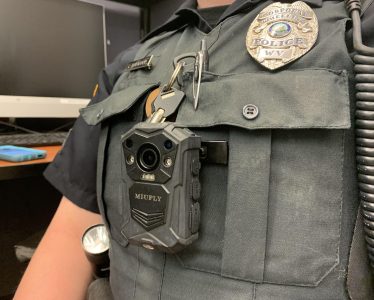
Body cameras? Both departments already have enough to keep every officer's actions in full view -- for more than one reason.
The wearing of such cameras is not only a constant reminder to officers that their interactions may face review, it is a form of protection against potential false accusations, Mitchell said.
He noted community members sometimes approach him at Moundsville police headquarters with complaints that -- thanks to a $25,000 grant that purchased the cameras and the massive computer server that underpins them -- can be checked for truthfulness.
"No, the officer was not rude. He did not swear," Mitchell said he is pleased to frequently be able to respond given the electronic record. "It's a very valuable tool for us."
In Wheeling, whose force swells to nearly 80 when fully staffed, the situation is much the same, Schwertfeger said. "We don't make it mandatory at this point, but that's coming."
He noted that even before the department was able to purchase enough cameras to cover every officer on duty, some had gotten their own as a sort of individual insurance policy.
Along that line, he also moved to make all records of "use of force" public since coming to Wheeling nine years ago from an urban area in Virginia.
Everything from a motor vehicle pursuit to the discharging of a gun is included. (The annual reports can be reviewed at wheelingwv.gov/departments/Police/wpdannual-reports.)
Wheeling also created a standards board to review any complaints filed against officers.
Schwertfeger said the average is 10-15 complaints per year.
DATA DRIVERS
Schwertfeger said knowing such numbers is part of keeping community peace. When he was working in the Charlottesville, Virginia, area, several departments joined for group analysis of their actions, particularly shootings.
"We found that we were mostly dealing with folks that were in acute crisis with mental health issues," Schwertfeger said.
When the departments responded to the data by training 75% of their officers to better deal with such individuals and those who are experiencing similar crises related to substance abuse, the shootings dropped dramatically.
Schwertfeger is now rotating Wheeling officers through the same kind of week-long training in groups. The second round -- which occurred this January and was funded by the state Department of Health and Human Resources and Youth Support Services -- paid off in less than a week, he said.
"We had a person up on the roof of a home on 14th Street in East Wheeling," Schwertfeger recalled. "He was just raging, high on methamphetamine and wanting to kill himself."
Schwertfeger was on the ground and feeling proud as he watched three freshly trained officers at work. "They were able to talk this guy down," and get him to the hospital.
DE-ESCALATE VS. DE-FUND
Mitchell, a 37-year veteran who previously worked with the Wheeling department, said smaller forces also recognize the value of such training, but don't have the funds.
"Where does the mental health issue begin and drug usage end?" he said of dealing with Moundsville's more present reality.
Cost is also an issue in terms of equipment. He added that Moundsville -- which doesn't experience much violent crime -- has enough funding for stun guns and pepper spray plus the training needed to use such weapons skillfully.
But, the smaller city can't afford the less-lethal shotguns that Wheeling has had for four years and Charleston is moving toward now. Such guns -- which are immediately recognizable by their bright orange stock -- fire bean bags meant to incapacitate rather than kill.
"Everybody would like to have as many tools as they possibly can," Mitchell said. "(But) there's only so many things you can practice with and be proficient with."
Schwertfeger said that is one of the ironies of the George Floyd era. While outrage led some to consider de-funding facets of police work, the crisis training and less-lethal equipment that can lead to a demonstrable de-escalation of policing is expensive.
A flipside of keeping that safer peace is that policing is a dangerous job that doesn't always pay that well, both men noted.
"Policing is a profession," Schwertfeger said, adding that a starting salary of $42,000 for Wheeling officers doesn't seem to be enough to keep the department fully staffed. He noted most professionals don't start the day wondering if they will be alive at the end.
Schwertfeger said three friends have been killed while on duty. Mitchell noted that even a weapons-free encounter can end in a wrestling match.
"We're not supposed to hurt people," Mitchell said of understanding that retaliation is not lawful. That doesn't mean it's easy. "Once you've been poked in the eye, you've been poked in the eye. Policemen are people."
ONE COMMUNITY
Schwertfeger suspects that a less-tangible recognition of humanity is actually the core of a safer peace. In yet another irony, he said that came home to him during non-violent protests of George Floyd's murder that took place in downtown Wheeling in May 2020.
A small group of young protestors, many of them people of color, broke off from the main group and headed toward I-70, he said. Fearing a fatality could result, police moved from observation to de-escalated deployment.
"This is one community ... They knew the Wheeling police officers (and) dialogue was immediate," Schwertfeger said. "It was really nothing, but that was a very powerful moment and that was a good thing."