
Governor Jim Justice Calls Special Session To Begin Monday on Redistricting, COVID-19 Funding
Trending
CHARLESTON -- Gov. Jim Justice on Friday called a special session starting Monday for the West Virginia Legislature to officially consider congressional and statehouse redistricting, as well as spending requests.
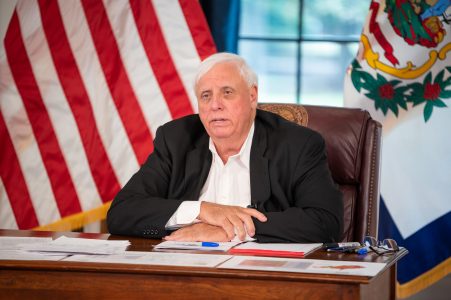
Justice announced the redistricting special session during his Thursday COVID-19 briefing at the State Capitol in Charleston.
"This is on all the redistricting that we have to do. We have to do this," Justice said. "The special session is part of the Legislature's constitutional duty to redistrict the state of West Virginia."
Both redistricting committees of the House of Delegates and the state Senate have met over the last few weeks after holding 12 regional public meetings and three virtual public meetings to collect input on what congressional, House and state Senate district lines should like look.
The House Redistricting Committee has held one meeting so far, with proposed congressional redistricting maps and one House of Delegates map that turns 67 districts into 100 single-member districts.
The Senate Redistricting Committee has met five times, including having a meeting Friday. While committee members are reviewing eight proposed senatorial district maps, the committee is doing the heavy lifting of taking the state from three congressional districts to two. The committee is working to find consensus on one congressional redistricting proposal out of 21 proposals that have been submitted by committee members. Three proposed maps were eliminated since last week.
The question for lawmakers is whether to draw two districts that split up areas with high population growth -- such as the Morgantown/Monongalia County, Eastern Panhandle, and Putnam County areas - or to split the state into a southern district and a northern district.
Whichever idea prevails, both districts must be as close to equal population as mathematically possible, be bounded by county lines without splitting counties, and consider compactness. While some maps scored high in the Maptitude software being used for compactness, those maps had larger population deviations, while maps that were statistically equal in population had poor compactness scores.
"This, in my opinion, highlights the balancing that this committee and ultimately the whole Senate and the whole Legislature is going to have to do," said Senate Redistricting Committee Chairman Charles Trump, R-Morgan. "Those … are constitutional requirements."
Supporters of the northern/southern map concept want to keep Southern West Virginia -- and particularly Kanawha, Putnam and Cabell counties - together in a district that provides an opportunity for its next member of Congress to easily represent the region's interests. Supporters of a more east/west split want to keep the Morgantown/Monongalia County and Eastern Panhandle area separate.
Committee members also must decide the new boundaries of the state Senate's 17 districts, taking into account population growth and loss in different regions of the state. Nine out of the 10 proposed senatorial maps take into account population growth in the Morgantown/Monongalia County area by giving the county its own senatorial district. The county has been split between the 2nd and 13th senatorial districts for decades.
Justice said Thursday he would have lawmakers also consider some appropriations requests of federal funds. The Legislature is required to meet and consider any use of federal funds during a state of emergency of more than $150 million. The Legislature also must grant spending authority for state agencies for spending certain federal funds that have specific requirements.
West Virginia was slated to receive at least $4 billion in funding through President Joe Biden's American Rescue Plan, including $1.36 billion directly to the state for use in COVID-19 aid and infrastructure spending. Senate Finance Committee Chairman Eric Tarr, R-Putnam, told committee members there could be as many as 50 supplemental appropriations bills for lawmakers to consider.
"This is the largest list of supplementals I've seen in my time around here," Tarr said. "The money that has come into the state agencies through the (American Rescue Plan) funding … the agency is directed to spend it in this manner, and we have to go in and grant spending authority. At a glance, we'll be giving spending authority of around $1 billion if the Legislature so chooses to do that."