Wheeling City Council Approves First Demolition Under New Historic Review Procedure
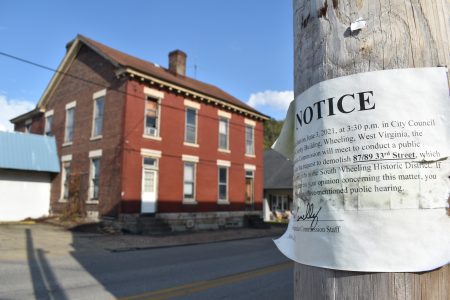
Photo by Eric Ayres This structure on 33rd Street in South Wheeling was the first in the city to undergo the new historic demolition review. Despite opposition to the proposed demolition by historic preservation entities, city leaders agreed with the property owner that the many renovations needed to bring the building back into use would be cost-prohibitive.
WHEELING — The first property to face the city of Wheeling’s new historic review process for demolition requests has been considered, and city council members agreed that the 120-year-old building can be razed.
Although the residential structure at 87/89 33rd St. was built in 1900 and boasts some elements of historic architecture, officials this week agreed it would be cost prohibitive to rehabilitate the building and make it suitable to function as a residential space.
Earlier this year, Wheeling City Council approved a measure requiring property owners in historic districts to apply for a demolition permit before a building can come down on properties that are considered to have “contributing structures” within a historic district.
A review process was put in place so members of the city’s Historic Landmarks Commission could consider the proposal and make a recommendation to council.
The review allows input from neighboring property owners and others with a vested interest in the historic district where a demolition has been proposed. City leaders had noted that before the new demolition review ordinance was enacted, historic properties could simply be raised without any consideration of investments made by others who have invested in their historic neighborhoods, even those districts that already have design review regulations in place for facade improvements or alterations.
In this particular case, there were people who voiced opposition to the demolition of the 33rd Street building, as the Historic Landmarks Commission noted in a report on this matter to council last month. Since the time a demolition permit application on this property was first read on May 6 of this year, members of the South Wheeling Preservation Alliance and the Friends of Wheeling have spoken in opposition to the request.
However, the Historic Landmarks Commission had not yet issued a recommendation on the proposal after conducting a public hearing and gathering input. Instead, the application was delayed to allow all involved parties to further investigate options.
Tambria Vossen — who along with her husband, Brian, own Vossen Realty in Wheeling — spoke before Wheeling City Council this week, urging the panel to assert a final say on the issue and allow the demolition to take place. Vossen said they had purchased the property with the intention of renovating it but have found that it would be too costly to make the investment worth the trouble.
“I know — with its deed — that it is historical, and we totally respect that,” Vossen said. “Our first objective is not to demolish property. We’ve restored a lot of properties that had been in dismal shape. It took a lot of effort, and they are superb now. Unfortunately, with this particular property, the only historic look and feel of it is in the front.”
Vossen said aside from the historic facade, the rest of the structure requires major work in order to make it fit for use again. But the building in question would need new windows, a new roof, mold removal, a new electrical system, new rear exits and all-new heating, ventilation and air conditioning systems.
“We’ve tried to do our due diligence to try to see if there was any economical way to save this structure,” Vossen said. “Unfortunately, the best cost we could come up with was well over $200,000.”
The Vossens have been encouraged to seek funding to help rehabilitate the building, but the funds that are available would not even “make a dent” in the cost of fixing the unit, which provides only small living spaces that would never allow the owners to recoup such an investment.
Vossen Realty has dedicated its resources to rehabilitate many properties throughout the city over the years, the owner noted.
“We are committed to South Wheeling, Center Wheeling, East Wheeling,” Vossen said. “We’ve got properties everywhere, but this just doesn’t make economic sense for us.”
On the 33rd Street property, there is the residential building and a “non-contributing” commercial building that is functional. Vossen said they would like to tear down the residential structure and invest in enhancements to the commercial site to make it a functioning and viable facility in the neighborhood.
“If we were allowed to tear down property, we would turn it into green space — a family friendly area, not a parking lot,” she said.
Councilman Ty Thorngate said this has been the first historic demolition application to come through the Historic Landmarks Commission since the new ordinance was passed earlier this year.
“I think it’s important to point out that the overall goal for that ordinance was to just delay demolition, not to deny,” said Thorngate, who serves as the city council representative on the Historic Landmarks Commission. “We’ve spent since June looking to find if there are any alternatives to demo. We’re not going to sit here and force them to sell the property. We’ve looked for alternatives, and there are none. While it’s painful to see a historic building go, overall they do have the right to tear it down.”
Thorngate encouraged his fellow council members to support the proposal to allow the demolition, particularly since the owners plan to enhance the adjacent commercial property. Ultimately, council members agreed to approve the demolition permit.
“I’m very much in favor of historic review, but the goal was not to put a stop to all demolition,” Mayor Glenn Elliott added. “It was just to make sure that demolition that does occur is done after exhausting all other viable options, and at least to put a pause on the process. We do want to preserve our historic architecture where we can. But I know first hand that old buildings often don’t make great economic sense.”
Top Headlines
Voice of Valor: Clark’s Life Shaped by Service and Second Chances

Mitchell Plant In Marshall County To Get U.S. Department Of Energy Funding

Picture Perfect Night for Fun Fest Fridays
W.Va. Foster Care Lawsuit Still Alive
CHARLESTON - A federal class action lawsuit filed during the administration of former governor Jim Justice ...

Weld Writes Book On Wellsburg’s Historic Homes