
Proposals Offer New Future for 1400 Block of Market Street in Downtown Wheeling
Trending
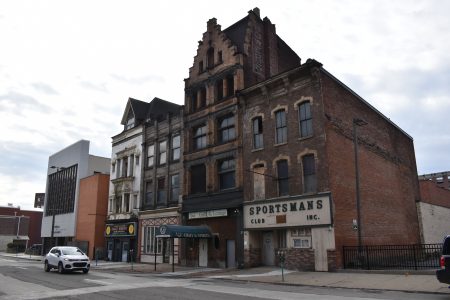
WHEELING -- A cluster of deteriorating old buildings in downtown Wheeling may soon be injected with hope for a new life, as city leaders look to select a new proposal for their redevelopment.
Action on the city-owned buildings in the 1400 block of Market Street has been a long time coming. The city purchased the properties at 1437, 1433 and 1492 Market Street in 2015 before any sitting city council member was on board. In 2016, shortly after current veteran council members first took office, the fourth building in the cluster -- 1429 Market Street -- also became available for purchase, so they bought it, too.
Most of the buildings in the cluster have remained vacant -- including the former Sportsman's Club and G&G Bar and Grill. The lower level of the 1437 Market Street building is currently occupied by the Market Street News adult book and novelty store, while the other spaces have remained vacant. Some portions of the buildings have been deteriorating, and sections of the rear areas of the properties were recently torn down.
This past week, members of the Development Committee of Wheeling City Council met with developers who submitted proposals to redevelop the 1400 block cluster.
Wheeling Mayor Glenn Elliott, chairman of the Development Committee, said the thought behind the city's purchase of the buildings originally was to tear them down and open up the prime section in the heart of downtown for development.
"The estimate to tear them down was around $350,000," Elliott said. "So the idea has been to take that money, and instead of tearing them down, market them to a developer to come save them and get the whole four buildings as a package to redevelop."
One promising developer had stepped forward with a proposal, but with the COVID-19 pandemic last year, that developer has since pulled out, the mayor said.
The city has since partnered with Wheeling Heritage to help bring in new options for the buildings' future.
"In conversations with Wheeling Heritage here in the last year, we made the decision that there's not a lot of time to keep hoping for them," Elliott noted.
"The buildings are not in great shape, but you can't just wait around for someone to come save them, you had to market them," said Betsy Sweeny, director of heritage programming at Wheeling Heritage. "So we partnered with the city to market the 1400 block and The Blue Church for historic redevelopment."
Sweeny said they collaborated with Steadfast City, a national economic development consulting company that connects cities, towns and nonprofits with qualified preservation developers. Steadfast City created a request for proposals and marketing campaign for them to advertise the buildings.
"That campaign ran for about two to three months and ultimately landed us with a handful of interested developers that submitted proposals for the buildings," Sweeny said.
Two of the three proposals for the 1400 block on Market Street were accepted by the city and were pitched to the Development Committee last week. Desmone Architects of Pittsburgh submitted one proposal, and TMR/BSG (architects T.M. Rybak & Associates and construction management firm Boiling Springs Group LLC) of Rutherford, N.J., submitted the other.
"These are both very thorough proposals," Elliott said. "Both are very different I would say -- one is more focused on a mixed use, with retail and a restaurant, activating some of the space on the first floor with upper floor apartments. In the back area where Tin Pan Alley used to be would be part outdoor decking and part parking.
"The other proposal is much more focused on just filling up every space, including new construction in the back with almost all residential and some office space. It's a different concept with maximizing every inch on that with residential - I think he packed in 48 units."
The Desmone proposal eyes a retail space on the lower level of 1437 Market Street, while the lower levels of the other three buildings would be combined into one large restaurant with outdoor seating and parking in the rear. A new stair tower would be constructed and used as a fire escape for the upper floors of the structures, which would be redeveloped as AirBnB units -- which developers say are desperately needed downtown -- complete with a local history motif.
The TMR/BSG proposal transforms the current lower levels of the buildings into office spaces or office/store spaces. All of the upper levels would be redeveloped into apartments, and new construction on all available spaces in the rear of the facilities would also see new construction of apartments.
Aside from simply assuming ownership of the properties, the developers are seeking different incentives from the city. Desmone's request is the original $350,000 that the city had proposed for redevelopment as opposed to demolition. The TMR/BSG funding gap is about $2 million, officials said.
City leaders are still taking both proposals under consideration. They plan to review details of the comprehensive proposals and vote in a future Development Committee meeting before sending a recommendation to city council for final action, which officials said they hoped to complete by year's end.
Officials said developers are also exploring the potential of opening a "revitalization corridor" in the area, simply for the fact that the more buildings that are involved, the more funding assistance becomes available for their project.
In fact, the investments pitched these properties outweigh the overall estimated market value of the properties once redevelopment is completed. The Desmone proposal states that the project development budget is around $6.65 million, while the estimated value after development is $3.4 million. That "gap" in value is made up by the many financial incentives, tax credits, grants and loans available for these types of historic renovations.
The old buildings in the 1400 block of Market Street have some vintage architectural features and do qualify for a wealth of funding assistance, including state and federal historic tax credits, new market tax credits, USDA loans, grants, the city's own facade improvement program and other funding boosts.
Officials said that's why the pitch for even more buildings for the "revitalization corridor" could be a win-win for the developer and for the city.
"With community development financing that's available, you can get a good allocation, but if you have a larger project that encompasses a lot of buildings, you can get an even better deal if it includes more properties," Sweeny said.
Wheeling Heritage purchased The Blue Church - an historic, pre-Civil War facility at 1206 Byron St. - and plans to receive and review requests for proposals from developers for that property through the same process as the 1400 block buildings.