
Parents Want Book Banned in Berkeley County Schools
Toni Morrison’s ‘The Bluest Eye’ Spurs Debate
Trending
Kandice Eckert recalled the day her 10th grader at Spring Mills High messaged her about a reading assignment.
"She's reading the book, and she sent (Shawn Eckert) a picture of the page," Kandice said. She's like, 'Oh my God. Look what they're making us read.'"
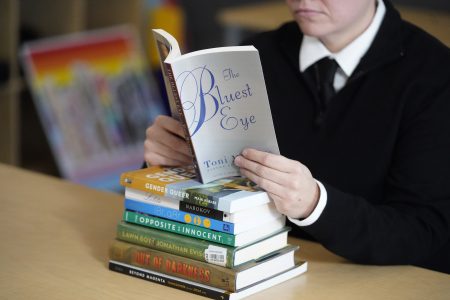
The book in question is "The Bluest Eye" by Toni Morrison, and the page is No. 163, the conclusion of a passage that describes a father raping his daughter.
"The Bluest Eye" is set in 1941 and follows a young African-American girl growing up in the Great Depression. According to Wikipedia, the story relates to how she is regarded as "ugly" due to her mannerisms and dark skin, resulting in an inferiority complex as she desires blue eyes, which she equates with "whiteness." The rape is told from the point of view of the main character's father.
The book was being read in a 10th grade honors English class at the high school, and since Eckert took to Facebook to share her displeasure with the assignment and alert other parents, discussion has swirled around social media about whether or not the book should be allowed in local classrooms.
THE ECKERTS
Kandice said following the message from her daughter, she contacted Spring Mills Principal Jason Kamlowsky, who, she said, looked into the book to find that it's on the approved reading list for the county. Kandice said she appreciated his looking into the situation and how he handled the situation, understanding the decision does not fall on the principal, but she is calling for the book to be banned.
"The teacher was saying about using it for racial inequality, which the book, where it's based, I get that, but the whole book is just descriptive," Kandice said.
According to the Eckerts, only certain portions of the book were to be read by the class, including the passage that contained Page 163.
"My daughter said that every time they do a book, they read it aloud in class," Kandice said. "She's like, 'This time, she didn't want to read this one aloud in class.' I can see why."
Since the initial text from their daughter, Kandice and Shawn said they have researched the book, seeing differing opinions on the appropriate level for reading, some places saying 15 and older while others saying 18-plus. They also made note of several districts across the country that have already banned the book or have had it challenged to be banned.
Most cases against the book site "lewd" content and "graphic" descriptions, which are the most concerning for the Eckerts. Kandice explained their daughter has been an avid reader since a young age, an overachiever who is almost sure to read ahead in class, but the family is concerned for those students who might read ahead, unaware of what was coming, or those who might be triggered by the content by personal experiences.
"I'm sure there's kids in that school who have dealt with rape or sexual assault," Eckert said.
"What kind of trigger is that going to be for them? What kind of memories is that going to bring back or thoughts that they're already having to deal with?"
The Eckerts said a trigger warning was provided prior to the assignment and that their daughter and students who requested one were provided an alternative assignment and the chance to step out of the classroom when "The Bluest Eye" was discussed.
She stressed that she knows sex is not foreign to teenagers and that some are having sex, but the family feels its not the place of a school to be having those conversations in an English classroom.
"I'm all for teaching them racial inequality," she said. "I'm pretty open-minded. But that's just way over the line."
Kandice and Shawn said the text from their daughter was an eye-opener and reminder that parents need to stay up to date on their children's lives and school, adding they are fortunate to have strong relationships with their children, who often talk with their parents. However, the couple voiced concern over those children who don't have conversations with their parents or who may not have that solid support system or those who may discuss the book with younger siblings.
SOCIAL MEDIA DISCUSSION
After Eckert's post, social media began to flood with outcry on both sides of the conversation: should the book be banned or not?
Efforts to ban books have been on the rise across the country recently, which according to an article from the New York Times, has been unprecedented.
"Parents, activists, school board officials and lawmakers around the country are challenging books at a pace not seen in decades," a New York Times article from Jan. 20 said. "The American Library Association said in a preliminary report that it received an 'unprecedented' 330 reports of book challenges, each of which can include multiple books, last fall."
As of Thursday afternoon, Eckert's post had 211 comments and had been shared 173 times as conversation continued almost a week later.
Many comments asked if the book was banned in other places, why not Berkeley County, and others turned to the scripture as a way of support for not allowing "The Bluest Eye."
"I think collectively, as a community, we need to stand up for this and not let this one slide," Jacob Barrett commented on the original post. "This is a pollution to the minds of our youth (our future)."
The conversation turned into a back and forth when Spring Mills teacher Jessica Salfia defended "The Bluest Eye," by citing descriptive parts of scripture that discussed sex, including Genesis 19, 2 Samuel King David and Song of Solomon.
"The largest complaint seems to be regarding the explicit sexual content. In the book, an 11-year-old girl is raped by her father. This scene is horrific, and I completely understand how this can be difficult and triggering for some students and families." Salfia wrote. "I can speak firsthand that any book with this type of material is handled with care, scaffolding and extreme professionalism by the educators at my school. Students who express discomfort are always offered alternative assignments or given the choice to skip parts of the text that may be triggering for them.
Salfia ended her post by asking where the line will be drawn if "The Bluest Eye" is banned.
Posts responding to Salfia's continued the conversation, one in particular that gained traction discussing the emotions felt by the main character surrounding the rape.
"That book you're defending sends the message that if a parent rapes you, it's their way of loving you," Chantelle Huffer posted. "That her father still loved her. That's explained in the book. … So essentially if one of your students is being raped by her father, she may think her father still loves her and maybe she shouldn't get him in trouble."
THE DISTRICT'S RESPONSE
Berkeley County Schools addressed the discussion and concern being had, noting the need to examine the book and similar incidents as times change.
"I think that one of the issues that we need to be mindful of is that as we move forward in looking at where we currently are, we understand that there are a variety of different viewpoints and positions and parents have their kids' interests at heart, as we do, as well," BCS Superintendent Dr. Patrick K. Murphy said. "We do have processes in place for how when these issues arise that we are going to look at them and move forward.
"We probably need to step back and relook at some of the things we are currently doing and making sure everyone is fully abreast and knowledgeable about what's happening."
Director of Secondary Leadership Holly Kleppner, who has served both as an English teacher and administrator in the past, noted these types of concerns and discussions are not new.
"I was an English teacher before I was a principal, and you always hand out your syllabus that has your reading materials on it so it can be viewed by the student or parent ahead of time," she said. "You always offer an alternative assignment if somebody feels uncomfortable. That's just a process that's been in place for a very long time. Different types of books pop up occasionally, and we have to reevaluate them because of the times. Different times, sometimes the classics, people are concerned with. Now that we have a lot of diversity, people are concerned about some of those topics."
She said when concern arises, it's always time to take a step back and reevaluate, explaining the recommended reading list is tied to the textbook adoption process. This current list, she said, has been around for roughly four years.
Kleppner added that teachers are good about providing alternative assignments and providing trigger warnings, which are more commonplace in modern times.
Kleppner stressed that these types of conversations are always good to have as each party has the students' best interest at heart.
"You're always going in the best interest of the student," she said. "You want to educate the student in a global society and a diverse society. You want them to have options, even if just pulling excerpts from books to give them different perspectives. That's our job as educators. We want to continue to do that, but if a parent raises a concern, they need to contact the principal and express those concerns so we can look into that."
Murphy urged parties on both sides to have perspective on all viewpoints as the situation gains attention.
"We don't want to do any harm," he said. "We want to do what's in the best interest of kids, and we're going to continue to work with our community and parents to accomplish that."