
Anti-Critical Race Theory Bill Is on Brink of Finish Line
Storch Breaks With GOP To Oppose Bill
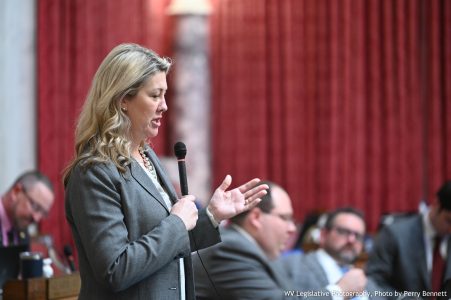 Photo courtesy of WV Legislative Photography
 Trending
CHARLESTON -- All eyes were on the West Virginia House of Delegates Friday, the day before the end of the 2022 legislative session, as it passed several bills after lengthy, contentious debates.
The House gaveled in late Friday morning working its way through more than 20 bills on third reading to get them over the finish line by midnight Saturday, when the session ends for the year.
The House passed Senate Bill 498, the Anti-Racism Act, in a 75-24 vote Friday afternoon, with Republican delegates Erikka Storch, R-Ohio, and Ruth Rowan, R-Hampshire, voting against the bill. The Senate will need to concur with changes made to the bill by the House.
SB 498 prohibits the teaching that one race is morally or intellectually superior or inferior to another; or that one race is inherently racist either consciously or unconsciously in West Virginia K-12 public schools.
The bill prohibits teaching that an individual's moral character is derived from their racial identity or that they bear responsibility for actions committed by those of similar racial backgrounds. It includes protections for free speech, historical discussion, and academic freedom under certain circumstances as long as alternative theories are discussed. It also includes a complaint and appeal process for students, parents, and staff to report violations of the provisions of the bill.
"I'm going to vote for this bill, because I don't believe that I am responsible for the actions of my ancestors 100 years ago," said Del. John Kelly, R-Wood. "I don't believe that an individual's moral character is determined by his race. I don't believe that. I believe this country has come a long way since 1946 when I was born."
"Unfortunately, there are those who would seek to promote identity or personal worth or personal values and even the future prospects of our kids and tell those kids that all those characteristics are pre-determined by the color of your skin," said Del. Todd Longanacre, R-Greenbrier. "That's unfortunate."
The bill is aimed at concerns over concepts and philosophies often linked to critical race theory (CRT). According to PEN America, a free speech rights advocacy organization, 174 similar bills have been introduced across 38 states since the beginning of the year. Opponents of the bill believe it will chill serious discussions of race in the classroom and be used to harass teachers.
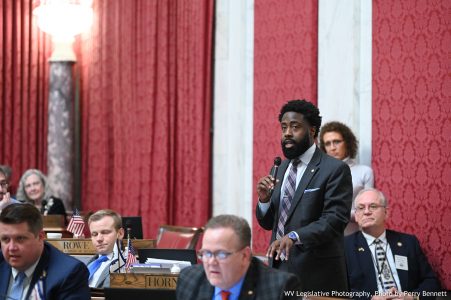 Photo courtesy of WV Legislative Photography
Del. Sean Hornbuckle, D-Cabell, seen here earlier in the 2022 legislative session, said Friday that SB 498 was simply a way to attract votes.
"I wish this bill was written for us. I'd probably have a complaint," said House Education Committee Minority Chairman Sean Hornbuckle, D-Cabell, one of four Black lawmakers in the Legislature.
During his floor speech against the bill, Hornbuckle held up multiple images depicting acts of racism and prejudice from history, gauging the reactions of Republican lawmakers.
"It's about a political play to reach into the pockets of America, spreading disinformation to get elected," Hornbuckle said. "It all stems from CRT, which time and time again we have spoken about. It is about the cross-sectionality of racism and law and has never - and I repeat - never spoke that anyone is better than anyone and that anyone should feel guilt. It doesn't teach that. … We desperately need to do better."
"This bill puts apprehension in the classroom. This bill handcuffs teachers," said Del. Danielle Walker, D-Monongalia, the Legislature's only Black woman lawmaker, reading from a letter from a constituent. "While you say it won't, you know the intent is to keep things comfortable, to share only what is not rocking the boat. Be bold, I ask you. Think of our teachers, think of our students. West Virginia has strong people who shouldn't be pushed to live in the dark or live with fear."
The House passed Senate Bill 268, creating exemptions from compulsory school attendance for children who participate in learning pods or micro schools, in a 56-41 vote. The bill lost 19 House Republicans, including House Education Committee Vice Chairman Joe Statler, R-Monongalia.
Learning pods are defined as a voluntary association of parents choosing to group their children together to participate in K-12 instruction as an alternative to enrolling in public schools, private schools and homeschool. A micro school is a tuition-charging school initiated by one or more teachers. The bill would require parents to inform the county school system that their children are participating in a learning pod or micro school.
The bill as it came over from the Senate limited learning pods and micro schools to no more than 100 children. The House Education Committee removed those limits in an 11-8 vote earlier this week. The bill also exempts learning pods and micro schools from the same health and safety regulations required upon private, parochial and church schools, such as fire, health, and safety inspections.
Del. Dana Ferrell, R-Kanawha, raised concerns about scam artists possibly starting micro schools and learning pods, charging tuition, and running off. Ferrell said he supported micro schools and learning pods, but the intention of those options is to offer educational opportunities to small groups of children, not to programs nearly the size of private schools.
"I'm not concerned about the freedom of people to be able to choose what type of education they want their children to have. I think that's a good thing," Ferrell said. "This just gives a license for people to do what they want to do. So I see red flags all over the place."
"All these other states that have these, I don't think I've heard anything in the news about the end of the days or the earth is ending," responded House Education Committee Chairman Joe Ellington, R-Mercer. "In these situations, these kids are going to be getting more one-on-one instruction than what they're seeing in our public schools. These kids usually do a lot better in the long run."
Senate Bill 1, creating a Mining Mutual Insurance Company, passed 61-36. The bill would create a company similar to what the state did for its medical professional liability program for physicians in 2004 (now part of MagMutual) and its workers' compensation program in 2005 (now Encova).
"This is simply another situation where we have got to take care of ourselves," said House Finance Committee Vice Chairman Vernon Criss, R-Wood.
The Legislative Auditor's Office released a report last year that found that five companies hold 90.7% of the state's coal mining reclamation bonds, with one company - Indemnity National Insurance Company - holding 66.9% of the bonds.
If one of these bonding companies would fail or if a mine operator abandoned its mine reclamation responsibilities, the state would be on the hook for millions of dollars through the emergency special mining reclamation fund. In order to start the new mining mutual insurance company, the state would use $50 million of tax surplus dollars and file monthly reports with the state Insurance Commission.
"If the current funding sources for the program were to prove insufficient to meet the demands of reclamation, the resulting additional financial obligations could prove to be detrimental to the state's budget," said House Finance Committee Chairman Eric Householder, R-Berkeley. "Does it cost less to be proactive than reactive? The answer is yes."
The $50 million would be required to be paid back once the company starts earning money through bonding and reclamation programs. But opponents of the bill raised concerns about using taxpayer dollars, how the loan would be paid back, and who the company is aimed at.
"We talk about picking winners and losers in here … but we're just going to be picking losers," said Del. Kayla Young, D-Kanawha. "People who can get bonds, they don't need this. This is for people who can't get bonds. This is only insuring high-risk people that people don't want to insure for good reason."
"I don't see how this is solving the problem," said Del. Shannon Kimes, R-Wood. "It doesn't solve the problem, but it creates problems and does no good in the end, because taxpayers are still going to be on the hook for the special reclamation fund."