
WVU Expert: Low Voter Turnout Boosted Mooney
Says Election Brought Out Most Conservative Core Voters
Trending
WHEELING -- Just over one in five registered voters across West Virginia cast ballots in this week's primary election, and that low turnout brought out the state's most "conservative core" supportive of former President Donald Trump, a West Virginia University professor suggests.
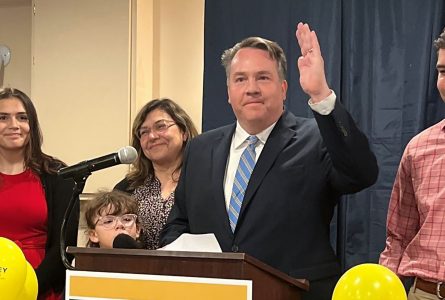
John Kilwein, chairman of the WVU Department of Political Science, explained that is likely why the Trump-endorsed U.S. Rep. Alex Mooney was able to defeat U.S. Rep. David McKinley on Tuesday by almost 19% of the vote to win the Republican nomination to West Virginia's new 2nd District U.S. House seat.
"Turnout was low, and the most committed core of the party came out," Kilwein said. "The question that raises is, does Trump still play a role? What we saw confirms that yes, he does still does have an impact.
"With two incumbents pitted against each other, it should have been a slugfest. You have to think turnout must have had some role."
Voter turnout was low Tuesday night for the primary election in the Northern Panhandle, though the number casting ballots locally still exceeded statewide numbers.
West Virginia had a statewide turnout rate of 22.73%, while all six Northern Panhandle counties posted turnout rates above that mark. But the local figures still were not very high.
Tyler County had the highest local turnout rate of 32.62%; followed by Ohio County at 28%; Hancock County at 27.16%; Brooke County at 25.04%; Wetzel County at 23.47%; and Marshall County at 23.02%.
Tyler, Hancock and Brooke counties had turnout numbers Tuesday that actually exceeded those they posted in the 2018 off-year primary election.
McKinley, a Wheeling native, won the most votes over Mooney in Ohio and Marshall counties, but lost in the other four counties.
Kilwein said the results indicate West Virginia as a whole still has "a strong allegiance to Trump."
"The conservative core has a distaste for Democrats, or anyone associated with Democrats," he explained.
Kilwein continued McKinley was viewed by many conservatives as having sided with Democrats when he voted for an infrastructure spending bill not supported by most Republicans, and for an investigation into happenings at the U.S. Capitol on Jan. 6, 2021, that they also opposed.
It seemed like "rational behavior" by McKinley to vote that the Jan. 6 events should be investigated, Kilwein said. Likewise, West Virginia has infrastructure problems, and it only made sense for him to support the infrastructure spending bill.
"But the conservative core does not want any cooperation with the other party," he explained.
Also playing a role in the low turnout was that voters saw few important races on the ballot, according to Kilwein.
"There really wasn't that much out there," he said. "This (McKinley-Mooney) was the only interesting one. It energized some small part of the electorate."
Kilwein expects there to be more interest 2024, when there will be a presidential contest and a race for the U.S. Senate seat occupied by Democrat Joe Manchin.
He suggested a move toward core conservatism in West Virginia was bolstered last year by redistricting efforts led by a GOP majority. He predicted that momentum is likely to increase.
"I think you are going to see a Republican majority that's going to be stronger at the end of the general election," Kilwein said.