
Deskins: Wheeling Area Economy “Not Fully Recovered” From COVID-19
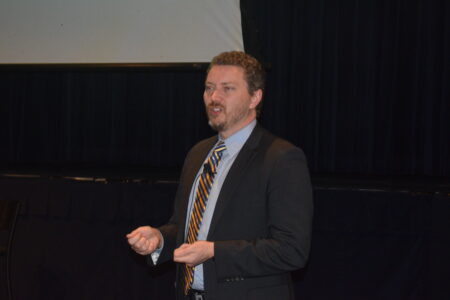 Photo by Derek Redd
 Trending
WHEELING - West Virginia University's top economic expert says the Wheeling area economy hasn't bounced back yet from the financial effects of the COVID-19 pandemic.
The Wheeling Area Chamber of Commerce hosted its 2022 Economic Outlook Conference Thursday morning at the Wheeling Island Hotel-Casino-Racetrack. Finance and business leaders provided their thoughts on the current economy, how it got to that point and where it is headed.
John Deskins, assistant dean and director of the Bureau of Business and Economic Research at West Virginia University's College of Business and Economics, told those attending that West Virginia has many good things going for it at present. Among these are an historically low unemployment rate and a slow but steady rate of growth.
"But the good things are very concentrated geographically," he said. "We have 45 of our 55 counties that are just moving sideways. The others have been stagnant.
"We have to find ways to expand that good news to more than just 10 counties."
He showed a map indicating that Marshall County was among those 10 leading growth counties in the state, along with Monongalia, Preston, Taylor, Harrison and Doddridge counties in North Central West Virginia, Berkeley and Jefferson counties in the Eastern Panhandle, and Jackson and Cabell counties along the state's western border.
Another graph detailed employment recovery in West Virginia county-by-county since 2020 and the pandemic. It showed all Northern Panhandle counties with a recovery rate of less than 96% since that time, with most other counties at 99%.
Deskins included more specific information about the "Wheeling area," which is defined as Ohio, Marshall and Wetzel counties in West Virginia, as well as Belmont County in Ohio. The counties all are in the same metropolitan statistical area, he explained.
"I can say it has been weaker here," Deskins said. "We have not recovered as much from COVID here as we have statewide.
"It's even worse than it looks because (pre-COVID) 2019 was a rough year for the Wheeling area."
Much pipeline construction in the area ended at that time, and Deskins attributed that to why employment numbers were already low in January 2020. In addition, both Ohio Valley Medical Center and the former East Ohio Regional Hospital closed their doors in late 2019.
Current unemployment numbers are overall a positive figure for the Wheeling area, he added. These are similar to the West Virginia average, which is at about 4%. The national unemployment rate is 3.5%
Local labor force participation rates, meanwhile, tell a different story. This measure indicated the percentage of people in the civilian labor force who are either working or actively looking for work.
West Virginia already has the lowest labor force percentage in the nation at about 55%, with the national rate currently at 62.3%.
Among the local counties, Ohio County's labor force rate was highest at 57.6%, with Wetzel's being the lowest at 46.5%.
"It's an older part of the state," Deskins said of the Wheeling area. "With that, comes lower workforce participation, and those lower demographics make it hard to get a lot of momentum on a region-wide basis."
In terms of per capita personal income, Ohio County is the richest county in West Virginia, according to Deskins. At about $70,000 per year, It exceeds the national level of about $69,000.
The average personal income level in West Virginia is listed at about $46,000, and that is on par with Belmont and Marshall county levels, the data indicates. Wetzel County is slightly behind at about $44,000.
Also speaking was David H. McKinley, president and chief investment officer at McKinley Carter Wealth Services, called the current economic state "a mixed bag." He said he has difficulty separating the state of the economy from that of the investments market.
"You've probably noticed the economy continues to look pretty strong, but the market is not," McKinley said. "We've had a really rough year in 2022 in both the stock and bond market, but the economy again continues to charge ahead.
"Unemployment is extraordinarily low, but the reality is the 2023 outlook for the economy is going to be pretty rough, and we have to prepare ourselves for that."
More jobs are being created each month, but earnings outlooks are "beginning to slow a bit," according to McKinley.
"The Federal Reserve is aggressively hiking interest rates to slow the growth of the economy - just to slow things down, and avoid the inflationary issues we have today," he said.
Leading economic indicators are slowing, "but not collapsing," he continued.
The economy doesn't reflect the current instability of the market, and McKinley believes "a lot will unfold" in the next six months."
"I wouldn't be a bit surprised if the fourth quarter of 2022 is a positive one - not enough to make up for the first three quarters of losses, but it will be a positive one," he continued.
He also believes that when the Federal Reserve recognizes there is a recession, markets will pick up.
"I know that sounds counterintuitive. But when (the Federal Reserve) achieves what they need to, they will start reducing interest rates and pull back," McKinley said.