
West Virginia Voters To Settle Education Power Struggle
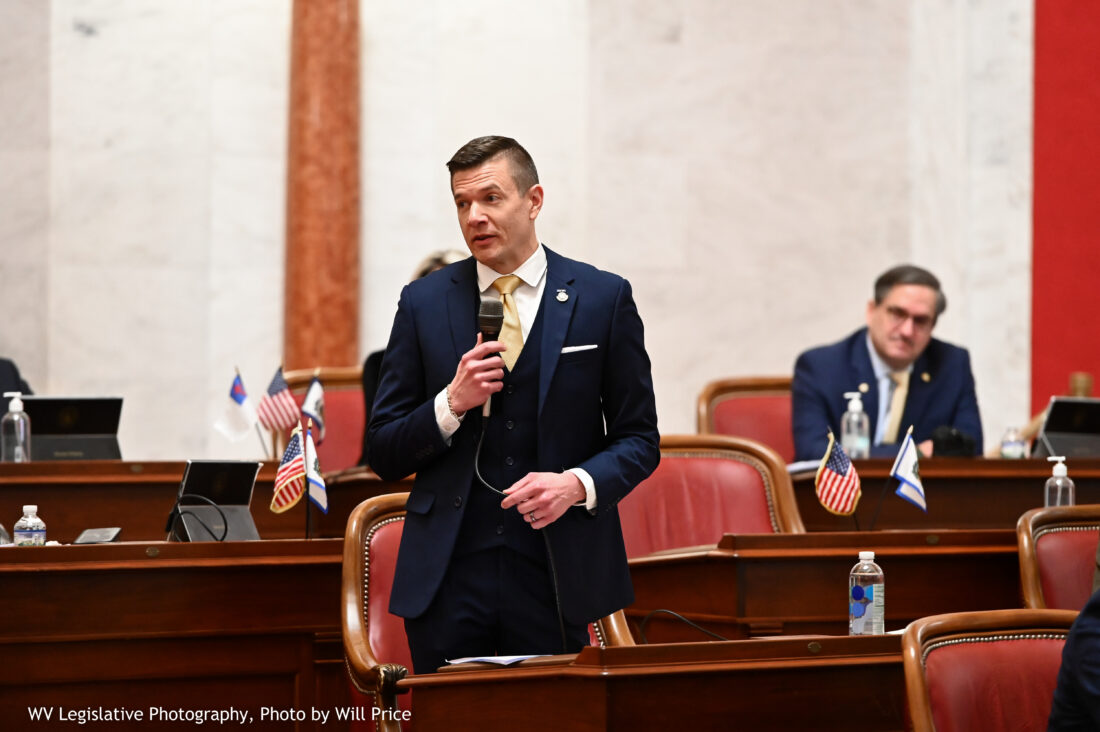
Senate Majority Whip Ryan Weld said Amendment 4 will provide more accountability for state education officials.
Photo courtesy of WV Legislative Photography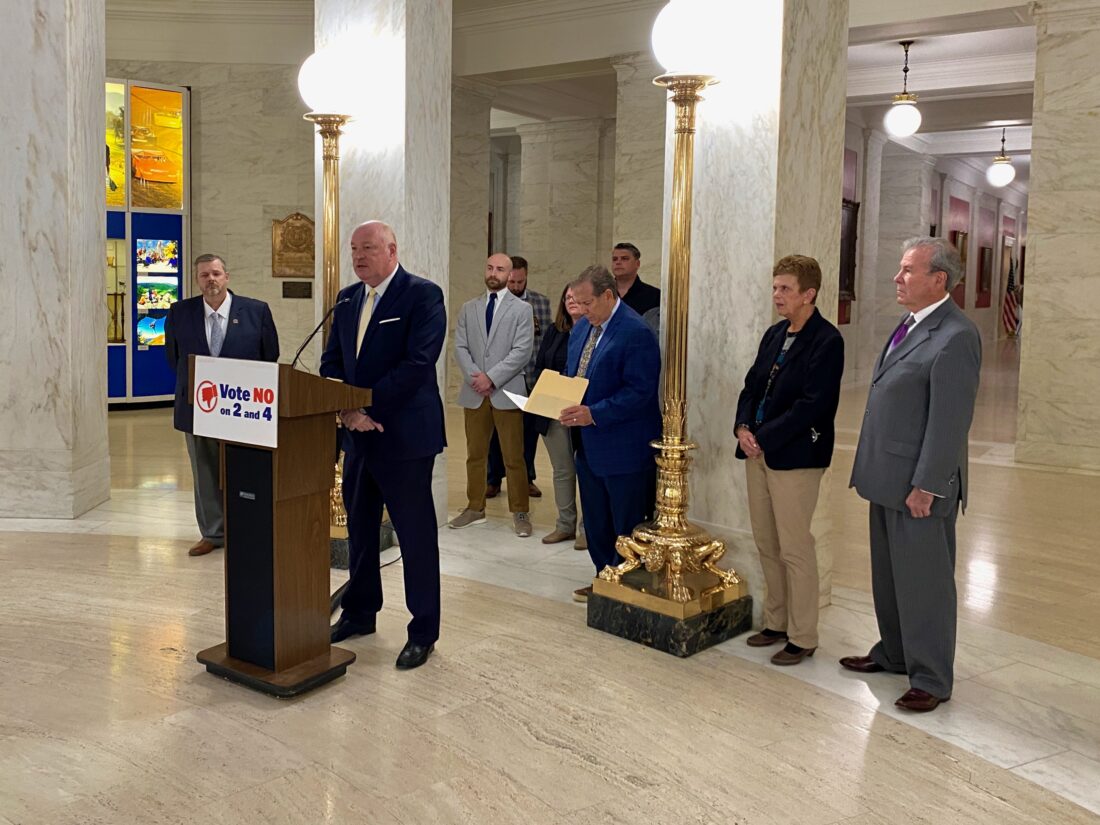
Dale Lee, president of the West Virginia Education Association, spokes out against Amendment 2 Tuesday morning, flanked by other public employee union representatives.
Photo by Steven Allen Adams
Legislative Rule-Making Review Committee member Rich Lindsay believes that Amendment 4 will inject politics into the educational process.
Photo courtesy of WV Legislative Photography
Senate Majority Whip Ryan Weld said Amendment 4 will provide more accountability for state education officials.
Photo courtesy of WV Legislative Photography
Dale Lee, president of the West Virginia Education Association, spokes out against Amendment 2 Tuesday morning, flanked by other public employee union representatives.
Photo by Steven Allen Adams
Legislative Rule-Making Review Committee member Rich Lindsay believes that Amendment 4 will inject politics into the educational process.
Photo courtesy of WV Legislative PhotographyTrending
CHARLESTON - Amendment 2 is getting all the attention these days, but voters in West Virginia have three other constitutional amendments to consider on the November ballot, including an amendment that would give lawmakers sign-off on education regulations.
Voters will head to the polls on Tuesday, Nov. 8, and vote for or against Amendment 4, putting the last state agency - the West Virginia Board of Education - under legislative rule-making authority. But opponents believe the amendment will take away the board’s independence and give too much authority to conservative lawmakers.
The West Virginia Legislature adopted House Joint Resolution 102 during the 2022 legislative session earlier this year, with the House of Delegates and state Senate approving it along mostly party lines.
HJR 102 puts a constitutional amendment on the ballot that clarifies that “the policy-making and rule-making authority of the state Board of Education is subject to legislative review, approval, amendment, or rejection.”
The state Constitution gives the West Virginia Board of Education a wide degree of independence, giving it “general supervision of the free schools of the state,” though it also says the board “shall perform such duties as may be prescribed by law.” The board reviews new or amended policies submitted to it by the state Department of Education at monthly meetings in Charleston.
The state Department of Education keeps the Legislature informed of its approved rules, regulations, and policies during meetings of the Legislative Oversight Commission on Education Accountability held during periodic legislative interim meetings, though lawmakers have no authority to approve or reject those rules.
Every other state department and agency must submit its rules to the Legislative Rule-Making Review Committee, which makes recommendations to the House and state Senate to approve or reject agencies' rules. If voters approve Amendment 4, state Board of Education rules would also have to go through the same process.
“It comes down to accountability,” said Senate Majority Whip Ryan Weld, R-Brooke, a member of the Legislative Rule-Making Review Committee. “Right now, all the rules and policies of the Board of Education are up to - and solely up to - the state Board of Education. What is the way for an individual who is a teacher or a principal could have redress with a member of the Board of Education? The answer is there is none.”
State Sen. Rich Lindsay, D-Kanawha, is also a member of the Legislative Rule-Making Review Committee, but he voted against HJR 102 and opposes Amendment 4.
“I think that educators are in the best position to determine what the rules should be in order to execute their profession in teaching children,” Lindsay said. “There was a time several years ago where the Legislature had a little more input and it really didn’t work out too well. I’ve been here four years and it seems like every year the Legislature involves itself in something that has to do with education.”
MAKING THE GRADE
The state Board of Education and former State Superintendent of Schools Clayton Burch released a statement in March opposing HJR 102 and the constitutional amendment. In the statement, they raised concerns about the part-time nature of the Legislature, which approves all submitted rules during its regular 60-day legislative session.
“HJR 102 seeks to subject the State Board’s rule-making authority to the fluctuations of the legislative process,” they wrote. “In doing so, the State Board would lose its ability to respond swiftly to the needs of teachers and students throughout the year. Decisions affecting daily classroom life would be placed in the hands of a partisan Legislature that changes every two years and only meets for 60 days each year.”
The statement was approved by the majority of the nine-member board, but one member declined to sign on to the statement - former Democratic Logan County state senator and former Logan County Board of Education member Paul Hardesty, who had only been recently appointed to the board three months earlier.
Since then, Hardesty was selected as the new president of the state board, replacing Miller Hall who resigned from the board not long after Hardesty’s selection. Burch stepped down as State Superintendent of Schools and was transferred to the Schools for the Deaf and the Blind. Instead of taking a hostile stance against the amendment, Hardesty has chosen to take a neutral stance on Amendment 4.
“The legislative branch has the prerogative to put ballot initiatives on the ballot,” Hardesty said in an interview earlier this summer. “During my tenure as president, I’m not going to get caught up in these constitutional amendments … I cannot personally change the outcome of either. The voters, the people that pay taxes in West Virginia, will decide their fate.”
County school superintendents are not taking a neutral view. Adam Cheeseman, superintendent of Doddridge County Schools and president of the West Virginia Association of School Administrators, told state board members in July that his organization opposed Amendment 4.
“Our founding fathers could have easily put all authority for education into the state Legislature’s hands. Instead, they chose to have the educational system governed by a state Board of Education and supervised by a state superintendent,” Cheeseman said. “This insulates our students from political winds that blow one way and then another … Our founding fathers knew that educational decisions should be separate and apart from legislative politics.”
Amendment 4 is also opposed by the West Virginia chapter of the American Federation of Teachers, the West Virginia Education Association, and the West Virginia School Service Personnel Association. Leaders of these unions held a press conference at the State Capitol Building earlier this week.
“Amendment 4 is just another way of our politicians trying to erode our public schools with their own private agenda,” said WVEA President Dale Lee.
“The Legislature would micromanage and approve all policies, waiver requests, curriculum, and other decisions by the state Board of Education who have experts serving in those capacities,” said AFT-WV President Fred Albert. “Additionally, it would affect many local boards due to local issues that ultimately end up needing state board approval.”
PULLING THE ROPE
Weld said that the state board would have the same emergency rule-making authority other state agencies have, which would allow them to implement policies temporarily until the Legislature approves or rejects permanent policies submitted by the state board. He also said it would allow lawmakers to deal with policies created by the state board that teachers tell them hinder their ability to teach.
“I’ve had teachers approach me and want to have policies changed to give them more control of their classrooms,” Weld said. “I agreed with them, but there was nothing I could do about it. There’s nothing that we legislators can do about it. There’s no accountability there or nor opportunity to hold someone accountable.”
Lindsay said that the state Board of Education, whose nine members are appointed by the Governor, helps ensure that politics doesn’t affect education policy. Inserting the Legislature into that process would create an unpredictable environment.
“Whenever politics is injected or certain biases are there, that hurts students and hurts education,” Lindsay said. “When you just have the Board of Education dictate rules, it does provide consistency and stability and certainty in the process. Our Legislature changes every two years and policy or rules shouldn’t be dictated by whoever has a beef with this, that, or the other.”
When asked Thursday about where he stands on Amendment 4, Gov. Jim Justice declined to state a specific position. But he expressed the desire for both the Legislature and the state Board of Education to work together to improve public education.
“I really believe that we all need in this situation to really pull the rope together,” Justice said. “There are many instances of, really, we have an overreach from the side of education and we need some guidance that the Legislature could be providing or a mechanism for the Legislature … but the bottom line is pull the rope together.”