
GOP Picks Up More State Seats
Republicans Extend Majority In West Virginia Legislature
Trending
CHARLESTON -- Assuming that unofficial vote totals hold after ballots are canvassed next week, Republicans in the West Virginia Legislature are now in a position of easily pushing through bills after securing more seats for their supermajorities in the House of Delegates and state Senate.
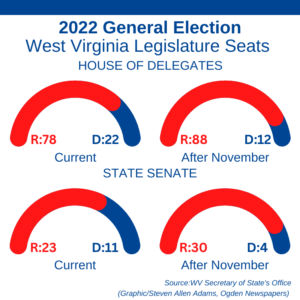
An analysis of statehouse races based on preliminary election results from Tuesday compiled by the West Virginia Secretary of State's Office shows that the Republican supermajority in the Senate will increase by seven seats, from 23 out of 34 seats to 30.
On the House side, the Republican supermajority will increase by 10 seats, from 78 out of 100 seats to 88 seats.
The only Democratic state senator who won election Tuesday night was Senate Minority Whip Michael Woelfel, D-Cabell, who was elected to a third term. That leaves him and state Sens. Robert Plymale, D-Wayne; Glenn Jeffries, D-Putnam; and Michael Caputo, D-Marion, in the Senate Democratic caucus.
Tuesday night saw one-term Senate Minority Leader Stephen Baldwin, D-Greenbrier, fall to Republican opponent Vince Deeds.
Baldwin at one point was in a four-person race with Deeds and two independent candidates, though one of those candidates withdrew their candidacy due to a residency issue. Deeds defeated Baldwin 59% to 38% with independent candidate Aaron Ransom siphoning off 3% of the votes cast.
"It's truly been an honor to serve as your senator for the last five years," Baldwin told supporters in a video message posted Tuesday night on his Senate Facebook page. "I put my whole heart and my whole soul into serving you. Tonight, we came up well short at the ballot box. I'm disappointed because there is so much work left to be done. At the same time, I'm so proud of all the work we did together."
Other Democratic state senators losing elections Tuesday were four-term state Sen. Ron Stollings, D-Boone, who fell to former U.S. Attorney Mike Stuart; one-term state Sen. Richard Lindsay, D-Kanawha, fell to Democrat-turned-Republican Mark Hunt, who has served off and on in the House over the last 20 years; and appointed state Sen. Hannah Geffert, D-Jefferson, who fell to Del. Jason Barrett.
Senate President Craig Blair, R-Berkeley, was disappointed in voters rejecting four constitutional amendments Tuesday night, but he was pleased in in the successes of Republican state Senate candidates.
"The voters did get one thing right tonight, and that's the number of Republicans that were re-elected and new ones that are coming," Blair said in an interview Tuesday night. "I think it's because they trust us and trust the work that we do. I've seen the poll numbers on the Legislature itself and it's very good from that standpoint."
It is the smallest Senate political minority since 1991 and 1992 when state Sen. Donna Boley, R-Pleasants, was the only Republican in the state Senate.
House upsets include four-term Del. Phillip Diserio, D-Brooke, losing to Republican Jimmy Willis; two-term Del. Lisa Zukoff, D-Marshall, losing to Republican Charles Sheedy Sr. in a three-way race; three-term Del. Ed Evans, D-McDowell, losing to Republican Anita Hall; one-term Del. Austin Haynes, R-Fayette, losing to Democratic opponent David Pritt; and Del. Cody Thompson, D-Randolph, losing to Republican Elias Coop-Gonzalez.
According to the House Clerk's Office, the House Democratic numbers are the smallest for a party caucus since 1964 when Republicans held nine seats. The House went to a 100-seat body in 1952. A request for comment from House Speaker Roger Hanshaw, R-Clay, was not returned.
The Republican pickups Tuesday maintain the supermajority status in both the House and the Senate where some votes and motions require two-thirds of members. It also gives Republicans in both chambers more than four-fifths needed to override the state constitutional provision requiring bills be read on three separate days.
Motions are made on some bills to speed their progress along by suspending constitutional rules, but these motions previously required some of the Democratic minority to agree. Diminished Democratic numbers in the House and Senate greatly reduce their ability to halt or slow legislation they disagree with.
According to unofficial turnout, 491,617 of the state's 1.15 million registered voters voted Tuesday, during early voting, and by absentee ballot, representing 42.6% of all registered voters - just 5 points away from the record-breaking 47.9% voter turnout during the 2018 midterm elections.