
Gov. Justice, Senate President Blair Make Final Pushes for, Against Amendment 2
Trending
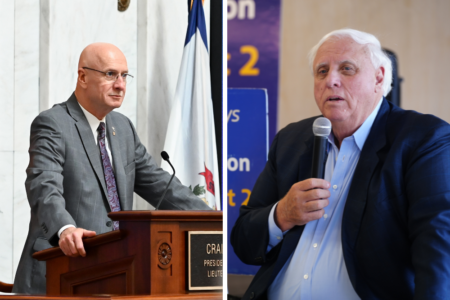
CHARLESTON - With voters heading to the polls today, Gov. Jim Justice hit local radio stations Monday urging voters to oppose Amendment 2 while state Senate President Craig Blair held a tele-townhall to encourage voters to support giving lawmakers authority to end collecting tangible personal property taxes.
Justice could be heard on talk radio stations in Wheeling, Morgantown, and Charleston Monday morning as well as appearing on Tonight Live on West Virginia’s Nexstar TV stations making one final push for voters to oppose what he once supported - amending the state Constitution to give the West Virginia Legislature the authority to eliminate six categories of tangible personal property taxes.
“I really believe overwhelming this will be defeated, and it should be,” Justice said Monday morning during his virtual COVID-19 briefing from the State Capitol Building
Blair, R-Berkeley, and Senate Finance Committee Chairman Eric Tarr, R-Putnam, took part in a tele-townhall Monday evening sponsored by the West Virginia Job Creator’s Alliance, a pro-Amendment 2 advocacy group.
Speaking by phone Monday afternoon, Blair said he was confident that voters would approve Amendment 2 and other amendments on the ballot Tuesday. Blair credited Amendment 2 for driving early voting turnout.
According to the West Virginia Secretary of State’s Office, 130,211 state residents cast early voting ballots as of the close of the early voting period Saturday with another 10,918 absentee ballots cast as of Monday, representing more than 12% of the state’s 1.15 million registered voters.
“I feel confident in Amendment 2 and all four of the amendments passing, as well as all of our candidates succeeding at the ballot box also,” Blair said. “Two months ago, it might have been a different story with low voter turnout. Actually, the amendments have helped with that.”
Amendment 2 doesn’t itself eliminate those taxes, but if approved by voters, it would allow lawmakers to pass legislation as soon as January to eliminate tangible personal property taxes on machinery and equipment, inventory, motor vehicles, computer equipment, furniture and fixtures, and leasehold investments.
These taxes accounted for more than $515 million in total real dollar assessments for all 55 counties combined for tax year 2021 according to the West Virginia Association of Counties, though it was unclear how much is actually collected by counties. Tax revenue goes towards county and city governments, as well as county school systems. Nearly one-third of all property tax revenue comes from tangible personal property taxes according to the non-partisan Tax Foundation.
Since officially coming out against Amendment 2 on Sept. 6, Justice has spent the last two months traversing the state for 28 “community conversations” with county and city leaders to rally opposition to Amendment 2. Justice said he believes these events have helped educate voters about his concerns about Amendment 2.
“I believe if you’ve been with me … you would have seen people in the beginning that just didn’t know. Now you see people who know, and they’re mad. They’re just plain mad,” Justice said. “Irregardless of how it comes out, I’ve done my job. My job was to inform them. Absolutely they were not informed. It would have passed going away.”
Justice has been tough on Blair and legislative supporters of Amendment 2, with his rhetoric comparing the statehouse to “the swamp” and accusing lawmakers of using the idea of eliminating motor vehicle tangible personal property taxes as a sweetener for eliminating the other tangible personal property taxes - mostly paid by small and large businesses. Blair has not been shy about firing back at Justice.
“I’ll give him this: he’s worked harder in the last two months than he’s worked in the last six years in doing anything for the State of West Virginia,” Blair said.
Despite supporting the elimination of the machinery/equipment and inventory tangible personal property taxes in State of the State addresses in 2018 and 2019, Justice has changed his focus to phasing out the personal income tax.
Justice proposed a 10% across-the-board cut in personal income tax rates over the summer, calling lawmakers into special session to consider bill. The House of Delegates supported the bill, which was similar to another bill passed by the House during the 2022 legislative session and would have returned more than $250 million to taxpayers. However, the state Senate refused to take up the bill.
Instead, Senate Republican leadership have a draft bill that would return $515 million to taxpayers and replace the lost tax revenue to counties directly from the general revenue budget by funding counties at their full assessment value plus use a formula to provide counties with a minimum of $1 million in addition to their full assessment value.
Combined with their own 10% personal income tax cut, the Senate GOP tax bill would return nearly $800 million to taxpayers annually, made possible by the state maintaining a flat $4.5 billion general revenue budget, $1.3 billion in state tax revenue surplus for the previous fiscal year, and surplus tax revenue for the current fiscal year already more than halfway to $1 billion four months in.
“I find it astounding that we have to work this hard to give a … dollar tax break back to the people of West Virginia year-in-year-out into the future,” Blair said. “It really boils down to a battle between the haves and the have-nots, and the haves do not want to give up any money that they have, any power that they have, to the rest of us in West Virginia. It’s very frustrating from that standpoint.”
But while two counties - Berkeley and Putnam - have endorsed Amendment 2, most county commissioners and county boards of education oppose it, along with law enforcement organizations, teacher unions, and others, citing the taking of local control away from counties.