
W.Va. Senate President Blair, House Speaker Hanshaw maintain leadership roles
Trending
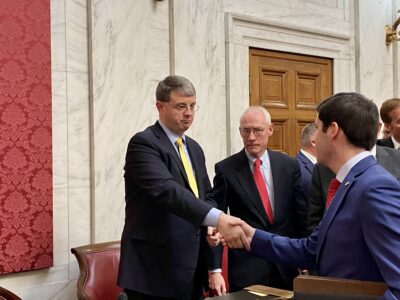
CHARLESTON - There was no white smoke like a papal selection, but Republican members of the West Virginia Legislature voted Sunday to re-confirm Senate President Craig Blair and House Speaker Roger Hanshaw as their leaders for another two years.
The newly elected Republican caucuses of the state Senate and House of Delegates met Sunday afternoon behind closed doors a day before the start of December legislative interim meetings to select their nominees for Senate President and House Speaker for the first session of the 86th Legislature beginning Wednesday, Jan. 11.
Blair, R-Berkeley, was re-selected by the Senate Republican Caucus as Senate President with no opposition Sunday. But Hanshaw, R-Clay, was not as lucky, facing a challenge from House Government Organization Committee Chairman Brandon Steele, R-Raleigh. But Hanshaw said he was humbled to once again have the support of House Republicans.
"It's always very humbling; it's humbling when members ask you to continue doing the work that you've been doing," Hanshaw said Sunday evening. "We have much to be proud of. We have moved this state an incredible distance in a short amount of time. All the members of this body have helped do it, and it's a pleasure to help lead that effort. I look forward to continuing two more years doing more of the same."
The House Republican caucus meeting began at 3 p.m. and lasted nearly two hours. According to sources who declined to be identified due to the privacy of the caucus setting, both Hanshaw and Steele made their cases to the caucus with members asking questions of each candidate. There were 83 out of 88 Republican members present, with Hanshaw receiving 53 votes and Steele receiving 30 votes. Steele was unavailable for comment.
Steele, an attorney and owner of an online news aggregator website, announced Aug. 8 his intentions to challenge Hanshaw for the Speaker's gavel. Steele was first elected to the House in 2018 and was unopposed in the November election for the new 42nd House District.
In challenging Hanshaw, Steele cited stalled progress during a summer special session on tax reform and a delay in legislation modernizing the state's anti-abortion law. Republicans in the House and Senate ultimately came to a compromise on a bill restricting abortion access with limited exceptions, but a bill passed by the House from Gov. Jim Justice to cut the personal income tax by 10% was never taken up by the Senate.
Hanshaw was elected by the House in 2018 to succeed former Speaker Tim Armstead, R-Kanawha, who was appointed by Justice to the West Virginia Supreme Court of Appeals. Hanshaw was elected to a full two-year term in 2019 and again in 2021. Hanshaw, an attorney for Bowles Rice and a former staff attorney for the Senate Republican caucus prior to 2014 when Democratic lawmakers held the majority, was first elected to the House in 2014.
Speaking Sunday evening after the caucus ended, Blair said he was honored to once again receive the support of his Republican members consisting of 31 out of 34 members.
"I never really didn't think I had it," Blair said. "I do the will of the members. That's what we've been doing for the last few hours. You have to do something egregious to be removed from being the Senate President. I've done nothing but try to serve the will of the members of the Senate. I had quite a lot of confidence that I would continue to be the Senate President."
Blair previously had an opponent for Senate President, but state Sen. Patricia Rucker, R-Jefferson dropped out. Rucker announced Nov. 22 on her personal website that she would no longer challenge Blair for the gavel, citing a collapse in support. She first announced her intentions to challenge Blair in August.
Blair has served as Senate President since 2021, succeeding former senate president and Jackson County Republican Mitch Carmichael after he lost a primary election to current Senate Education Committee Chairwoman Amy Grady, R-Mercer. Blair was first elected to the Senate in 2013 and has served three terms. He is the former chairman of the Senate Government Organization and Finance committees.
As Senate President. Blair is next in the line of succession if Gov. Jim Justice is incapacitated, giving Blair the honorary title of Lieutenant Governor.
Sunday's votes are preliminary. The official votes for Senate President and House Speaker take place every two years in odd-numbered years after an election on the first day of the new 60-day legislative session. Both parties nominate a member for Senate President and House Speaker, with the nominee of the party with the most members winning the top leadership positions.
After the vote, the minority party often moves to vote again by acclamation with both parties unanimously selecting the majority party's nominee in a show of unity and bipartisanship.
Also Sunday afternoon, the House Democratic caucus met and re-selected Del. Doug Skaff, D-Kanawha, to serve as House Minority Leader. Skaff's minority shrunk after the November election from 22 seats out of 100 seats to 12 seats, but he said his caucus will continue to push their priorities and oppose bills from the majority they believe will be harmful.
"It's an honor that my peers asked me to be in the minority leader position again," Skaff said. "Although our numbers might have shrunk a bit, it's an honor that we still have a voice that we need to represent. There's a lot of people in West Virginia who are underrepresented, and priorities are all screwed up by this majority-led state. We, as the minority caucus and team of 12, will do everything we can to amplify our message and make sure that all West Virginians are looked out for."
Del. Shawn Fluharty, D-Ohio, will once again serve in the role as House Minority Whip. Fluharty pointed to the defeat of four constitutional amendments on the November ballot as a sign that while Republicans may have the majority, not all West Virginians support Republican agenda items.
"While we have fewer numbers now, November also sent a message when all four amendments were turned down; that the policies they pursue are not very popular with the people," Fluharty said. "We have an obligation and a duty to be their voice and be vocal on things, because now - given the numbers that they have - there is nothing stopping them, and we have to be a roadblock and a voice for the people of West Virginia."
The Senate Democratic caucus has even fewer members, dropping from 11 to four seats after the November election, and dropping from four seats to three seats last week after Putnam County state Sen. Glenn Jeffries switched parties from Democrat to Republicans. The remaining Democratic members are Senate Minority Whip Michael Woelfel, D-Cabell, and state senators Robert Plymale, D-Wayne, and Mike Caputo, D-Marion.