
Economic Development, Revenues Among 2022’s Top State Government Stories
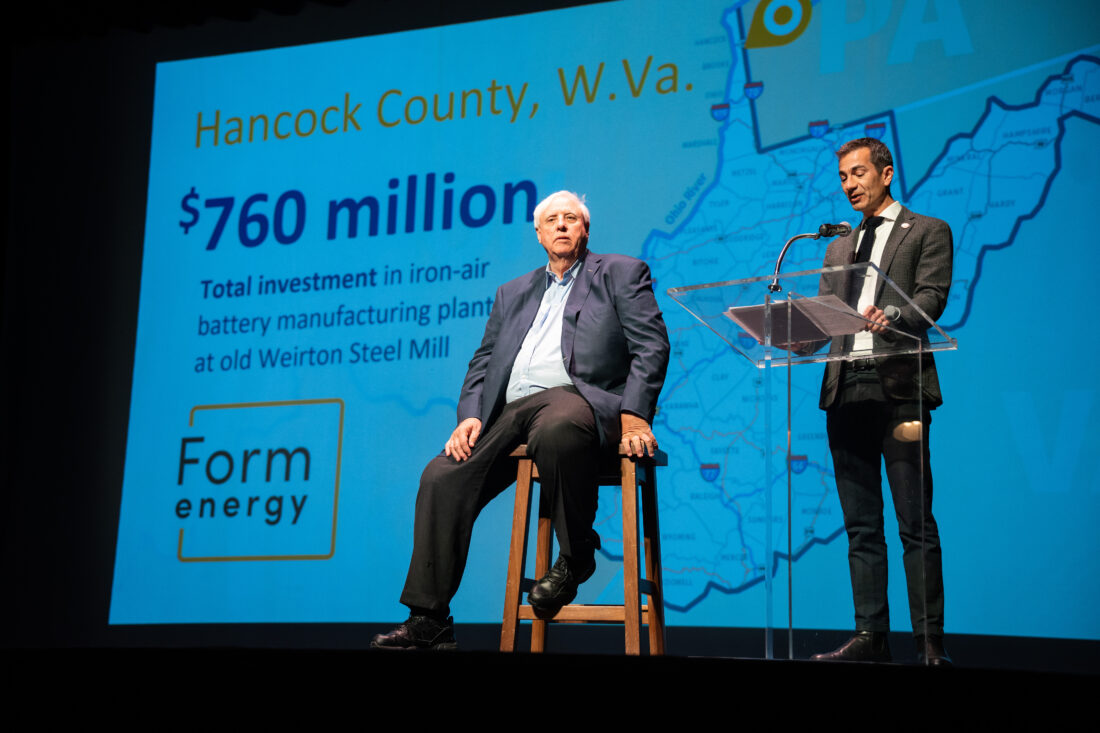
Gov. Jim Justice, left, and Form Energy CEO Mateo Jaramillo announce that Weirton would be home to a new battery manufacturing facility.
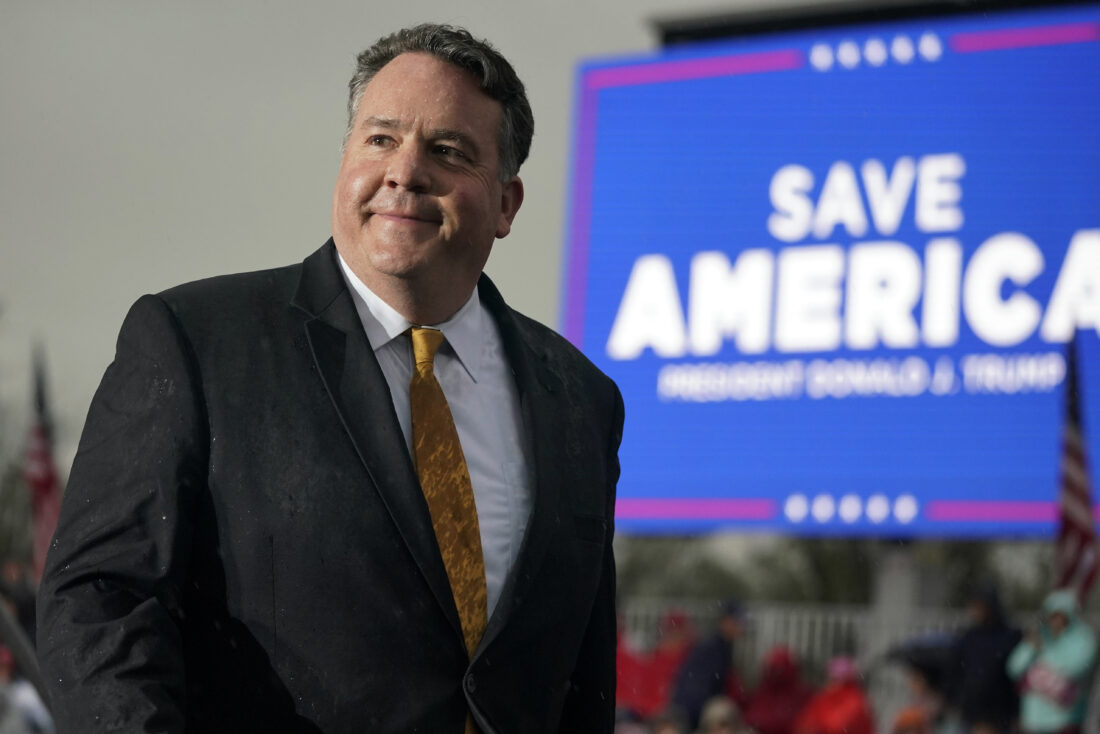
U.S. Rep. Alex Mooney, R-W.Va., defeated fellow U.S. Rep. David McKinley, R-W.Va., in a heated primary election for the Republican nomination for the new 2nd Congressional District.
AP Photo
Gov. Jim Justice, left, and Form Energy CEO Mateo Jaramillo announce that Weirton would be home to a new battery manufacturing facility.
U.S. Rep. Alex Mooney, R-W.Va., defeated fellow U.S. Rep. David McKinley, R-W.Va., in a heated primary election for the Republican nomination for the new 2nd Congressional District.
AP PhotoTrending
CHARLESTON - As West Virginia turned the last page on 2022, several stories dominated the past year, including multiple economic development announcements across the state, political rivalries, electoral landslides, record-breaking tax revenues, and social issues.
1. West Virginia begins, ends 2022 with major economic development announcements.
There were no shortages of economic development announcements across West Virginia in 2022. Even before the start of the 2022 legislative session in January, lawmakers were meeting in a special session to approve a new tax credit to secure a then-unknown company to West Virginia.
That unknown company was later to be revealed as North Carolina-based steel manufacturer Nucor. The $2.7 billion investment by Nucor in Mason County is expected to create as many as 1,000 new construction jobs over two years, with 800 full-time jobs once the electric arc furnace is completed.
The Nucor announcement was followed by Canadian-based electric bus manufacturer GreenPower which completed an electric school bus manufacturing plant earlier this year. West Virginia University Health System announced an expansion of a partnership with Owens & Minor Inc. to launch a health care products preparedness center in Morgantown.
Towards the end of summer, Seattle-based electric boat manufacturer Pure Watercraft announced it would create a facility in Brooke County to build electric pontoon boats and create 100 jobs. California-based Sparkz announced it would build an electric battery plant in Taylor County near Bridgeport and create 350 jobs.
In September, BHE Renewables and Precision Castparts - both owned by Berkshire Hathaway - announced the purchase of more than 2,000 acres at the former Century Aluminum site in Jackson County to build a modern titanium melt facility powered by a first-of-its-kind solar energy micro-grid. The project represents a $500 million investment.
In November, Omnis Sublimation Recovery Technologies announced a $60 million investment in Wyoming County to extract rare earth metals used for batteries and electronics. In December, Maryland-based Competitive Power Ventures confirmed Monday that Doddridge County will be home to a new 1,800 megawatt combined-cycle natural gas-fired power plant that will also use carbon capture and sequestration to reduce its greenhouse gas emissions.
And last week, Massachusetts-based Form Energy said they will build a manufacturing facility to build specialty batteries on the former Weirton Steel site. The new Form Energy facility will be a $760 million investment in West Virginia with the goal of creating as many as 750 jobs.
“Today, Christmas has come early to the City of Weirton,” said state Sen. Ryan Weld, R-Brooke, at a Dec. 22 announcement in Charleston for the Form Energy project.
2. Mooney vs. McKinley
The May Republican primary saw the defeat of six-term 1st District Congressman David McKinley by four-term 2nd District Congressman Alex Mooney in a hotly contested election.
The two federal lawmakers were lumped into the new 2nd Congressional District covering the entire northern half of the state after population losses in the state reduced West Virginia’s congressional districts from three to two. Both McKinley and Mooney said in the fall of 2021 that they would seek election to the new district seat.
McKinley, a Wheeling native and an engineer, was first elected to Congress in 2010. He was a former state lawmaker, a candidate for governor, and a previous chairman of the state’s Republican Party. Mooney, who moved to Charles Town after a previous life as a Maryland state lawmaker and state party chairman, was first elected to Congress in 2014 to the seat once held by U.S. Sen. Shelley Moore Capito, R-W.Va.
McKinley was endorsed by Republican Gov. Jim Justice and Democratic U.S. Sen. Joe Manchin, while Mooney was endorsed by former president Donald Trump in a state that still widely supports Trump according to several opinion polls at the time.
McKinley attacked Mooney over his pending ethics investigations in Congress where he was accused of misusing campaign donations for personal use, receiving gifts from donors, and lying to investigators. Mooney attacked McKinley for supporting the $1.2 trillion Infrastructure Investment and Jobs Act, a bill that President Joe Biden had negotiated with both Manchin and Capito.
In the end, Mooney defeated McKinley 66% to 34% with McKinley only winning three out of the 26 counties in the 2nd District. Mooney easily defeated his Democratic opponent in November, then quickly turned around and announced his candidacy for U.S. Senate in 2024 against Manchin.
3. West Virginia is in the money
West Virginia ended fiscal year 2022 in July with a $1.3 billion tax surplus for the general revenue budget. The year-to-date tax revenue surplus for the current fiscal year that began in July is $687.5 million as of the end of November, putting the state on pace to meet or exceed last fiscal year’s $1.3 billion surplus.
The surpluses are due to multiple factors: tax revenues derived for the higher prices of coal and natural gas, the influx of federal COVID-19 stimulus and infrastructure funding freeing up state tax dollars, and natural growth in tax collections, and the maintaining of a flat budget with no new expenditures since 2018.
As a result, Republican lawmakers and Justice both want to return some of these dollars to taxpayers but both sides spent the summer and fall clashing over the best way to do that.
Republican lawmakers supported Amendment 2, a proposed amendment to the state Constitution that would have given lawmakers the authority to eliminate several categories of tangible personal property taxes, including machinery/equipment, inventory, and motor vehicles. The amendment was on the November ballot.
Justice once supported eliminating these taxes, but he decided to focus on a 10% personal income tax cut. While the House of Delegates supported Justice’s 10% personal income tax cut, Republicans in the state Senate didn’t take the bill up, instead backing a resolution that expressed support for Amendment 2 and a plan to replace the lost tax revenue to counties and school systems with funding from the state budget.
After Senate Republicans blocked his tax cut plan, Justice chose to travel the state to rally opposition to Amendment 2, even using his English bulldog Babydog to oppose the amendment. Voters rejected Amendment 2 by nearly 30 points. Republican lawmakers, particularly in the Senate, remain upset at Justice’s attack on Amendment 2, which could affect his 2023 legislative agenda.
4. West Virginia sees red.
While voters in November rejected all four constitutional amendments proposed by Republican lawmakers, they did not reject Republican lawmakers themselves.
After the November elections, the Senate Republican majority grew to 30 out of 34 seats, leaving only four Democratic state senators: Michael Woelfel, D-Cabell, Robert Plymale, D-Wayne, Glenn Jeffries, D-Putnam, and Mike Caputo, D-Marion. At the beginning of December, Jeffries changed his party registration to Republican, giving the GOP 31 out of 34 senate seats.
With Jeffries’ party switch, that leaves just 15 Democratic lawmakers in the Legislature, making up 11% of the 134-member legislative branch. After the November elections, the Republican majority in the 100-member House of Delegates grew from 78 members to 88 members, leaving just 12 Democrats.