
Campus Carry Bill Passes W.Va. House Judiciary Committee

West Virginia CDL representative Zach Campbell said SB 10 would help make college campuses more safe.
Photo courtesy of WV Legislative Photography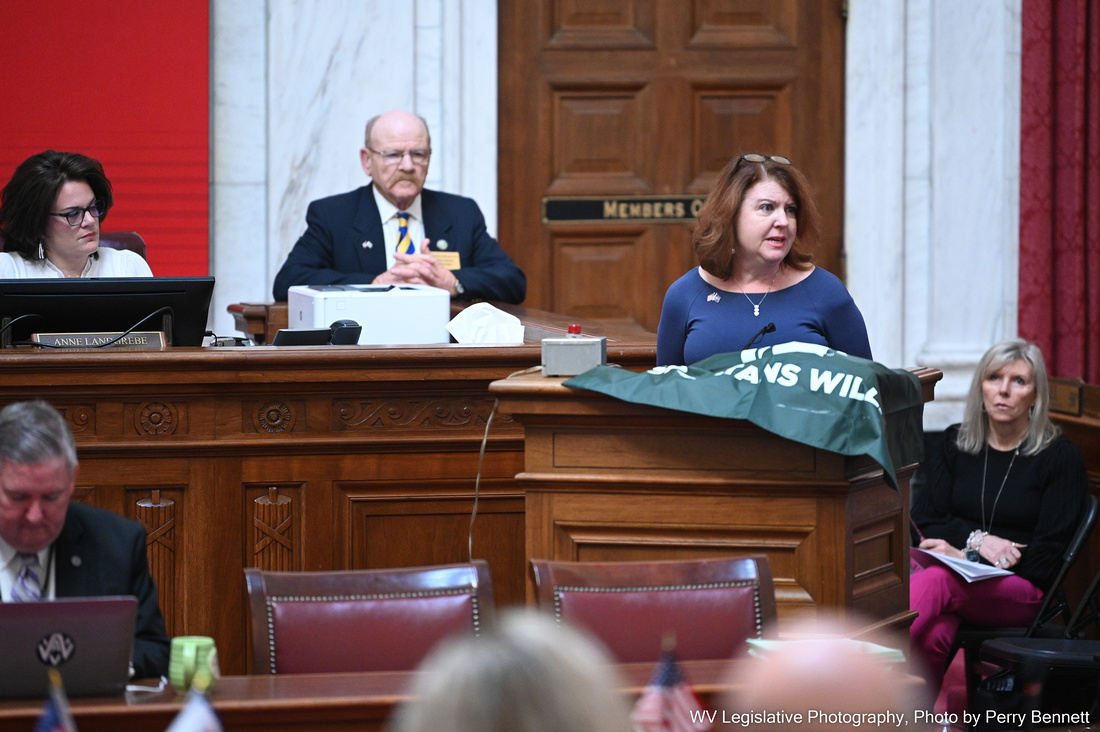
Adrianne Derring was on the campus of Michigan State University with her daughter Monday the day before a mass shooting there resulted in three dead students.
Photo courtesy of WV Legislative Photography
West Virginia CDL representative Zach Campbell said SB 10 would help make college campuses more safe.
Photo courtesy of WV Legislative Photography
Adrianne Derring was on the campus of Michigan State University with her daughter Monday the day before a mass shooting there resulted in three dead students.
Photo courtesy of WV Legislative PhotographyTrending
CHARLESTON - A bill that would allow students and the public with valid concealed carry permits to have firearms on college campuses in West Virginia cleared another hurdle Wednesday as it gets closer to a vote before the full House of Delegates.
The House Judiciary Committee recommended for passage a committee substitute for Senate Bill 10, the Campus Self-Defense Act, Wednesday afternoon, but not before hearing concerns from students and professors.
SB 10 would lift prohibitions on public colleges and university students and visitors from carrying a concealed weapon on campus as long as they have a current and valid concealed carry permit beginning July 1, 2024. The bill includes numerous exemptions, including prohibiting concealed carry at certain sporting events, specific buildings, events, and proceedings.
The bill also prohibits concealed carry at on-campus residence halls except for common areas, such as lounges, dining areas, and study halls. Colleges and universities must provide secure storage for weapons at residence halls and can charge fees for storage.
Del. Mike Honaker, R-Greenbrier, is a former Virginia State Police trooper who responded to the 2007 Virginia Tech school shooting that killed 32 people after the killer chained the doors of a building and fired into individual classrooms. Honaker said that SB 10 could provide a student or a staff member the opportunity to defend themselves in a similar situation.
“I know we feel so strongly one way or the other about the Second Amendment, but so few of us ever experience the outcomes or the results of what it really looks like and what it really feels like,” Honaker said. “There are those of us in this room with a fear that another Virginia Tech will take place. We’ll wish to God there was somebody in that place that had a firearm to defend themselves and the people around them.”
Del. Evan Hansen, D-Monongalia, said he is concerned that additional people might be killed if someone with minimal training with a handgun responds to a mass shooter, as well as other issues that could happen with immature college students or students dealing with mental health issues.
“My opposition to this bill is not because I think it will lead to more bad guys with guns,” Hansen said. “My opposition is I don’t think that this draws the boundaries in the right place. On balance, I think it’s going to make people less safe than more safe.”
The House Judiciary Committee held a public hearing Wednesday morning on SB 10, with 39 speakers signing up - 37 spoke against the bill while only two spoke in favor.
Adrianne Derring, a student at West Virginia University and the mother of a student at Morgantown High School, was on the campus of Michigan State University with her daughter on a campus visit Monday. The next day, a 43-year-old male who was not a student or employee of the university killed three students and wounded five others on campus before killing himself later that night when confronted by law enforcement.
“My daughter and I were standing in that exact space. Every time I picture myself there, more guns in that situation is not the answer,” Derring said. “No child should bear that responsibility on campus.”
Art Thomm, a lobbyist for the National Rifle Association, also cited Tuesday’s mass shooting at Michigan State as an example of the need to have armed students on campus.
“Our loved ones deserve the right to defend themselves from a deadly attack in a gun-free zone without having to make the choice of employment, education, or their life,” Thomm said.
The bill is opposed by many of the state’s public colleges and universities, including West Virginia University and Marshall University. Faculty from those two schools spoke out Wednesday against the bill.
“We believe that allowing firearms onto our campuses by anyone other than our trained personnel may bring unintended negative consequences to the university community, including public health issues such as accidents, suicides, and/or intent to cause fear or harm, as well as negative effects on recruitment and retention of students, faculty, and staff,” Eloise Elliot, WVU Faculty Senate representative to state government.
Chris White, a history professor at Marshall and former infantryman in the U.S. Marine Corps, said there is a huge difference between members of the military and law enforcement who undergo extensive tactical training with firearms and a student who takes the tests for carrying a concealed firearm.
“Every single moment in which a weapon is in the hands of a soldier or a police officer is controlled. None of those safety controls will be imposed on our students or anyone else who comes onto campus,” White said. “I’m not going to say that this is going to increase actual violence on campus. It might, but what I do know is it’s going to increase accidental discharges because the students and other people there are not trained in the same way military and law enforcement are, as well as suicides.”
Other college and university students expressed fear for their own safety and the safety of other students on campus, either due to accidents or opportunities for students to attempt suicide by firearm.
“We believe it fosters an environment of mistrust and uncertainty and anxiety,” said Bella Mitchell, a senior at WVU and a College of Applied Human Sciences College Senator for WVU’s Student Government Association. “Also, it is completely unnecessary for the environment which we live in. We feel as though it is unfair to put people in these situations and we feel as though asking students to give up their feelings of safety for someone’s potential heroism is unfair.”
“I find this bill to be unnecessary in the face of many other issues our state currently has,” said Emma Crouch, a freshman at Marshall. “It would make me and many of my peers feel less safe on campus, especially in the residence halls. Colleges have high rates of mental illness and an increased use of alcohol and drugs, making the presence of guns potentially deadly.”
Zach Campbell, a representative of the West Virginia Citizens Defense League, argued that the bill merely removes administrative penalties put in my place by colleges and universities for carrying a handgun on campus.
“Senate Bill 10 does not make it legal for a state-licensed concealed carry holder to carry a firearm on a public university campus,” Campbell said. “It is clear today that it is already 100% legal. This is for concealed carry permit holders only … I ask you to look beyond the rhetoric of this issue and look at the bill.”