Wheeling Council Votes 6-0 To Pass CROWN Act
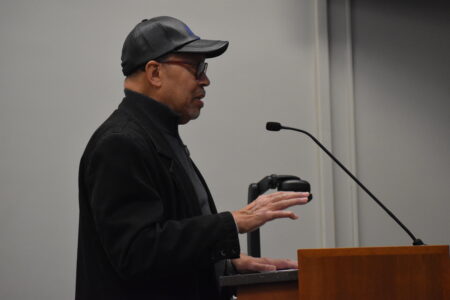
photo by: Eric Ayres
Darryl Clausell, president of the West Virginia Chapter of the NAACP and chairman of the Ohio County Chapter of the NAACP, addresses members of Wheeling City Council on Tuesday night before legislation to adopt the CROWN Act was unanimously approved.
WHEELING – After more than a year of public debate over the issue, members of Wheeling City Council voted unanimously during its regular meeting Tuesday night to pass legislation that – in essence – adopts the CROWN Act.
The issue – standing for “Creating a Respectful and Open World for Natural Hair” Act – deems it a violation of human rights to discriminate against a person because of their hair, particularly culturally embraced or race-based hairstyles, hair textures or headwear.
Members of the Wheeling Human Rights Commission and the NAACP have urged city leaders to adopt the CROWN Act as the issue has made its way to public forums before council off and on over the course of more than a year. Opponents to the legislation have described the measure as another political football that would tie the hands of employers, school officials and others who try to maintain dress codes or grooming policies that are equal to everyone across the board, regardless of race.
“At various points over the past year, city council has been told why it should or should not approve the so-called CROWN Act to ban discrimination based on natural hair texture,” Wheeling Mayor Glenn Elliott said. “Supporters, including many members of our Human Rights Commission, see it as an effort to eradicate systemic racism and as a step closer to racial fairness. Opponents say no such discrimination exists in Wheeling, and this is a solution in need of a problem.
“To me, the question here is whether this is the right thing to do to build a better Wheeling. And I believe it is. And on such matters, I believe the words of Dr. Martin Luther King Jr. hold weight: ‘The time is always right to do what is right.'”
City leaders exited the normal course of business to allow citizens who signed up to speak on the topic to step forward and make their statements before council took a final vote on the measure.
Darrell Clausell, Wheeling resident and president of the West Virginia Chapter of the NAACP and chairman of the Ohio County chapter of the NAACP, previously spoke publicly in support of the CROWN Act. Clausell noted that while many victims of discrimination are afraid to step forward, there has been a local case in which a student was discriminated against because of her hair, and more recently, a case involving another local student came to light.
“The first one was in the middle schools,” Clausell said. “This next one was in the highest institutions of academia. Realize that it does exist — it’s just nobody is going to come forward in a 94-6 percent majority-minority and talk about being discriminated against.”
Clausell said the CROWN Act helps promote school belonging and engagement for all students, reduces disparities in school discipline and increases academic success. To date, a total of 18 other states have already passed legislation supporting the CROWN Act, along with Washington, D.C., and various municipalities across the nation and jurisdictions throughout West Virginia, Clausell noted.
Former state NAACP president and former state Sen. Owens Brown said women often explore ways to change their appearance and project a new look by wearing different hairstyles, but African American women’s hairstyles have seemed to be the ones singled out as being problematic.
“African Americans are the only group that has been penalized in the workplace based on their hair,” Brown said. “All from the issue about how a Black person’s hair looks becomes a smokescreen to justify not hiring them because of their color.”
Brown said that if someone cannot understand the ramifications of not passing the CROWN Act, then he would question the intellect and capacity of any council member who would vote against it. He said council must vote unanimously for it or against it – asserting that it cannot be a split vote.
And it was not. The only member of Wheeling City Council who in the past took issue with the manner in which the Human Rights Commission brought the matter before council – Councilman Dave Palmer – was not present during Tuesday night’s meeting. He was out sick and did not cast a vote on the legislation.
However, there were citizens who came forward and spoke against the ordinance Tuesday night.
Local businessman John Gebhard of Wheeling indicated this legislation not only prevents businesses from disciplining employees but also opens the door to lawsuits against local businesses that try to enforce standard policies.
“I own two corporations, and at one time, I had a lot of bad employees,” Gebhard said. “I believe that if someone comes in smelling like they climbed out of a dumpster, you should be able to tell them to go home. If an employee has facial piercings and looks unprofessional, they should be told to remove them.”
Gebhard said this goes for uniforms, cleanliness, grooming and other important workplace policies.
“Employers should have the right to terminate those employees who do not abide by their policies,” he said. “This article provides grounds for frivolous lawsuits against businesses in Wheeling. This article should be voted down.”
Wheeling resident Julia Chaplin, who has been outspoken over the past several months against the CROWN Act legislation, said she was “aghast” to believe that cases of racially based hair discrimination had actually come to light locally, but somehow escaped the limelight from being all over the news.
“When a business or organization wants to hire or fire a person, if that person falls under this regulation, they can use it as a legal excuse, regardless of whether the accusation was valid or not,” Chaplin said, asserting that the CROWN Act will be bad for businesses but also bad for the local workforce if companies are reluctant to hire Black employees for fear of potential lawsuits based on this legislation. “Knowing that our mayor and city council is made up of two attorneys and five businessmen, I’m astonished that with your combined business experience that you have not come to the conclusion that implementing this amendment will be disastrous for our city of Wheeling in attracting businesses.”
The mayor strongly disagreed, saying that the legislation sends a strong message that Wheeling is the Friendly City, it is open for business and it is open to everyone.
“This issue has received, in my opinion, a disproportionate amount of attention from some who are opposed to it,” Elliott said, noting that he drafted the legislation himself based on amendments that other cities have adopted. “People think it’s a lot more than it really is. It’s not the boogeyman that a lot of people portray it as.”
The amendment enhances the city’s definition of racial discrimination under its Human Rights Commission code, expanding it to include “discrimination based on hair textures and protective hairstyles historically associated with a particular race.” The definition of “protective hairstyles” includes, but is not limited to, hairstyles such as “braids, locks and twists,” according to the language in the newly adopted amendment.
“I quite frankly wish we didn’t have to have this conversation, because I wish our state would do the right thing on these issues,” Elliott said, noting that efforts to bring the CROWN Act to the floor of the statehouse in Charleston have been fruitless in recent years. “The folks in the legislature time and time again seem to focus on a different direction of civil rights – one that I don’t always find agreeable. But I think this is something that is right for the city of Wheeling. I think this is going to make us more competitive, not less competitive.”
Top Headlines

NASA fuels rocket to launch astronauts on the first lunar trip in half a century
Judge Blocks Trump Order To End Funding For NPR, PBS
WASHINGTON (AP) — Citing the First Amendment, a federal judge on Tuesday agreed to permanently block the Trump ...
Trump Orders Creation Of National Eligible Voter List
WASHINGTON (AP) — President Donald Trump on Tuesday signed an executive order to create a nationwide list of ...

Challenger Center Shares In Artemis II Excitement
Morrisey Signs Bill Repealing High School Transfer Rule
LANSING, W.Va. – Gov. Patrick Morrisey said Tuesday he signed a bill repealing the controversial student transfer ...