
Future of Pleasants Power Remains Murky
 File Photo
Trending
CHARLESTON - The order issued by the West Virginia Public Service Commission encouraging continued discussions to keep the Pleasants Power Plant warmed up for a year still leaves some unanswered questions as a community marks a grim milestone.
The PSC authorized Monongahela Power Co. and Potomac Edison Co. to continue negotiations with Texas-based Energy Transition and Environmental Management (ETEM) to finalize a letter of intent to maintain the power plant and keep the plant’s 154 workers employed beginning in June and ending May 2024.
Once the companies agree on a letter of intent, they will be required to come again before the PSC for its approval and to sign off on any month-to-month reimbursement obligations. Mon Power and Potomac Edison had sought a $36 million temporary surcharge for residential, commercial, and industrial customers in North Central West Virginia and the Eastern Panhandle to cover costs and reimburse ETEM, though the companies have since admitted the costs could increase.
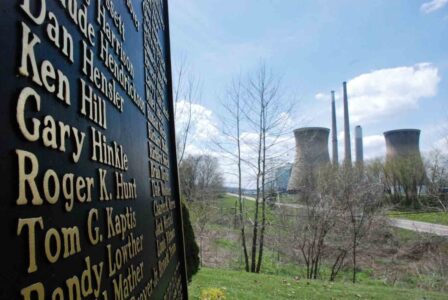
Pleasants Power, located south of St. Marys and Belmont in Pleasants County near the Wood County border, was commissioned in 1979 and fully operational in 1980. Today marks 45 years since 51 workers died at the plant when part of one of the cooling towers collapsed in what was once considered the deadliest construction accident in U.S. history.
For the local community, Pleasants Power is not just another job creator and economic engine. The plant has been on the chopping block since 2018, when the plant was first slated to be shut down. Deactivation of the plant was moved to 2022 but put on hold in 2019 after the Legislature passed a bill in a special session to provide FirstEnergy Solutions a $12.5 million annual break in business and occupation taxes for the plant.
Energy Harbor announced last March it would close the plant beginning May 31, selling the plant to ETEM for demolition while leasing the plant and burning off its remaining coal stockpiles. Lawmakers in the West Virginia Senate and House of Delegates adopted two non-binding resolutions expressing support for Mon Power and Potomac Edison to purchase Pleasants Power.
Del. Trenton Barnhart, R-Pleasants, was the lead sponsor of the House resolution. He expressed his pleasure that progress was being made towards a temporary solution.
“I applaud the PSC’s decision to approve Mon Power’s request for an interim solution for the Pleasants Power Station,” Barnhart said. “Pleasants Power is the economic engine that keeps our communities going and I’m so thankful that the PSC has recognized its importance to our regional economy as well as to our state’s energy portfolio. I look forward to continuing to work with all stakeholders to help bring a long-term solution for Pleasants Power and for the people of Pleasants County.”
Gov. Jim Justice, speaking during his virtual administration briefing Wednesday, continued to express his support for Pleasants Power and for allowing the PSC to continue its work in evaluating the proposal from Mon Power and Potomac Edison.
“The PSC, they have a job to do and they’re doing their job,” Justice said. “I personally believe we should do anything in our power to keep that plant open. It would just be terrible … for that plant to close.”
Mon Power and Potomac Edison - both subsidiaries of Akron-based FirstEnergy Corp. - needs the 12-month period between June and May 2024 to consider whether to bring Pleasants Power into the company portfolio. During that time, the plant will no longer generate electricity, but workers would keep the plant maintained for a future re-start.
Emmett Pepper, policy director for Energy Efficient West Virginia, said he was pleased that there would be no immediate cost increase for Mon Power and Potomac Edison customers. But he is concerned about future added costs that may have to be borne by ratepayers. Energy Efficient West Virginia was part of a group of environmental and consumer advocate organizations opposed to the Pleasants Power plan.
“We are glad that there is no immediate rate impact to ratepayers,” Pepper said. “But we are concerned that these proposed charges could potentially be forced onto ratepayers in the future.”
During testimony last week before the PSC, representatives of the companies said they do not want to operate three coal-fired power plants in West Virginia. Instead, the likely scenario would be shutting down the Fort Martin coal-fired plant near Morgantown and replacing it with Pleasants Power, which has newer environmental controls and would cost less to bring up to recent standards.
Opponents of the Pleasants Power plan say that the plant is not needed when the state produces more power than it needs. They cite the lack of clarity on what future costs could be for ratepayers either from the short-term deal with ETEM or long-term from a possible purchase of the plant. They also push back against claims that the shutdowns of coal-fired power plants are creating reliability issues in the PJM grid that powers much of the northeast.
“It is not fair to West Virginia families with high energy burdens, many of whom are on fixed incomes, to pay for that,” Pepper said. “It’s also not fair to small businesses who are not politically connected enough to lobby for a special tax break for their businesses, like the Pleasants plant did recently. West Virginians’ reliability challenges will not be fixed by another power plant and PJM has already specifically said that Pleasants can retire without impacting grid reliability.”